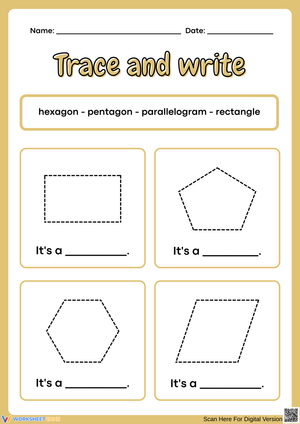
These 5th grade parallelogram printable worksheets resources give teachers something most geometry packets skip: property-based reasoning practice that treats the parallelogram family as a connected system rather than a collection of separate shapes. Students classify, sort, compare attributes, and explain their thinking in writing — the full range of work the fifth-grade geometry standard actually calls for.
The Misconception That Shows Up First
The most persistent student error at this level is not mislabeling a slanted quadrilateral — it is drawing a hard line between categories that should overlap. Ask a student whether a rectangle is a parallelogram and watch the hesitation: most students know a rectangle has two pairs of parallel sides, but many still say no, because their working definition comes from the slanted-figure picture rather than from properties. The same error appears with squares. A student who marks a square correctly in an identification task will often write "square" as the only label, as though being a square removes the figure from the parallelogram family entirely. The sorting tasks and always/sometimes/never prompts in this set put that conflict directly in front of students and require property-based thinking rather than visual pattern matching.
Skills Covered Across the Set
Each worksheet targets a specific slice of the classification work fifth graders need, which makes it easier to match the right task to the right moment in a unit. The set includes:
- Shape identification — students decide whether each figure is a parallelogram and name one property that supports their answer.
- Attribute sorting — rectangles, rhombuses, squares, trapezoids, and general quadrilaterals grouped by shared properties rather than by name alone.
- Vocabulary work using terms like parallel, congruent, opposite sides, and quadrilateral in context rather than in a memorization list.
- Always, sometimes, never prompts that require students to justify their reasoning in one or two sentences.
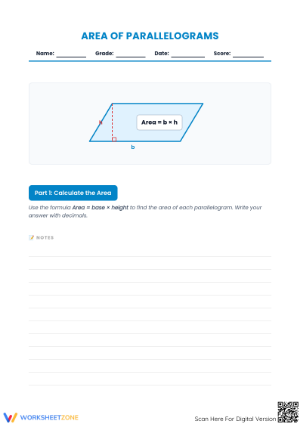
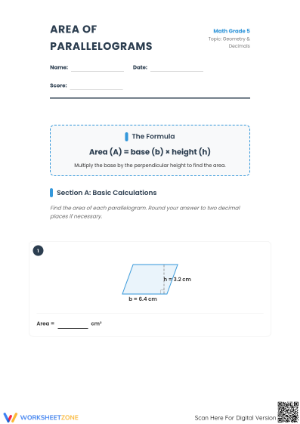
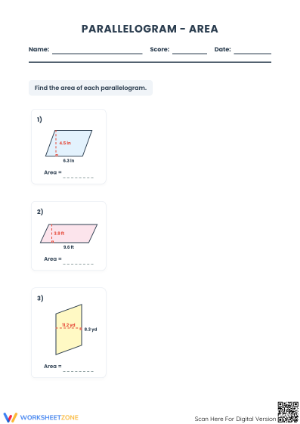
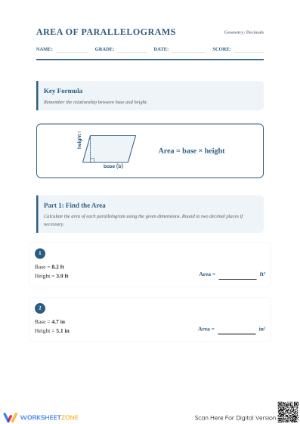
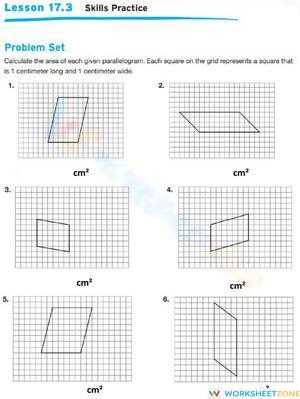
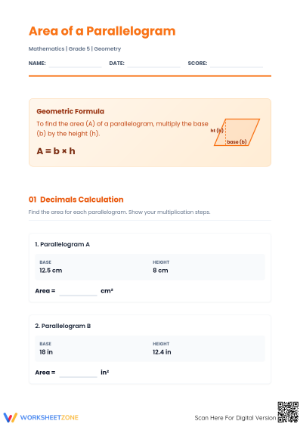
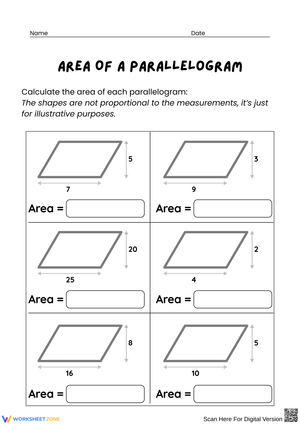
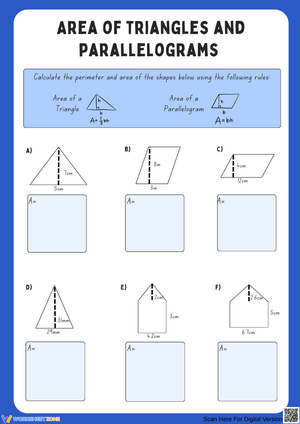
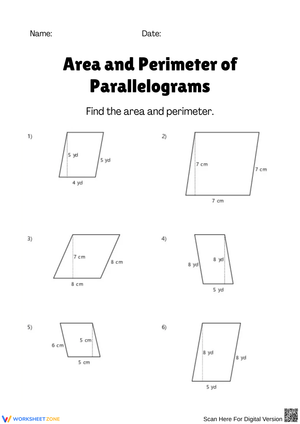
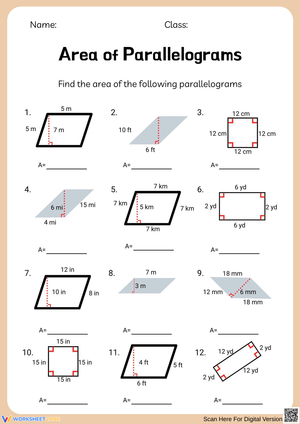
- Area connection tasks that link parallelogram classification with the base-times-height measurement work students completed earlier in fifth grade.
The 5th grade parallelogram printable worksheets set includes rotated figures, unusual proportions, and nonexamples alongside standard textbook shapes. That variety trains students to check properties rather than match an image, which is the habit the classification standard demands.
Standard Alignment
CCSS.MATH.CONTENT.5.G.B.3 asks students to understand that attributes belonging to a category of two-dimensional figures also belong to all subcategories of that category. In classroom terms, that means a square is simultaneously a rhombus, a rectangle, and a parallelogram — and fifth graders need to say so and explain why. This standard falls at the end of the fifth-grade geometry progression and points directly toward the deductive reasoning students encounter in middle school, which makes property-based classification practice now genuinely important for long-term transfer. CCSS.MATH.CONTENT.5.G.B.4 extends this further by asking students to classify figures inside a hierarchy, which is exactly where sorting tasks, written justification prompts, and always/sometimes/never questions earn their place in the lesson sequence.
Fitting These Worksheets Into Your Lesson Planning
Short identification tasks — the worksheets that ask students to mark each figure as a parallelogram or not — run well as warm-ups or exit tickets. They take five to seven minutes, and the results tell you at a glance which students are still using a narrow visual prototype as their mental model. Sorting tasks with mixed quadrilateral sets need more time and more conversation, which makes them better suited to partner work or a small-group table where you can pause and address a misconception before it calcifies. The always/sometimes/never prompts belong in the second half of the unit, once students have enough vocabulary to write a real explanation rather than simply guess.
The 5th grade parallelogram printable worksheets resources also fit naturally into spiral review. Students tend to classify shapes correctly right after instruction, then lose precision a week or two later when the unit moves on. Assigning one short identification or sorting worksheet during the next unit's warm-up block — not as a quiz, just as a five-minute retrieval moment — keeps the vocabulary active and gives you an honest read on retention before the end-of-unit assessment.
Adjusting the Set for a Range of Learners
For students still building basic quadrilateral vocabulary, start with identification worksheets that show three or four clearly distinct figures and ask only for a yes-or-no answer plus one named property. Keeping the task that narrow limits cognitive load and lets students focus on properties rather than on writing fluency. Once those students can reliably identify parallel sides and opposite angles without prompting, move them into sorting tasks with more mixed and ambiguous quadrilateral sets.
Students who classify quickly and correctly need tasks that push into justification: why does a square belong to more than one category, and what is the minimum set of properties that makes a rhombus also a parallelogram? The always/sometimes/never prompts work best for this group. When assessing, a 5th grade parallelogram printable worksheets task that pairs identification with a written explanation gives you clearer evidence of whether a student has internalized the hierarchy or is still working from visual memory alone.
Frequently Asked Questions
Do these worksheets address the full parallelogram family, or just the basic slanted figure?
The set includes rectangles, rhombuses, and squares alongside general parallelograms. Students sort, compare, and classify all four types across multiple worksheets, which is what the fifth-grade standard requires rather than recognizing a single figure in isolation.
Which worksheets work for homework and which are better kept in class?
Identification and vocabulary tasks work well for homework because they do not ask students to negotiate new concepts on their own. Sorting tasks and always/sometimes/never prompts are better assigned in class, where you can address questions about category overlap before students build new misconceptions independently.
What if students identify a parallelogram correctly but can't explain why a rectangle or square also qualifies?
That gap is common, and it points to a definition that is still visual rather than property-based. The most direct fix is to have students write at least one property next to every answer on a few identification tasks — not as a separate writing assignment, but as a habit built into the routine. The always/sometimes/never prompts push this work explicitly, because a correct yes or no is not accepted without a sentence-level justification.
Are these worksheets appropriate for students who are behind in geometry vocabulary?
Yes, particularly the identification worksheets that pair each figure with a list of properties and ask students to circle what applies. That format gives students the vocabulary in context without requiring recall from memory — a reasonable first step for students who need more repetition before they can use geometric terms independently in writing or discussion.














 Interactive Worksheet Maker
 Quiz Maker
 Word Search Maker
 Crossword Puzzle Maker
 Word Scramble Generator
 Sentence Scramble Generator
 Handwriting Worksheet Generator
 Name Tracing Generator
 Fill In The Blank Generator




 BACK TOSCHOOL