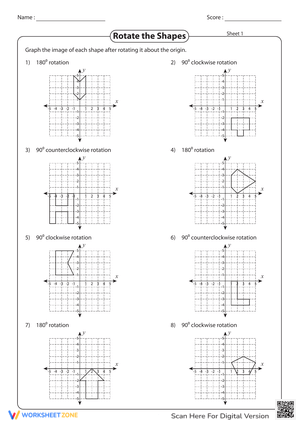
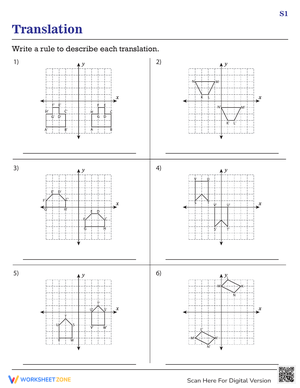
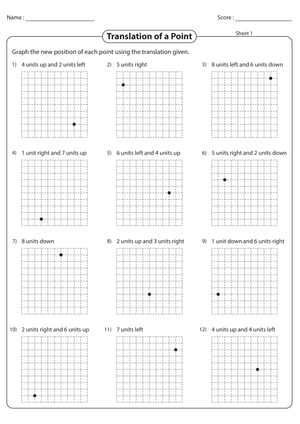
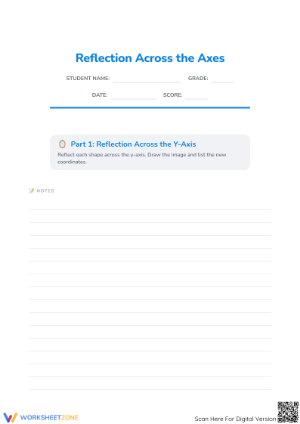
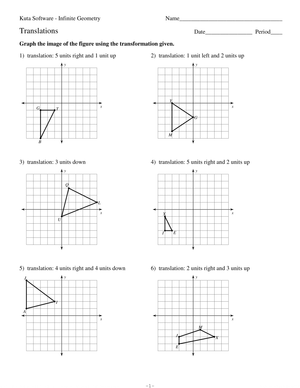
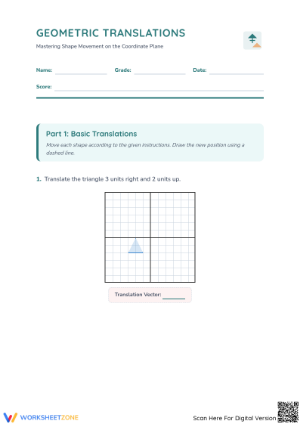
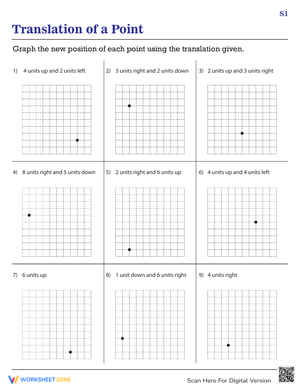
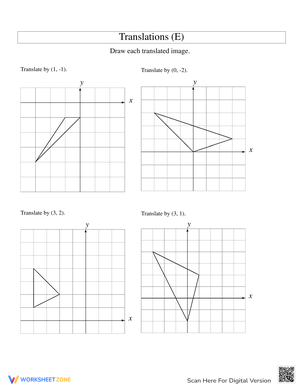
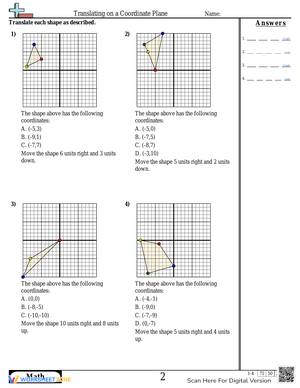
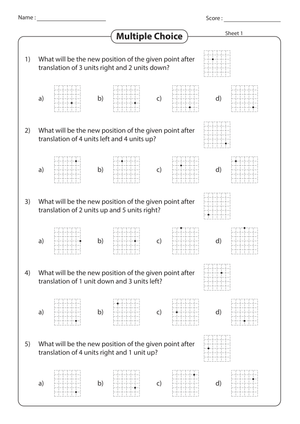
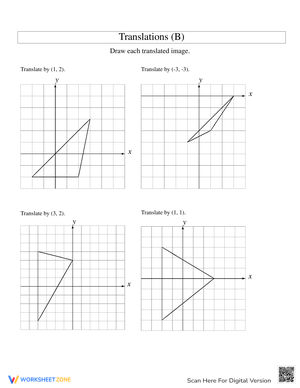
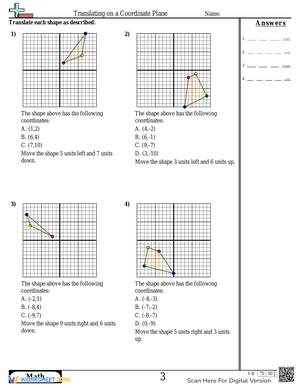
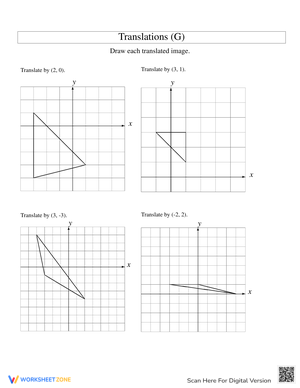
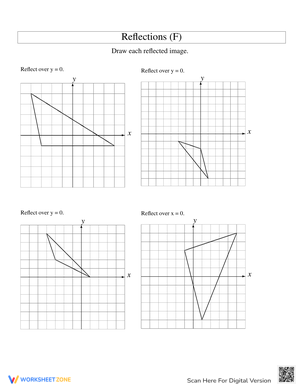
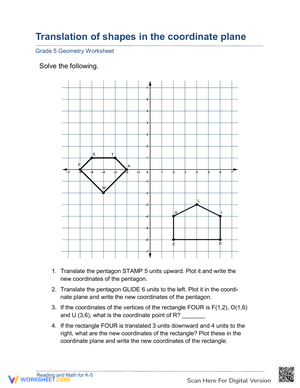
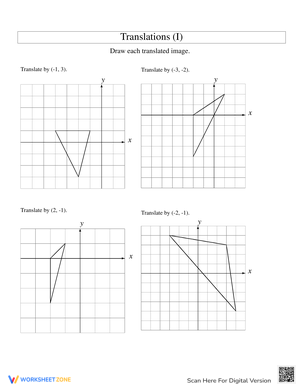
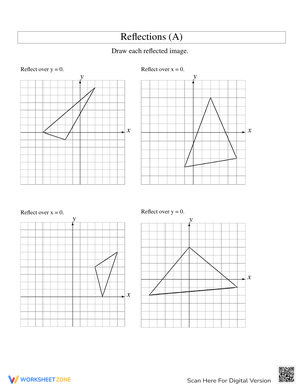
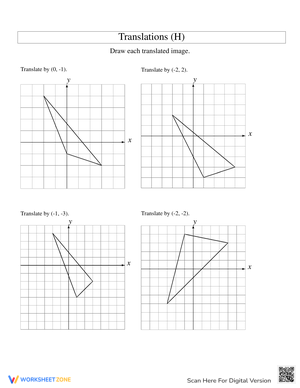
These 5th grade transformations pdf worksheets give teachers a coordinate-grid practice set where each worksheet targets a single move type — translation, reflection, rotation, or symmetry — with enough structured repetition for students to demonstrate what they actually understand rather than approximate from visual context. The collection works as direct-instruction follow-up, a geometry center task, a reteach tool for small groups, and a printable homework option that families can follow without additional explanation.
Where Students Consistently Make Mistakes
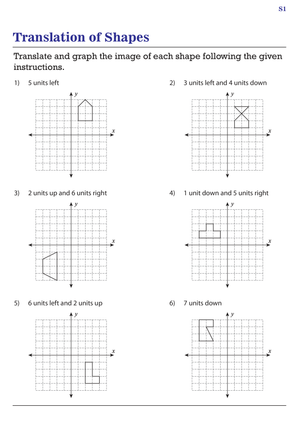
The most predictable error in grade 5 transformation work is not a misunderstood concept — it is an incomplete procedure. A student may move three vertices of a quadrilateral correctly and place the fourth wrong because they started counting from inside the figure rather than from a labeled grid point. That one-vertex slip looks like understanding from across the room. On the worksheet, it shows up as an image that is almost right but technically incorrect, and the student cannot locate the error because they are checking the whole shape rather than each point in sequence. Building in a check step — asking students to write the ordered pair for each image vertex before connecting the sides — reveals these slips without requiring teacher intervention on every paper.
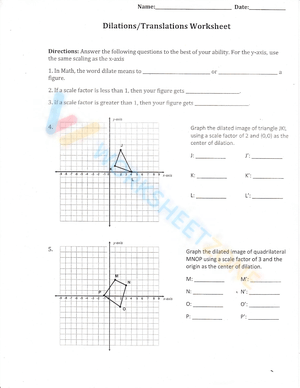
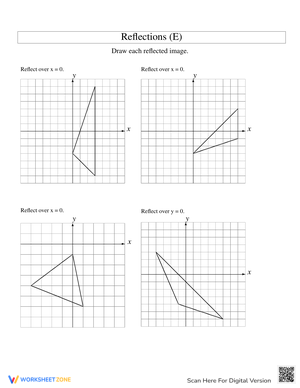
Reflection errors follow a distinct pattern. Students who flip a figure correctly over the x-axis will often treat y-axis reflections the same way, sliding the figure horizontally instead of mirroring it. The image ends up in the wrong quadrant, but it looks plausible because the shape itself is correct. A worksheet that asks students to name the transformation after completing the plot — rather than providing the transformation type in the task header — surfaces this confusion faster than any teacher question can.
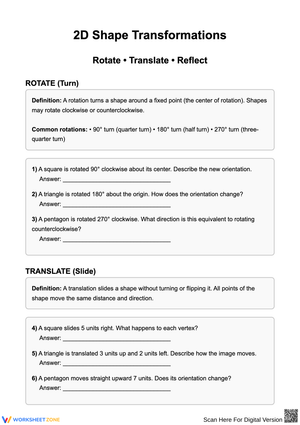
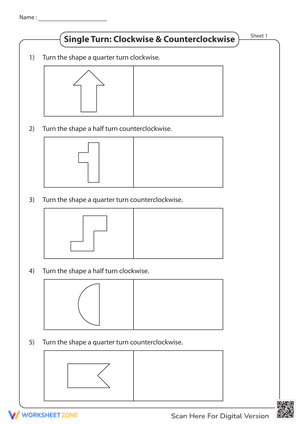
Rotation is where confident grade 5 students make category errors most often. Clockwise and counterclockwise 90-degree rotations produce images that look nearly identical to students checking by eye, so they guess the direction and move on. Asking students to trace the path of a single vertex around the center point before drawing the full image gives them a concrete record of what changed and makes the direction matter.
Skills Each Worksheet in the Set Builds
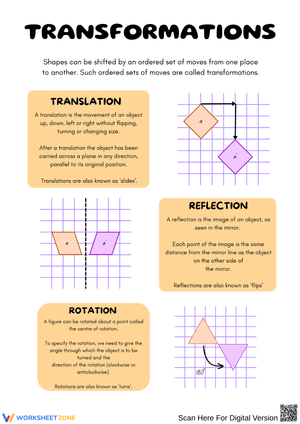
The sequence in these 5th grade transformations pdf worksheets runs from entry-level to more demanding: translation first, then reflection, then rotation, with symmetry and mixed-review worksheets available for spiral practice and assessment preparation. That order corresponds to the visual reasoning load at each stage — students can count a translation directly on the grid before they need to reason about mirror distances or turning angles.
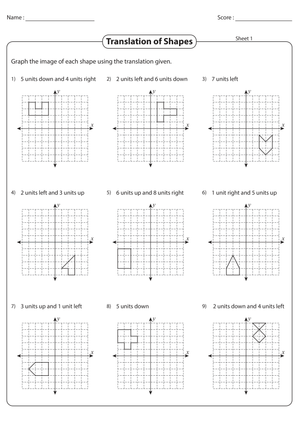
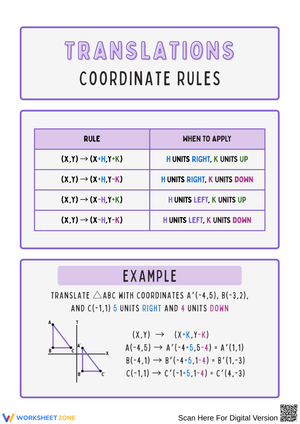
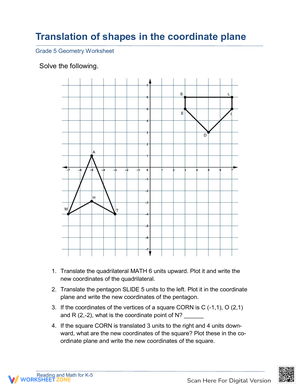
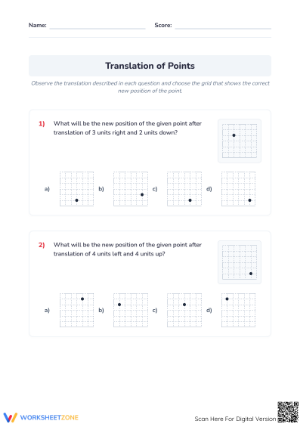
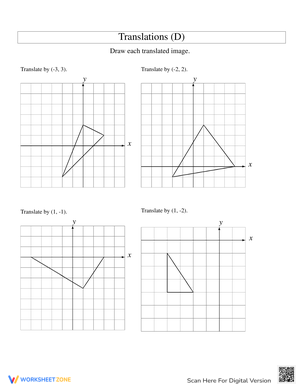
- Translation worksheets ask students to count horizontal and vertical movement, plot each image vertex, and record the resulting ordered pair — which keeps coordinate-plane practice embedded in the geometry task rather than treated as a prerequisite.
- Reflection worksheets have students verify that preimage and image vertices sit at equal distances from the line of reflection by counting grid spaces rather than estimating from the figure's outline.
- Rotation worksheets ask students to track how vertex order shifts as the figure turns around a center point — the most visually demanding task in the set and the one where careful vertex-by-vertex checking matters most.
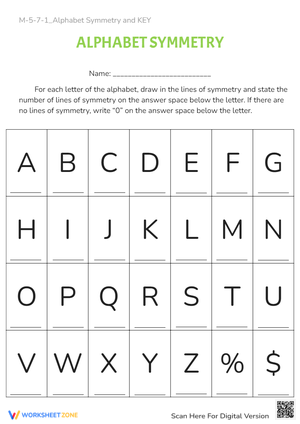
- Symmetry worksheets focus on identifying lines of symmetry in figures, which works as a lower-entry format and as a conceptual bridge to reflection tasks.
- Mixed-review worksheets require students to identify the transformation type without a label, the format closest to what unit assessments actually ask.
Building These Worksheets Into Your Instructional Week
Single-skill worksheets fit the ten minutes after direct instruction, when students are ready to try the move independently while the lesson is still fresh. In that window, a translation or reflection worksheet does the work a guided-practice assignment would do — it prints cleanly, fits in a folder, and gives you something to collect at the door. The geometry center version of the same worksheet works better with colored pencils in the bin so students can trace preimage and image in different colors, making vertex-by-vertex comparison visible without any additional instructions.
For small-group reteach sessions, the coordinate-plane worksheets in this set let you address two skills at once: the transformation concept and the ordered-pair fluency that grade 5 students still vary on considerably. One student may misplace a reflection because they are confusing which axis is which; another may have the transformation logic right but reverse the x- and y-values when writing coordinates. The worksheet surfaces both issues at the same time, which matters when you have eight minutes with a group and need to locate the gap quickly.
These 5th grade transformations pdf worksheets also hold up well for sub plans. The directions are self-contained, the grid format is familiar, and the task on each worksheet requires no warm-up context or manipulative setup — which is exactly what makes them reliable when you are not in the room to redirect.
Standard Alignment
CCSS.MATH.CONTENT.5.G.A.1 defines the first-quadrant coordinate system grade 5 students are expected to use: perpendicular axes, labeled unit intervals, and ordered pairs that locate any point on the plane. Transformation worksheets at this grade level work entirely within that first-quadrant frame, so students are applying the coordinate skill the standard requires rather than practicing something adjacent to it. The grid serves as both the setting for geometric movement and the evidence record for each move — students can point to exactly where a vertex landed and write the ordered pair that confirms it.
Grade 5 is not the CCSS anchor grade for formal transformation standards — that work is specified in Grade 8 under 8.G.A. But 5.G.A.1 and 5.G.A.2 establish the coordinate-plane fluency that makes introductory transformation tasks both accessible and meaningful at this level. Teachers who work translations and reflections into grade 5 geometry are building the visual and procedural groundwork students need when transformation rules and coordinate reasoning become formal topics in middle school.
Adjusting the Work Across Ability Levels
Students who are still uncertain about axis direction or ordered-pair notation need more time on single-skill translation worksheets before moving to reflection or rotation tasks. A practical adjustment: ask those students to circle the starting vertex and annotate its coordinates before counting any movement. That one step reduces the vertex-skipping error considerably and gives you a quick check of whether the coordinate confusion runs deeper than a counting habit.
For students ready for extension, the format does not need to change — the thinking demand does. After completing a rotation worksheet, ask them to explain in writing why a 90-degree clockwise rotation and a 270-degree counterclockwise rotation produce the same image. That question requires conceptual understanding that goes well beyond plotting and costs nothing beyond the margin of the worksheet they just finished.
Mixed-review worksheets serve a third group: students who can execute each transformation correctly when it is labeled but struggle to identify the move when no label is given. Those worksheets work well as exit tickets before a unit assessment, since they reveal whether students have internalized the distinguishing features of each transformation or are still reading context clues to figure out what to do.
Frequently Asked Questions
What order should I use to introduce transformations in grade 5?
Start with translations. Counting horizontal and vertical movement on a grid connects directly to the ordered-pair work students are developing in grade 5, and it does not require thinking about mirror images or rotation angles yet. Reflections come next, once students can plot image vertices accurately. Rotations are the most visually demanding move type and work best after students are steady with the first two.
Do these worksheets work for students who are still shaky on coordinate-plane basics?
Yes, with some structure. Students who reverse x- and y-values or lose track of which axis is which will make errors on transformation tasks that look like transformation errors but are actually coordinate errors. Using translation worksheets first — where the movement is straightforward and the coordinate recording is the main task — lets you see where the gap is before adding the complexity of reflections or rotations.
How do these worksheets fit into a mixed-ability classroom?
These 5th grade transformations pdf worksheets support tiered practice without requiring separate lesson plans for each group. Assign translation and reflection worksheets to students who need more time on foundational coordinate skills. Assign rotation and mixed-review worksheets to students ready for the next level of visual reasoning. The consistent grid format across the set means all students are working with familiar materials — what changes is the cognitive demand of the transformation skill assigned.
Are these worksheets useful for unit review or test prep?
Mixed-review worksheets are the strongest option for review: students must identify and execute transformations without a topic heading signaling what kind of move to apply, which mirrors what most assessments ask. Single-skill worksheets are better for targeted review when a student has shown weakness on a specific transformation type in earlier practice.














 Interactive Worksheet Maker
 Quiz Maker
 Word Search Maker
 Crossword Puzzle Maker
 Word Scramble Generator
 Sentence Scramble Generator
 Handwriting Worksheet Generator
 Name Tracing Generator
 Fill In The Blank Generator




 BACK TOSCHOOL