


























Views
Downloads

Converting Area Units Worksheet | Grade 6 Essential
Paste this activity's link or code into your existing LMS (Google Classroom, Canvas, Teams, Schoology, Moodle, etc.).
Students can open and work on the activity right away, with no student login required.
You'll still be able to track student progress and results from your teacher account.
This Grade 6 math worksheet provides a comprehensive framework for mastering metric area conversions. Students learn to transition between square kilometers, meters, centimeters, and millimeters with high accuracy. By applying conversion factors to 19 distinct problems, learners develop the spatial reasoning required for advanced geometry and real-world measurement applications.
At a Glance
- Grade: 6 · Subject: Math
- Standard:
CCSS.MATH.CONTENT.6.G.A.1— Find the area of right triangles, other triangles, special quadrilaterals, and polygons- Skill Focus: Metric Area Unit Conversion
- Format: 3 pages · 19 problems · Answer key included · PDF
- Best For: Independent practice and homework reinforcement
- Time: 25–35 minutes
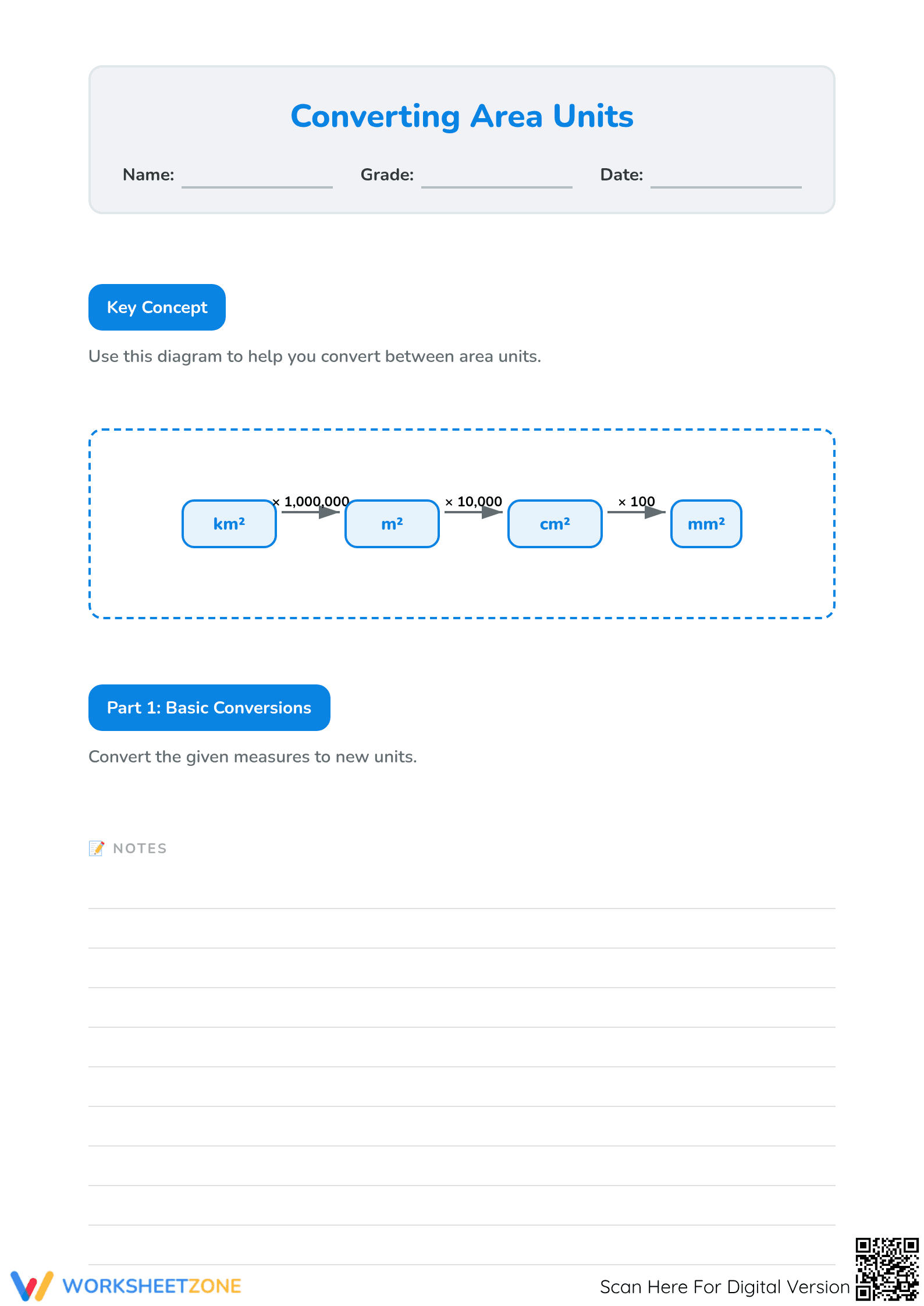
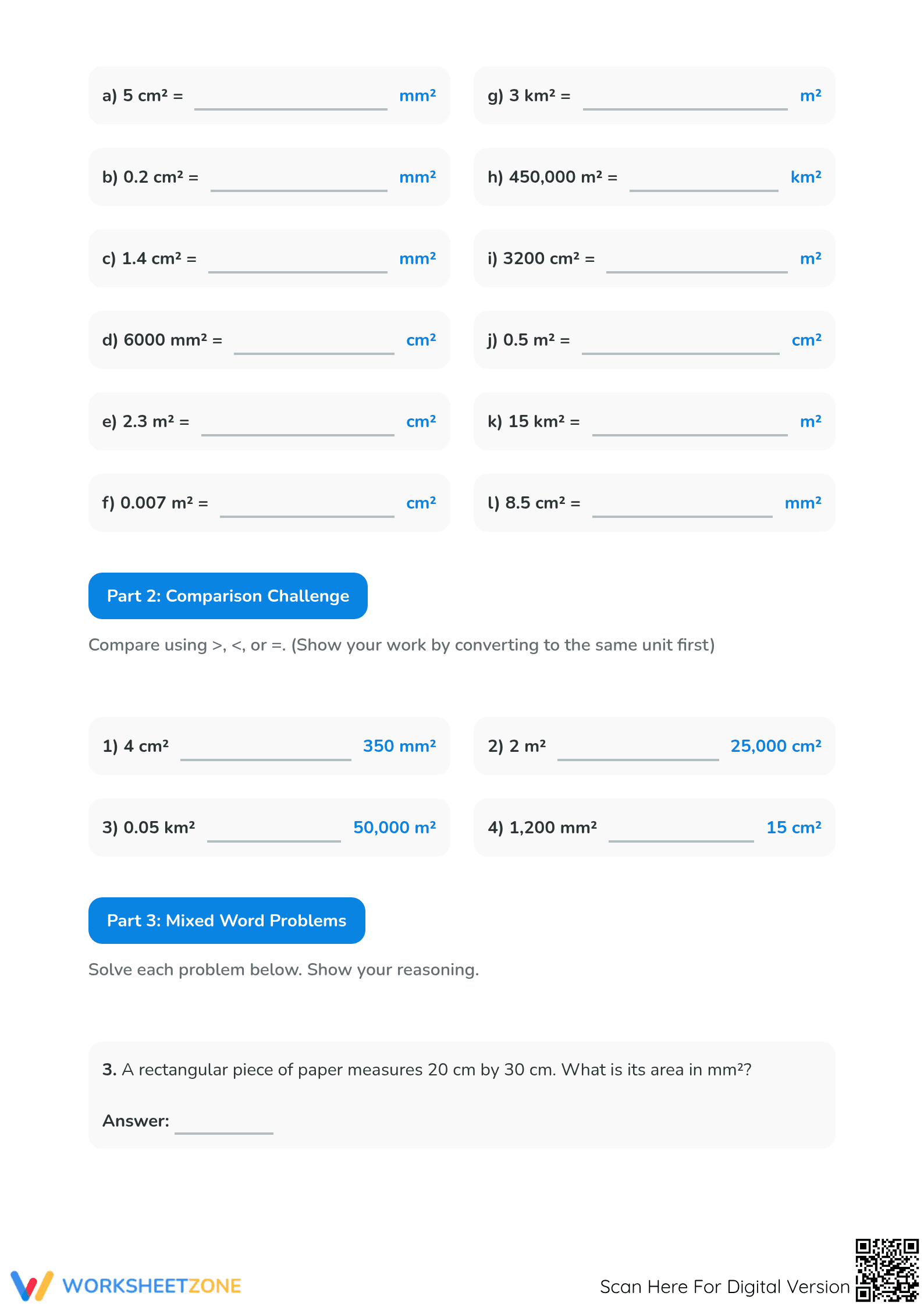
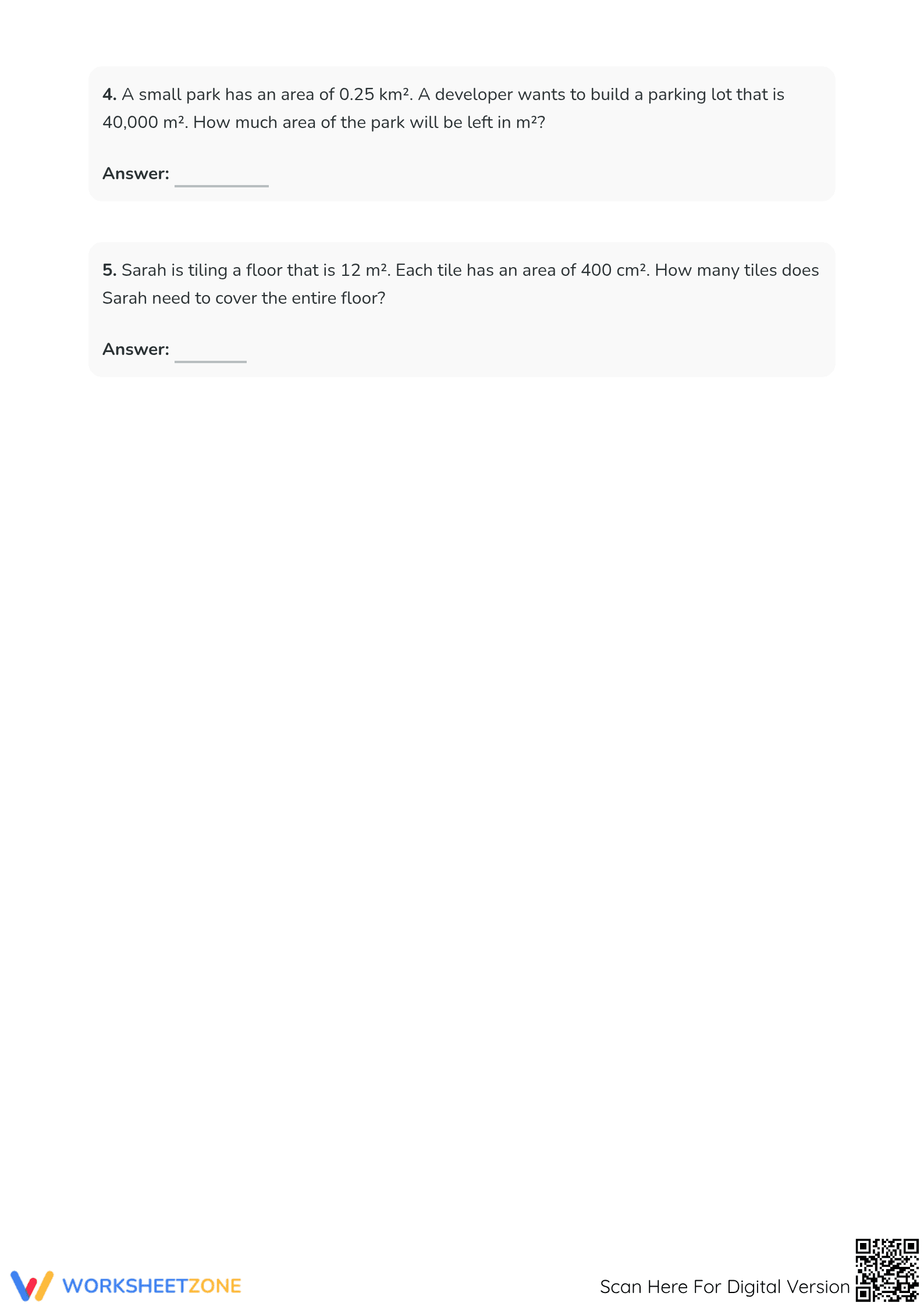
The resource contains three structured pages designed to build confidence. It begins with a visual "Key Concept" diagram that maps out the multiplication factors needed to move between units. Part 1 features 12 basic conversion exercises. Part 2 challenges students with 4 comparison tasks using inequality symbols. Part 3 concludes with 3 multi-step word problems that require calculating area before converting the final unit.
This resource is designed for a zero-prep classroom environment. Teachers can follow a simple three-step workflow: Print the three-page PDF (30 seconds), Distribute to students as an independent activity (30 seconds), and Review using the provided answer key (1 minute). Total preparation time is under 2 minutes, making it an ideal choice for substitute plans or sudden instructional shifts.
This worksheet aligns with CCSS.MATH.CONTENT.6.G.A.1, which focuses on finding the area of polygons and understanding the relationship between different units of measure. It also supports 5.MD.A.1 by extending linear conversion logic into two-dimensional space. Both standard codes can be copied directly into lesson plans, IEP goals, or district curriculum mapping tools.
Use this worksheet during the "You Do" phase of a gradual release lesson on geometry. It serves as an excellent formative assessment tool; teachers should observe if students correctly apply the squared conversion factor rather than linear factors. Expected completion time ranges from 25 to 35 minutes depending on student familiarity with large-number multiplication.
This material is tailored for Grade 6 students but remains highly effective for Grade 5 enrichment or Grade 7 remediation. It is particularly useful for English Language Learners who benefit from the visual conversion map. Pair this resource with a metric ruler or a digital area calculator to provide a multi-modal learning experience.
According to the RAND AIRS 2024 report on mathematics instructional materials, high-quality worksheets that provide explicit visual scaffolds—such as the conversion map included here—significantly reduce cognitive load for middle school learners. By isolating the conversion process from the initial area calculation, students can focus on the mathematical precision required for standard CCSS.MATH.CONTENT.6.G.A.1. Research indicates that structured practice in unit conversion is a prerequisite for success in high school physics and advanced engineering tracks. This worksheet provides the necessary repetition to move these skills from short-term memory to long-term mastery. The inclusion of word problems ensures that students do not just memorize procedures but understand the context of measurement in the physical world. This balanced approach is cited as a key factor in improving NAEP mathematics scores across diverse student populations.


