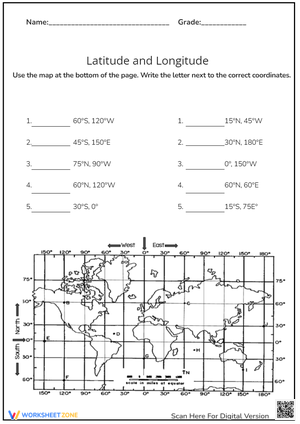
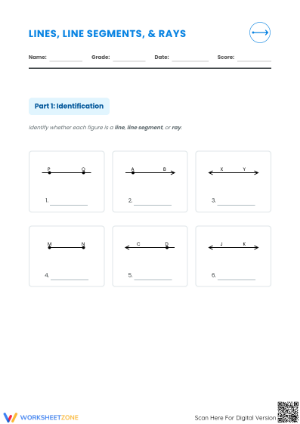
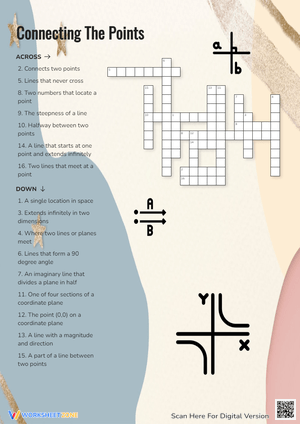
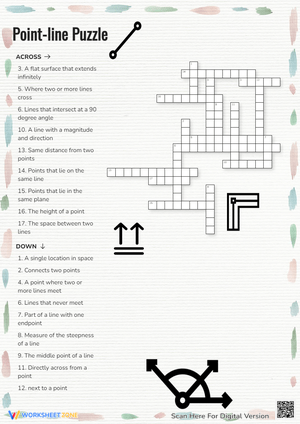
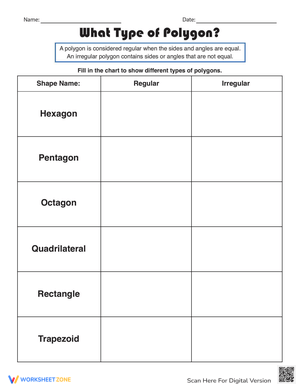
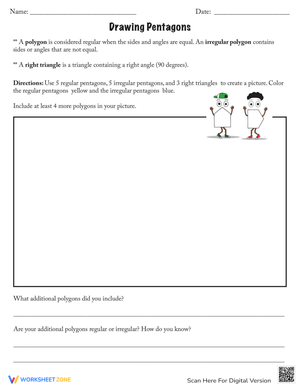
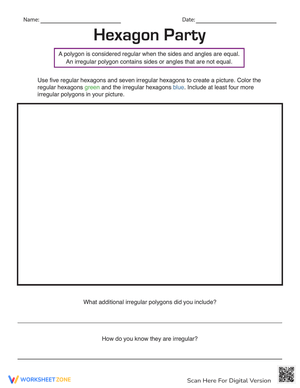
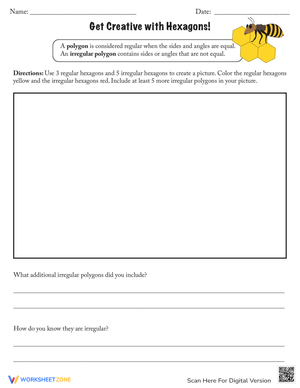
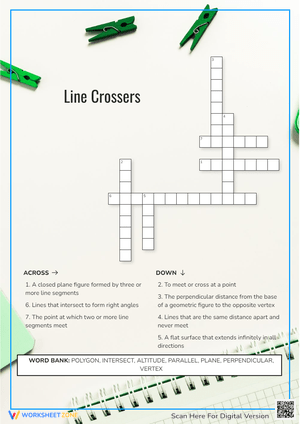
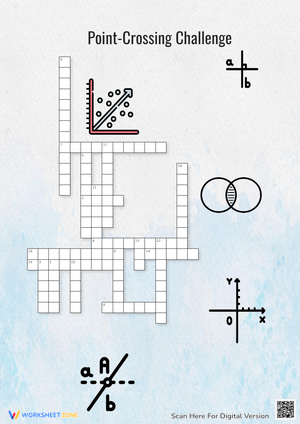
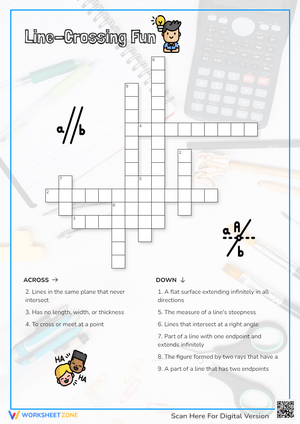
These lines printable worksheets for 5th grade give teachers a focused geometry review set built around line vocabulary, identification, and the figure-description reasoning students need before shape classification begins. The collection from Worksheetzone targets terms students encountered in Grade 4 but frequently misapply by the time they reach the polygon unit—and delivers them in a format that fits almost anywhere in the instructional day.
The Specific Skills Targeted
Each worksheet in the set keeps attention on five terms: line, line segment, ray, parallel lines, and perpendicular lines. That scope is deliberate. Grade 5 does not introduce new line vocabulary—it raises the expectation that students use existing vocabulary precisely, especially while describing attributes of polygons and quadrilaterals. A student who guesses "parallel" because two sides look evenly spaced is not ready for the classification questions that follow. These worksheets slow that guessing down.
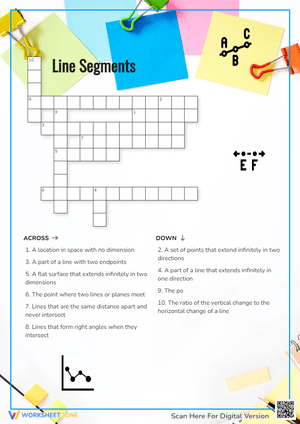
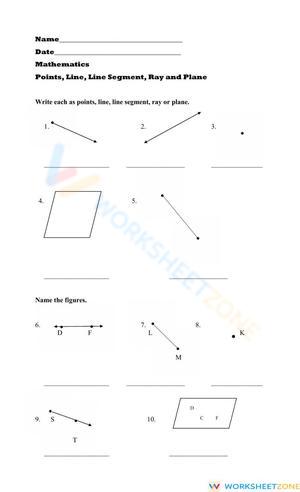
Task types in quality lines printable worksheets for 5th grade span a useful range. Students name terms from labeled diagrams, draw and label their own examples, sort figures by visible line relationships, and write brief justifications for their answers. That last task type produces the clearest evidence of real understanding—a student who writes these sides are parallel because they would never meet, even extended is showing reasoning, not just recall.
Drawing tasks earn their place here. When a student must sketch a ray versus a segment, the pencil work itself requires engaging with the structural difference—one endpoint versus two, or infinite extension in one direction. A multiple-choice item cannot reveal whether a student actually understands that distinction or is pattern-matching to a remembered picture.
Mistakes Students Make That These Worksheets Help You Catch
The most persistent Grade 5 geometry error is context transfer. A student who correctly identifies a ray in a stand-alone diagram will often miss the same term once it appears inside a larger figure or drawn at an oblique angle. The worksheets address this by pairing isolated vocabulary items with figure-embedded questions on the same worksheet, so teachers get both kinds of evidence in a single sitting rather than discovering the gap during the next unit.
Labeling by appearance instead of by properties is the second major issue. Students call two sides parallel because they look evenly spaced, or name any straight mark a line even when both endpoints are clearly shown. A brief written-justification prompt helps here. If a student writes I think these are perpendicular because the corner looks like a square corner, the teacher has a concrete opening—how do we verify that, and what would checking actually mean?—rather than simply correcting the label.
One subtler pattern: students who label rays and segments correctly in a horizontal orientation will rotate the paper when lines appear at a diagonal. That reflex signals they are still anchored to appearance rather than geometric properties. Drawing items at non-standard orientations push back on this directly, and several worksheets in the set include exactly that.
How to Build These Worksheets Into Your Lesson Plans
The most efficient starting point is as a pre-teaching check at the opening of a figure-classification lesson. Running four or five items as a warm-up surfaces vocabulary gaps before they become classification errors twenty minutes into instruction. A student who marks two non-parallel sides as parallel during the warm-up gives the teacher a concrete opening for a short clarifying explanation right then—not after the lesson has already moved past the point where the correction is useful.
During math workshop, a worksheet functions well as a station task. Students work through identification and drawing items independently, then compare how they labeled a figure when the group reconvenes. That brief comparison—"I said these were perpendicular; what did you mark?"—generates more active vocabulary use than the worksheet alone, and takes about five minutes of discussion time at most.
Lines printable worksheets for 5th grade also handle homework and substitute plans without complications. The directions are self-contained, no digital access is needed, and teachers can quietly differentiate by assigning different items from the same worksheet to different students. Printed geometry practice also lets students annotate directly—circling endpoints, extending lines with a pencil, crossing out incorrect options—in ways that make their thinking visible for a quick review the next morning.
Standard Alignment
The primary standard these worksheets support is CCSS.MATH.CONTENT.5.G.B.3, which requires students to understand that attributes belonging to a category of two-dimensional figures also belong to all subcategories. Parallel and perpendicular line vocabulary is the language students use when they explain those attribute relationships. Describing a rectangle as having two pairs of parallel sides, or explaining why a square is always a rectangle, requires students to know what "parallel" means precisely—not approximately.
CCSS.MATH.CONTENT.5.G.B.4, which calls for classifying two-dimensional figures in a hierarchy based on properties, leans on the same vocabulary. Students who are uncertain whether two sides are truly parallel, or who cannot articulate what makes a corner perpendicular, stall when the reasoning demands get heavier. Using these worksheets as a pre-unit check or mid-unit reteach places the vocabulary exactly where students need it before the conceptual load increases.
Adjusting the Worksheets for a Range of Learners
For students still consolidating the basic terms, focus first on naming and drawing tasks—hold off on figure-embedded questions until isolated vocabulary is stable. A student who is confusing rays and segments in a stand-alone context is not yet ready to locate a ray inside a polygon diagram. Holding back the complexity until the foundation is steady is faster than reteaching after a session that ended in frustration.
Students who have the vocabulary down need the written-justification prompts as their challenge point. Ask them to produce two reasons for each classification, or to generate a counterexample—a case where two lines look parallel but are not, or a figure where a student might wrongly assume perpendicularity. That critical examination moves beyond recall into the geometric reasoning Grade 5 actually targets.
Lines printable worksheets for 5th grade handle mixed-ability groupings well because the task types within each worksheet naturally move from simpler naming and matching toward more demanding figure and justification work. A teacher can assign the first several items to some students and the full worksheet to others without that split being visually obvious—everyone is working from the same printed resource.
Frequently Asked Questions
Is this vocabulary new in Grade 5, or are students expected to know it already?
Students first encounter lines, line segments, rays, and parallel and perpendicular concepts in Grade 4. In Grade 5, the expectation shifts from recognition to application—students use these terms to justify attribute descriptions and figure classifications, not simply identify a labeled picture.
How long does each worksheet take to complete?
Most students finish identification and drawing items in eight to twelve minutes. Explanation and justification tasks add time, especially for students still working through their reasoning in writing. For a warm-up slot, selecting four to six items from a worksheet keeps the timing tight enough to leave room for the main lesson.
Do these worksheets work for small-group intervention?
Yes. Printed materials are especially useful for reteach groups because students can point, mark, and revise directly on the resource while a teacher listens to the vocabulary they use. That listening is often more revealing than a scored digital response—a student who says it goes on forever but I wasn't sure which direction is pointing the teacher to the exact gap.
Can a teacher use these as formative assessment rather than straight practice?
Straightforwardly, yes. The drawing and justification tasks produce written evidence teachers can collect and sort quickly. Scanning answers for the two or three most common error patterns takes a few minutes and still gives concrete information for the next day's instruction—enough to decide whether to reteach, move forward, or address one misconception in a short whole-class moment before the lesson continues.














 Interactive Worksheet Maker
 Quiz Maker
 Word Search Maker
 Crossword Puzzle Maker
 Word Scramble Generator
 Sentence Scramble Generator
 Handwriting Worksheet Generator
 Name Tracing Generator
 Fill In The Blank Generator




 BACK TOSCHOOL