


























Views
Downloads


Essential Interpersonal Skills Worksheet | Grades 3-5 Ready
Paste this activity's link or code into your existing LMS (Google Classroom, Canvas, Teams, Schoology, Moodle, etc.).
Students can open and work on the activity right away, with no student login required.
You'll still be able to track student progress and results from your teacher account.
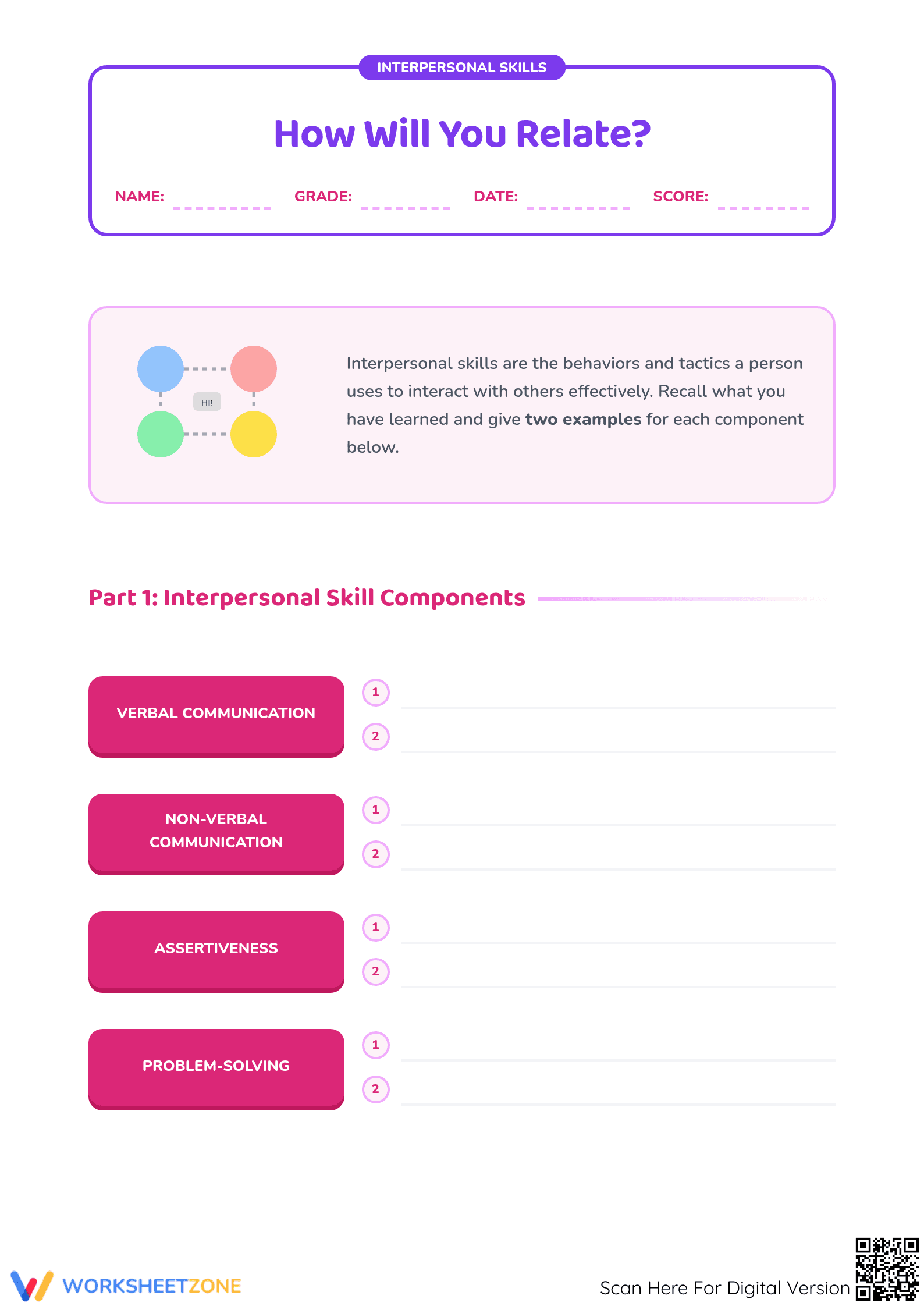
This Grade 3-5 interpersonal skills worksheet provides a comprehensive framework for students to identify and practice essential social behaviors. By defining key components like assertiveness and negotiation, students develop the vocabulary and situational awareness needed for successful peer interactions and collaborative classroom environments. It transforms abstract social concepts into concrete, actionable student behaviors.
At a Glance
- Grade: 3-5 · Subject: Social Skills
- Standard:
CCSS.ELA-LITERACY.SL.4.1— Engage effectively in collaborative discussions and build on others' ideas- Skill Focus: Interpersonal Communication
- Format: 3 pages · 19 tasks · Answer key included · PDF
- Best For: Small group SEL or morning meetings
- Time: 30–45 minutes
The three-page PDF includes a structured breakdown of seven interpersonal components, three real-world social scenarios, and a personal reflection checklist. Students are prompted to provide two concrete examples for skills like non-verbal communication and decision-making, ensuring they move beyond abstract definitions to practical application. The layout is clean and student-friendly, featuring clear headings and ample writing space.
This resource is designed for immediate classroom implementation with a total teacher prep time of under 2 minutes. Simply print the three-page packet and distribute it during a social-emotional learning block or as a supplemental ELA activity. Students can work through the definitions independently or in pairs, while the final reflection page serves as a ready-made formative assessment for student self-awareness and goal setting.
This worksheet aligns with CCSS.ELA-LITERACY.SL.4.1, which requires students to engage effectively in a range of collaborative discussions with diverse partners. By practicing negotiation and assertiveness through written scenarios, students prepare for the verbal demands of group work and peer conflict resolution. Both standard codes can be copied directly into lesson plans, IEP goals, or district curriculum mapping tools.
Use this worksheet during a mid-unit lesson on communication to reinforce the difference between verbal and non-verbal cues. It is also highly effective as a restorative practice tool after a classroom conflict, allowing students to reflect on which skills they could have used to reach a better outcome. Expect students to take approximately 35 minutes to complete all three sections thoughtfully, including the final self-reflection.
This resource is ideal for general education students in grades 3 through 5, as well as social skills groups for students with IEP goals related to pragmatics and behavior. It pairs naturally with an anchor chart on active listening or a direct instruction lesson on "I" statements. The content is accessible for various reading levels while maintaining high expectations for social reasoning.
Research from Fisher & Frey (2014) emphasizes that social-emotional competencies like those addressed in this worksheet are foundational to academic success and classroom management. By explicitly teaching CCSS.ELA-LITERACY.SL.4.1 through the lens of interpersonal components, educators provide the scaffolding necessary for students to navigate complex social landscapes. The 19 tasks included here offer a structured progression from identification to application, ensuring that students do not just memorize terms but internalize behaviors. According to the NAEP, students who demonstrate strong interpersonal skills often show higher engagement in collaborative literacy tasks. This worksheet serves as a vital bridge between social-emotional learning and ELA standards, providing a clear evidence base for student progress in communication and self-reflection.


