


























Views
Downloads

Essential Communication Guide | Grade 4-5
Paste this activity's link or code into your existing LMS (Google Classroom, Canvas, Teams, Schoology, Moodle, etc.).
Students can open and work on the activity right away, with no student login required.
You'll still be able to track student progress and results from your teacher account.
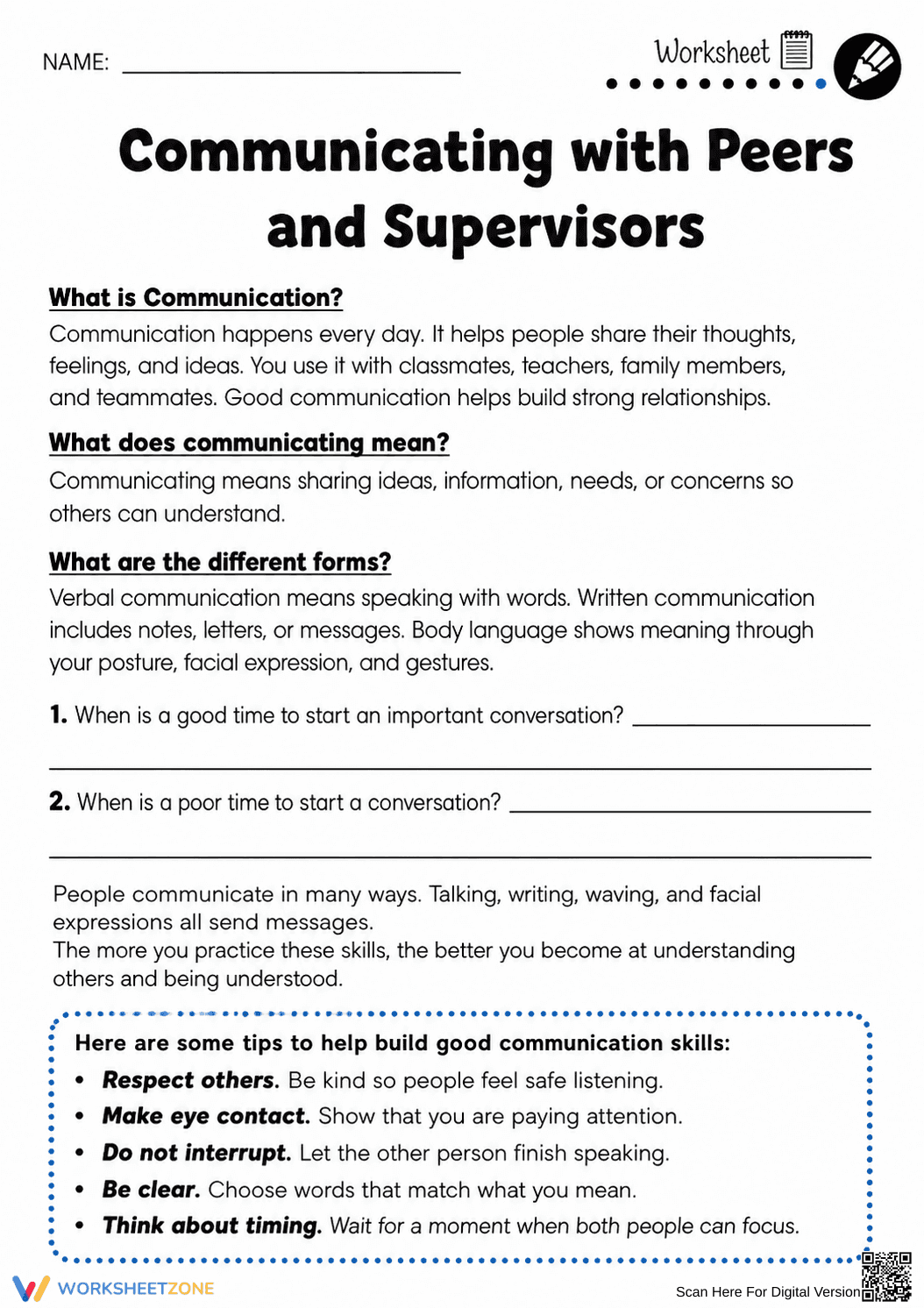
This Grade 4-5 communication worksheet provides a structured framework for students to master social interactions with classmates and authority figures. By defining communication forms and analyzing situational timing, students learn to convey ideas clearly while maintaining respect. This resource ensures students identify appropriate social cues to improve interpersonal relationships and classroom behavior.
At a Glance
- Grade: 4-5 · Subject: Teaching Communication Skills
- Standard:
SL.4.1— Engage in collaborative discussions by following rules for polite and effective conversation.- Skill Focus: Peer and supervisor interaction
- Format: 2 pages · 14 problems · Answer key included · PDF
- Best For: Social-emotional learning and classroom management
- Time: 20–30 minutes
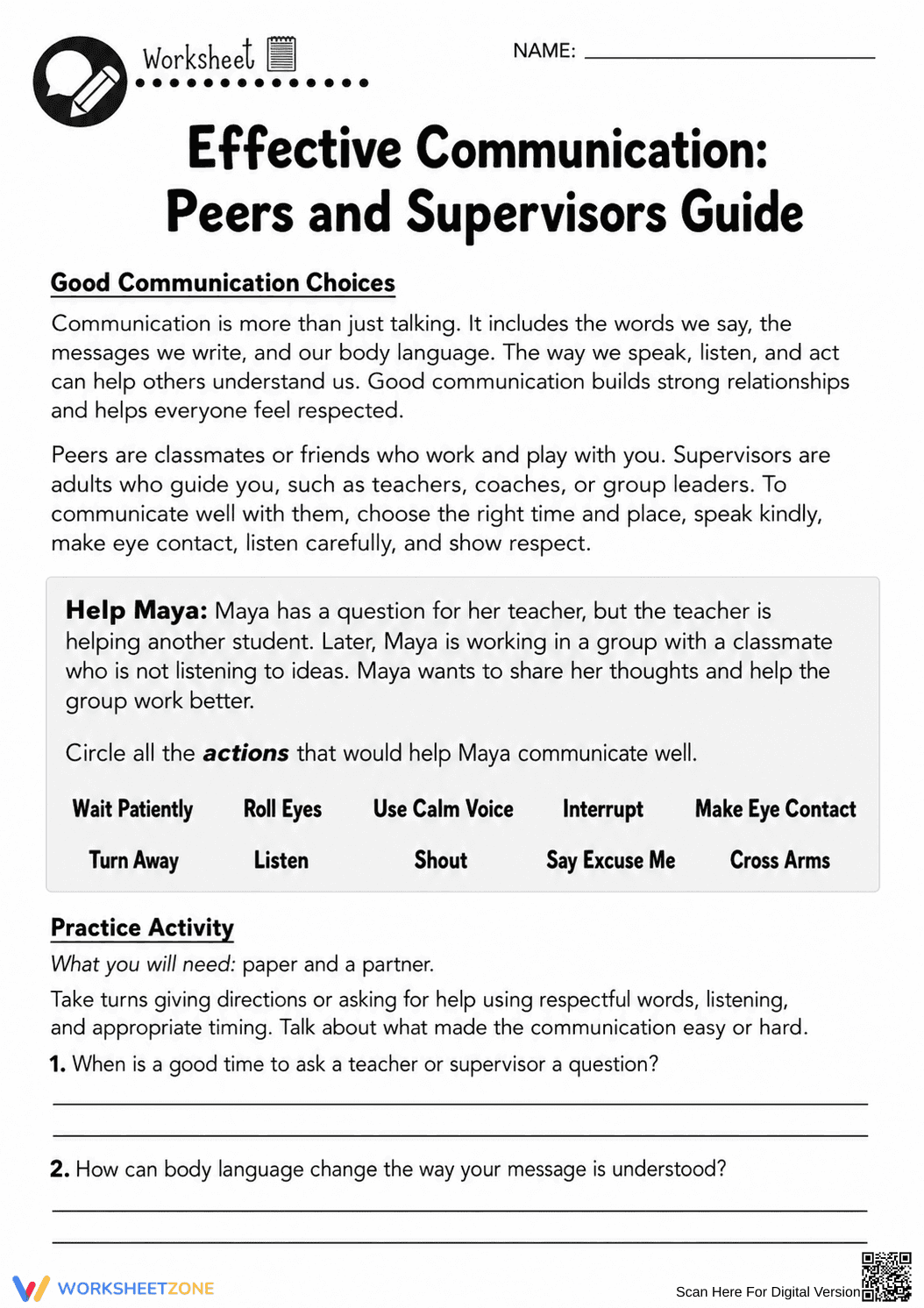
What's Inside: This 2-page PDF includes a vocabulary section defining verbal, written, and body language communication. Page one features open-ended reflection questions on conversational timing and five essential communication tips. Page two introduces the "Help Maya" scenario, where students evaluate 10 social actions, followed by a partner-based practice activity reinforcing real-world application.
Zero-Prep Workflow
This resource is designed for immediate implementation with minimal oversight. First, print the double-sided worksheet. Next, distribute copies and have students read the introductory definitions independently. Finally, facilitate a brief review of the "Help Maya" scenario to clarify why behaviors like rolling eyes hinder communication. This layout is ideal for sub plans or morning work.
Standards Alignment
The primary focus is CCSS.ELA-LITERACY.SL.4.1: "Engage effectively in a range of collaborative discussions with diverse partners on grade 4 topics and texts, building on others' ideas and expressing their own clearly." The worksheet targets SL.4.1.C by teaching students to follow agreed-upon rules for discussions. These codes can be copied directly into lesson plans or IEP goals.
How to Use It
This worksheet is most effective during the "guided practice" phase of a social skills lesson. After a direct instruction session on active listening, assign the scenario-based circling task to gauge student understanding of social cues. For a formative assessment, observe students during the "Practice Activity" on page two; look for students who successfully maintain eye contact and wait for a natural pause before speaking. This activity typically takes 25 minutes to complete in a standard classroom setting.
Who It's For
This resource is tailored for students in Grade 4 and Grade 5 who are navigating the transition from primary to middle school social dynamics. It is particularly beneficial for students with IEP goals related to social-emotional learning or those participating in small-group counseling. It pairs naturally with an anchor chart on active listening or a short reading passage about workplace etiquette and professional behavior.
Effective communication is a foundational component of Social and Emotional Learning (SEL) that directly impacts academic success and classroom climate. According to Fisher & Frey (2014), explicit instruction in speaking and listening skills, such as the CCSS.ELA-LITERACY.SL.4.1 standard, allows students to move from basic social interaction to purposeful, collaborative academic discourse. This worksheet addresses the nuance of communication by distinguishing between peer-level talk and supervisor-level interactions, a critical distinction for students transitioning into middle school environments. By identifying appropriate timing and interpreting non-verbal cues like body language, students develop the self-awareness necessary for self-regulation and social efficacy. Research indicates that students who receive structured guidance in these soft skills show significant gains in academic performance compared to peers without such interventions. This resource provides the necessary scaffolding to bridge the gap between understanding a social rule and applying it in real-time classroom or professional scenarios.


