


























Views
Downloads
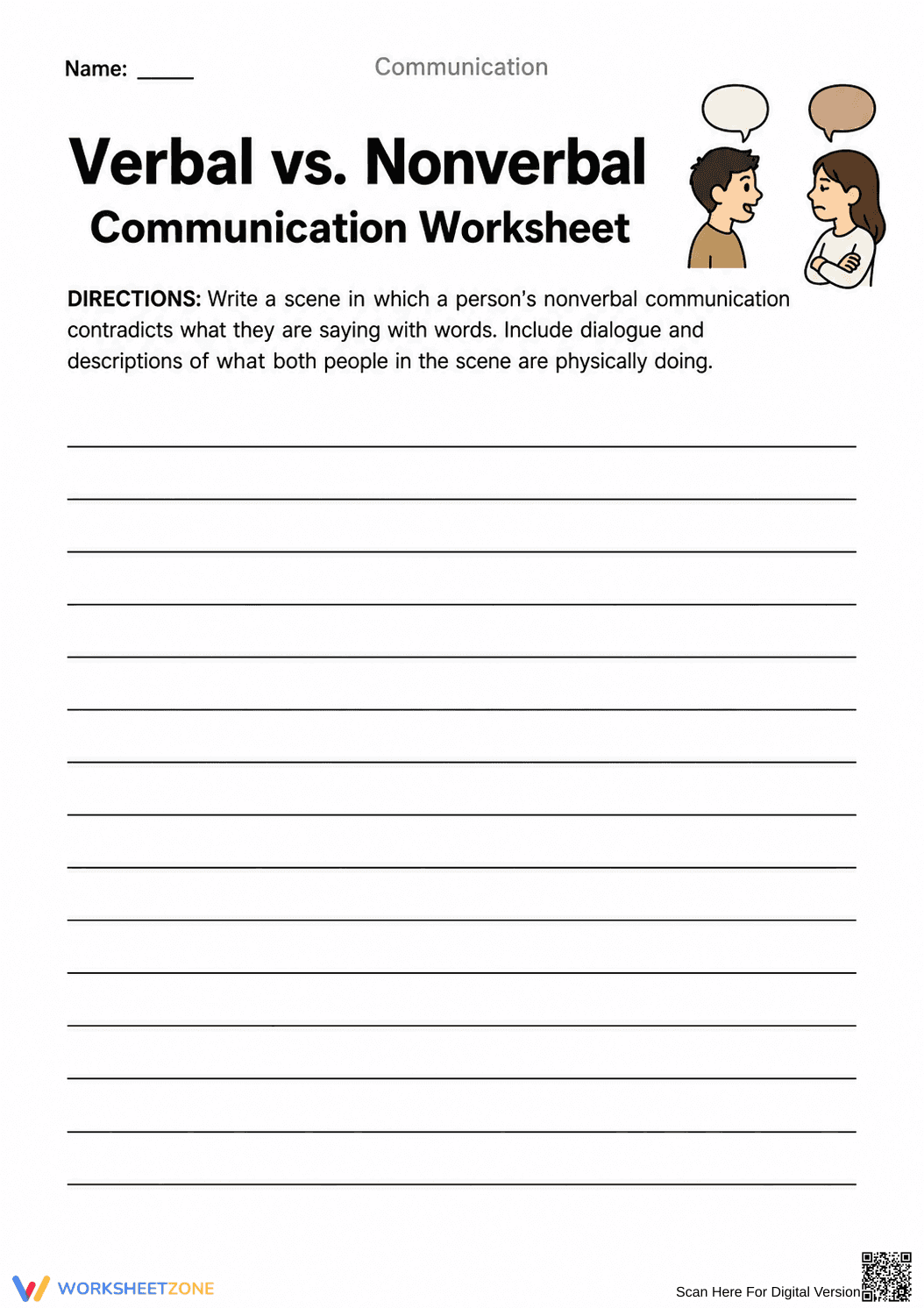

Essential Verbal vs Nonverbal Communication Worksheet
Paste this activity's link or code into your existing LMS (Google Classroom, Canvas, Teams, Schoology, Moodle, etc.).
Students can open and work on the activity right away, with no student login required.
You'll still be able to track student progress and results from your teacher account.
This communication worksheet empowers students to explore the complex relationship between spoken words and body language. By tasking learners with writing a scene where nonverbal cues contradict verbal messages, the activity sharpens their social awareness and creative writing precision. Students move beyond basic definitions to demonstrate a functional understanding of how physical actions can completely change the meaning of a conversation.
At a Glance
- Grade: 5 · Subject: Teaching Communication Skills
- Standard:
CCSS.ELA-LITERACY.SL.5.1— Engage effectively in collaborative discussions and communication tasks- Skill Focus: Nonverbal Contradiction
- Format: 1 page · 1 creative task · Open-ended · PDF
- Best For: Social-emotional learning and creative writing
- Time: 15–20 minutes
What's Inside
The worksheet features a clear, focused prompt that directs students to create a two-person scene. It includes ample lined space for drafting dialogue and detailed physical descriptions. The layout is intentionally minimalist to prevent cognitive overload, focusing entirely on the student's ability to visualize and record the clash between what a character says and what their body reveals. No additional materials are required for completion.
Zero-Prep Workflow
The zero-prep design allows for immediate implementation in any classroom setting. First, print the single-page PDF (30 seconds). Second, distribute the worksheet and read the prompt aloud to ensure students understand the concept of contradiction (2 minutes). Third, allow students to write their scenes independently while you circulate to provide feedback on their physical descriptions (15 minutes). This efficient structure makes it an ideal resource for substitute folders or last-minute social skills lessons.
Standards Alignment
This resource is primarily aligned with CCSS.ELA-LITERACY.SL.5.1, which requires students to engage effectively in communication tasks. By analyzing and creating nonverbal subtext, students also meet requirements for descriptive writing found in CCSS.ELA-LITERACY.W.5.3.B. Both standard codes can be copied directly into lesson plans, IEP goals, or district curriculum mapping tools to document the integration of social-emotional learning with core literacy standards.
How to Use It
Use this worksheet as a formative assessment after a lesson on social cues. It works exceptionally well during the independent practice phase of a gradual release model. Teachers should look for students who can describe specific physical actions—like crossing arms or looking away—rather than just stating the character is angry. This provides a clear window into the student's level of social-emotional perception and expected completion time is 20 minutes.
Who It's For
This activity is designed for Grade 3 through Grade 5 students, but it is particularly effective for social skills groups and students with IEP goals related to pragmatic language. It pairs naturally with a short video clip of a conversation or an anchor chart detailing common nonverbal signals. It also serves as an excellent bridge for English Language Learners (ELLs) to practice nuanced vocabulary and descriptive storytelling.
According to Fisher & Frey (2014), the ability to synthesize verbal and nonverbal information is a critical component of communicative competence. This worksheet addresses CCSS.ELA-LITERACY.SL.5.1 by requiring students to construct a narrative where physical cues and spoken words diverge, a high-level cognitive task that mirrors real-world social complexity. Research indicates that explicit instruction in nonverbal communication significantly improves social-emotional outcomes for upper elementary students. By focusing on the contradiction between dialogue and body language, the activity forces students to analyze the subtext of human interaction. This resource provides a structured framework for practicing these skills without the need for extensive teacher preparation, making it an efficient tool for both general education and specialized social skills instruction. The inclusion of specific requirements for physical descriptions ensures that students move beyond simple dialogue to consider the holistic nature of communication.


