


























Views
Downloads



Types of Communication Worksheet | Grade 5 Essential
Paste this activity's link or code into your existing LMS (Google Classroom, Canvas, Teams, Schoology, Moodle, etc.).
Students can open and work on the activity right away, with no student login required.
You'll still be able to track student progress and results from your teacher account.
This Grade 5 social skills worksheet helps students distinguish between assertive, passive, and aggressive communication styles. By analyzing real-world scenarios, learners develop the vocabulary and emotional intelligence needed to express their needs respectfully. Students will practice the "Assertiveness Formula" to transform conflict into constructive dialogue, ensuring they can advocate for themselves in any social environment.
At a Glance
- Grade: 5 · Subject: Social Skills
- Standard:
CCSS.ELA-LITERACY.SL.5.1— Engage in collaborative discussions and express ideas clearly while respecting others.- Skill Focus: Assertive vs. Passive/Aggressive Communication
- Format: 4 pages · 18 problems · No-prep packet · PDF
- Best For: Social-emotional learning and conflict resolution
- Time: 30–45 minutes
What's Inside
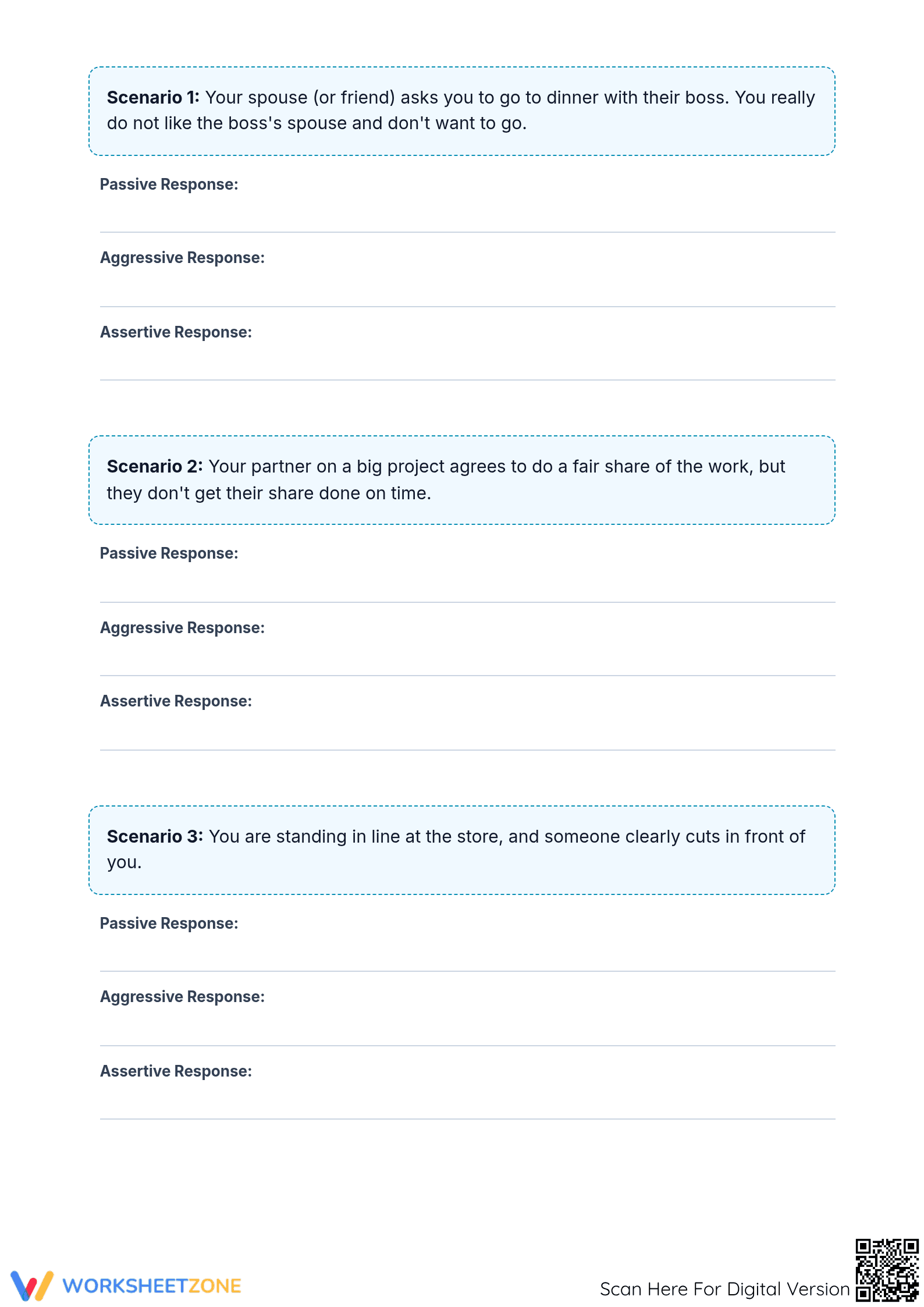
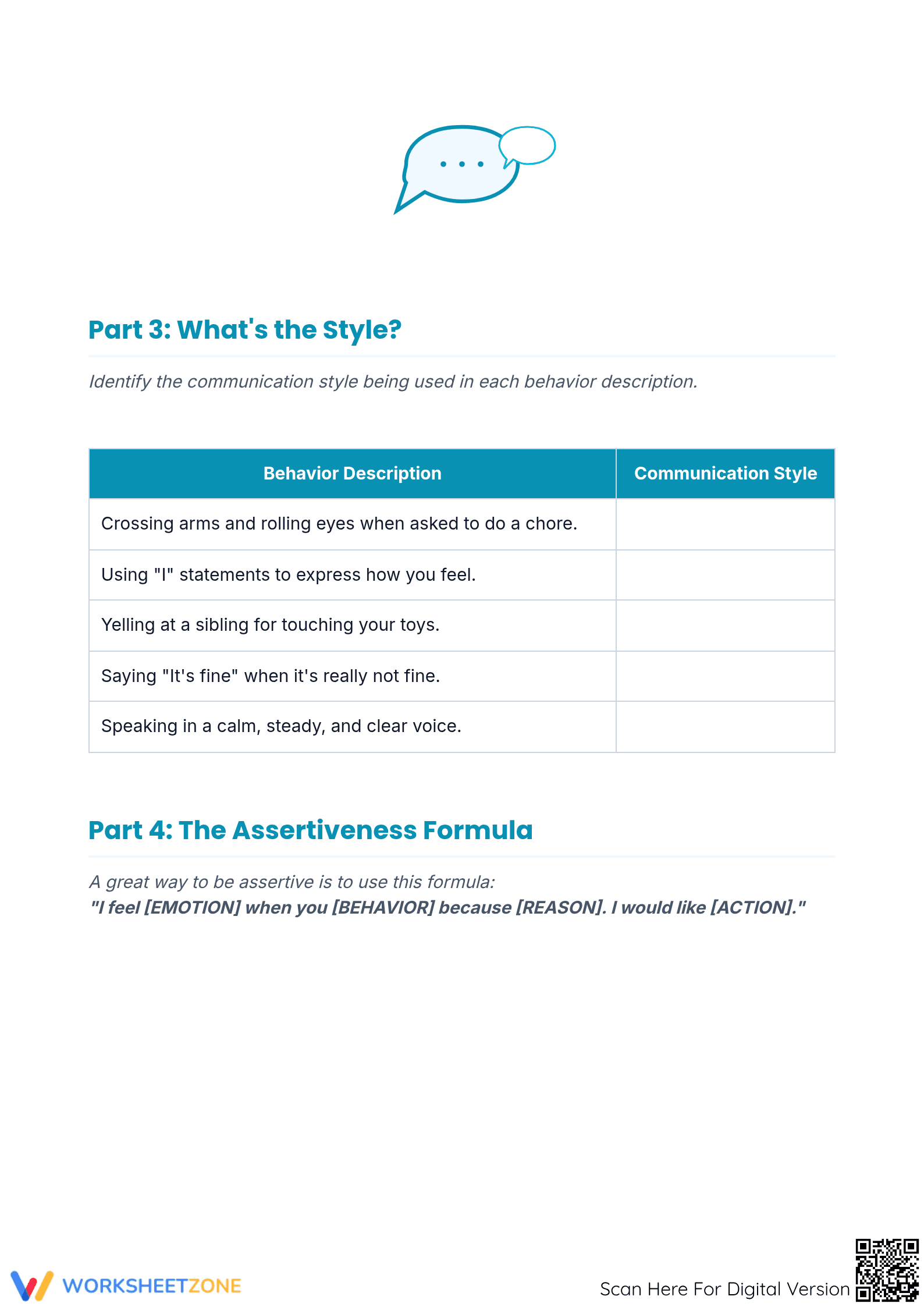
This comprehensive 4-page packet begins with a clear glossary of four key terms: assertive, aggressive, passive, and passive-aggressive. It features three detailed social scenarios where students must draft three different responses for each. The worksheet also includes a behavior identification table, a guided "Assertiveness Formula" rewrite section, and a personal reflection component to encourage metacognition.
Zero-Prep Workflow
Teachers can implement this resource with less than two minutes of preparation. First, print the 4-page PDF for each student (1 minute). Second, distribute the packets and briefly review the glossary on page one (5 minutes). Third, allow students to work through the scenarios independently or in pairs, then review the "Assertiveness Formula" as a whole group (25 minutes). This structure is ideal for substitute plans.
Standards Alignment
This resource is aligned with `CCSS.ELA-LITERACY.SL.5.1`, which requires students to engage effectively in a range of collaborative discussions. It specifically supports sub-standard SL.5.1.C by teaching students to pose and respond to specific questions by making comments that contribute to the discussion. This standard code can be copied directly into lesson plans, IEP goals, or district curriculum mapping tools.
How to Use It
Use this worksheet during a dedicated Social-Emotional Learning (SEL) block or as a supplemental English activity. It is particularly effective after a direct instruction lesson on conflict resolution. For a formative assessment, observe students during the "Assertiveness Formula" rewrite section to see if they can correctly identify the reason and action components. Completion typically takes 30 to 45 minutes.
Who It's For
This packet is designed for Grade 4 and Grade 5 students, including those in general education and those receiving special education services for social-behavioral goals. It pairs naturally with an anchor chart on "I-statements" or a short video demonstration of different body language cues to provide a multi-modal learning experience.
According to Fisher & Frey (2014), explicit instruction in social-emotional communication is vital for students transitioning into middle school. This worksheet addresses the CCSS.ELA-LITERACY.SL.5.1 standard by providing a structured framework for students to practice assertive communication, a skill that research indicates reduces peer conflict and improves academic focus. By breaking down communication into four distinct styles—assertive, passive, aggressive, and passive-aggressive—the resource allows students to categorize behaviors and choose more effective responses. The inclusion of the "Assertiveness Formula" provides a linguistic scaffold that helps students internalize the structure of respectful self-advocacy. This evidence-based approach ensures that students are not just identifying problems but are actively building the verbal tools necessary for successful interpersonal interactions. Such targeted practice is a cornerstone of modern social-emotional curricula, providing measurable data for progress monitoring in both general and special education settings.


