


























Views
Downloads




Message, Audience, Delivery Worksheet | Grade 4 Essential
Paste this activity's link or code into your existing LMS (Google Classroom, Canvas, Teams, Schoology, Moodle, etc.).
Students can open and work on the activity right away, with no student login required.
You'll still be able to track student progress and results from your teacher account.
This Grade 4 communication worksheet helps students master the three pillars of effective interaction: the message, the audience, and the delivery. By analyzing scenarios and planning their own responses, students learn to share ideas clearly and respectfully. This comprehensive resource ensures students understand how context and non-verbal cues influence social success.
At a Glance
- Grade: 4 · Subject: Social Skills & Communication
- Standard:
CCSS.ELA-LITERACY.SL.4.4— Report on a topic or recount an experience in an organized manner- Skill Focus: Strategic communication planning
- Format: 5 pages · 10 problems · Answer key included · PDF
- Best For: Social-emotional learning and speech therapy
- Time: 30–45 minutes
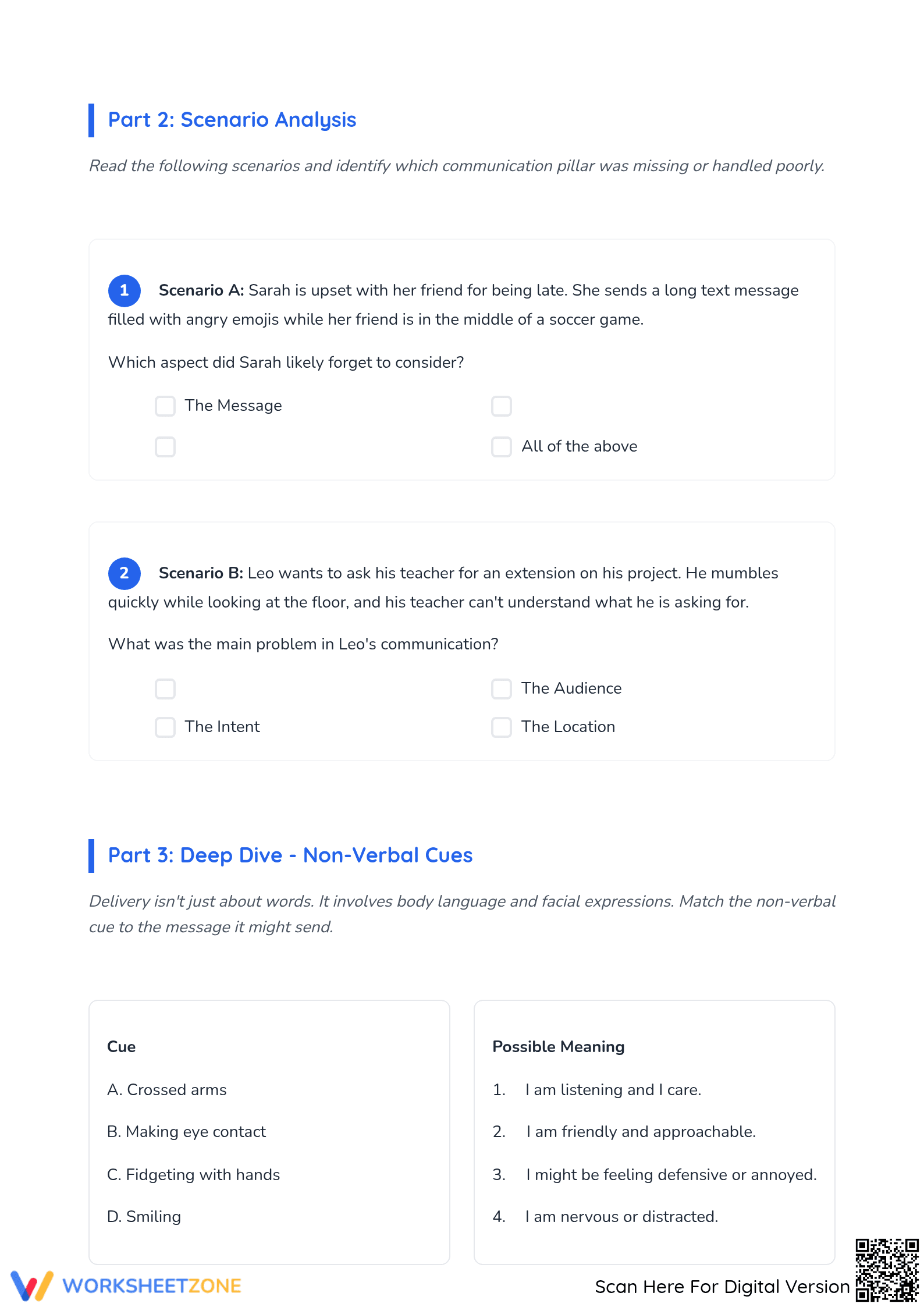
This 5-page packet contains a structured communication planner, scenario analysis questions, a non-verbal cue matching activity, and a roleplay script-writing section. Students are guided through the process of identifying what they want to say, who they are saying it to, and the best medium for delivery. The final page includes a goal-setting prompt to encourage real-world application of these social skills.
The zero-prep design allows for immediate classroom implementation. First, print the 5-page PDF (30 seconds). Next, distribute the packets to students for independent or small-group work (1 minute). Finally, review the scenario analysis and matching sections using the included answer key to provide instant feedback (5 minutes). This resource is an ideal solution for unexpected sub plans or scheduled SEL blocks.
This resource is aligned with `CCSS.ELA-LITERACY.SL.4.4`, which requires students to report on a topic or recount an experience in an organized manner, using appropriate facts and relevant, descriptive details to support main ideas. It also supports `CCSS.ELA-LITERACY.SL.4.1` by fostering the skills necessary for collaborative discussions. Both standard codes can be copied directly into lesson plans, IEP goals, or district curriculum mapping tools.
Use this worksheet during a dedicated Social-Emotional Learning (SEL) block to introduce the concept of intentional communication. It works best after a brief direct instruction session on non-verbal cues. As a formative assessment, observe students during the Part 4 Roleplay Practice to see if they can translate their written plans into spoken dialogue. Expect completion within a 45-minute period.
This resource is designed for general education students in Grades 3-5, but it is particularly effective for students receiving speech and language services or those with social-communication IEP goals. It pairs naturally with an anchor chart on "Active Listening" or a short video demonstration of different communication styles.
Effective communication instruction requires a balance of theoretical understanding and practical application. According to Fisher & Frey (2014), the gradual release of responsibility model—moving from guided planning to independent roleplay—is essential for students to internalize complex social-emotional skills like those found in `CCSS.ELA-LITERACY.SL.4.4`. This worksheet facilitates that transition by providing 10 structured tasks that move from identifying communication pillars to creating original scripts. Research from the RAND AIRS 2024 report suggests that explicit instruction in social skills, including the analysis of non-verbal cues and audience awareness, significantly improves peer-to-peer interactions and classroom climate. By using this 5-page resource, educators provide students with a repeatable framework for resolving conflicts and sharing significant ideas, ensuring that the Message, Audience, and Delivery are always aligned for maximum clarity and respect in diverse social settings.


