


























Views
Downloads

Sunflower Life Cycle Worksheet | Grade 3 Essential
Paste this activity's link or code into your existing LMS (Google Classroom, Canvas, Teams, Schoology, Moodle, etc.).
Students can open and work on the activity right away, with no student login required.
You'll still be able to track student progress and results from your teacher account.
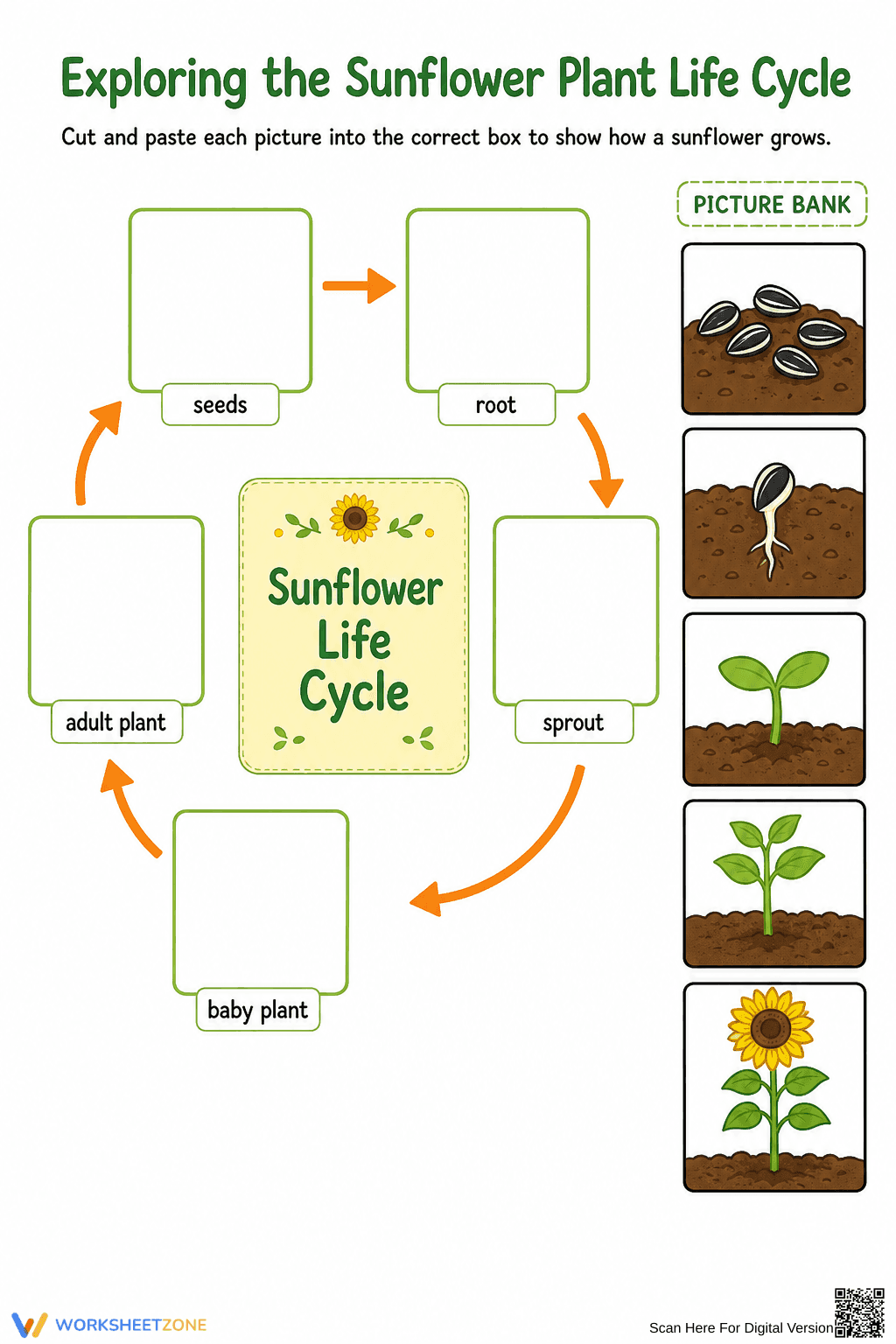
This sunflower life cycle worksheet helps students master biological sequencing by identifying and ordering the five key stages of plant growth. Students transition from seeds to adult blooms, developing a concrete understanding of how flowering plants develop over time. It provides a clear visual framework for early elementary science curriculum.
At a Glance
- Grade: 3 · Subject: Science
- Standard:
3-LS1-1— Develop models to describe that organisms have unique and diverse life cycles- Skill Focus: Sunflower life cycle sequencing
- Format: 1 page · 5 problems · Answer key included · PDF
- Best For: Independent practice or science centers
- Time: 15–20 minutes
The worksheet features a central "Sunflower Life Cycle" diagram with five empty boxes connected by directional arrows. On the right, a "Picture Bank" provides high-quality illustrations of seeds, roots, sprouts, baby plants, and adult sunflowers. The layout is designed for either traditional cut-and-paste tactile learning or digital interaction, ensuring flexibility for different classroom environments.
Zero-Prep Workflow
- Print: Generate the single-page PDF for your entire class in under 30 seconds.
- Distribute: Hand out the sheets and provide scissors and glue for the cut-and-paste activity.
- Review: Use the included answer key to check for student understanding in less than 5 minutes.
This resource is an ideal "grab-and-go" option for substitute folders or unexpected schedule changes.
Standards Alignment
This resource is aligned with `3-LS1-1`, which requires students to develop models to describe that organisms have unique and diverse life cycles but all have in common birth, growth, reproduction, and death. It also supports early biology concepts by illustrating the physical needs of plants during growth. Both standard codes can be copied directly into lesson plans, IEP goals, or district curriculum mapping tools.
How to Use It
Use this worksheet as a formative assessment after a direct instruction lesson on botany. As students work, circulate to observe if they can distinguish between the "sprout" and "baby plant" stages, which often require closer inspection of leaf development. It also serves as an excellent follow-up activity after a classroom seed-planting experiment to predict future growth stages. Expected completion time is 15 to 20 minutes.
Who It's For
This activity is tailored for Grade 2 and Grade 3 students, though it remains accessible for Grade 1 learners with teacher support. It is particularly effective for English Language Learners (ELLs) due to the heavy reliance on visual cues and vocabulary labels. Pair this with a non-fiction text about sunflowers or a time-lapse video of plant growth for a comprehensive lesson.
According to the RAND AIRS 2024 report, high-quality visual models in early science education significantly improve long-term retention of biological processes. This worksheet addresses the 3-LS1-1 standard by requiring students to construct a chronological model of a sunflower's life cycle, moving from seeds to maturity. By engaging in the physical act of sequencing five distinct stages—seeds, root, sprout, baby plant, and adult plant—students internalize the concept of cyclical growth. Research from Fisher & Frey (2014) suggests that combining visual banks with labeled graphic organizers supports the gradual release of responsibility, allowing students to move from guided observation to independent mastery. This 1-page PDF resource provides the necessary scaffolding for diverse learners to demonstrate their understanding of plant biology without the cognitive load of heavy text, making it a reliable tool for meeting state science frameworks.


