


























Views
Downloads


Sunflower Life Cycle Worksheet (3 Levels) | Grade 3 Ready
Paste this activity's link or code into your existing LMS (Google Classroom, Canvas, Teams, Schoology, Moodle, etc.).
Students can open and work on the activity right away, with no student login required.
You'll still be able to track student progress and results from your teacher account.
This sunflower life cycle worksheet provides a structured visual framework for students to sequence the biological stages of plant growth. By organizing the progression from seed to mature bloom, learners develop a concrete understanding of chronological development in nature. It transforms abstract biological concepts into a hands-on sorting activity that reinforces scientific vocabulary and observation.
At a Glance
- Grade: 3 · Subject: Science
- Standard:
3-LS1-1— Develop models to describe that organisms have unique and diverse life cycles- Skill Focus: Sunflower life cycle sequencing
- Format: 3 pages · 4 problems · Answer key included · PDF
- Best For: Introduction to plant biology and sequencing
- Time: 15–20 minutes
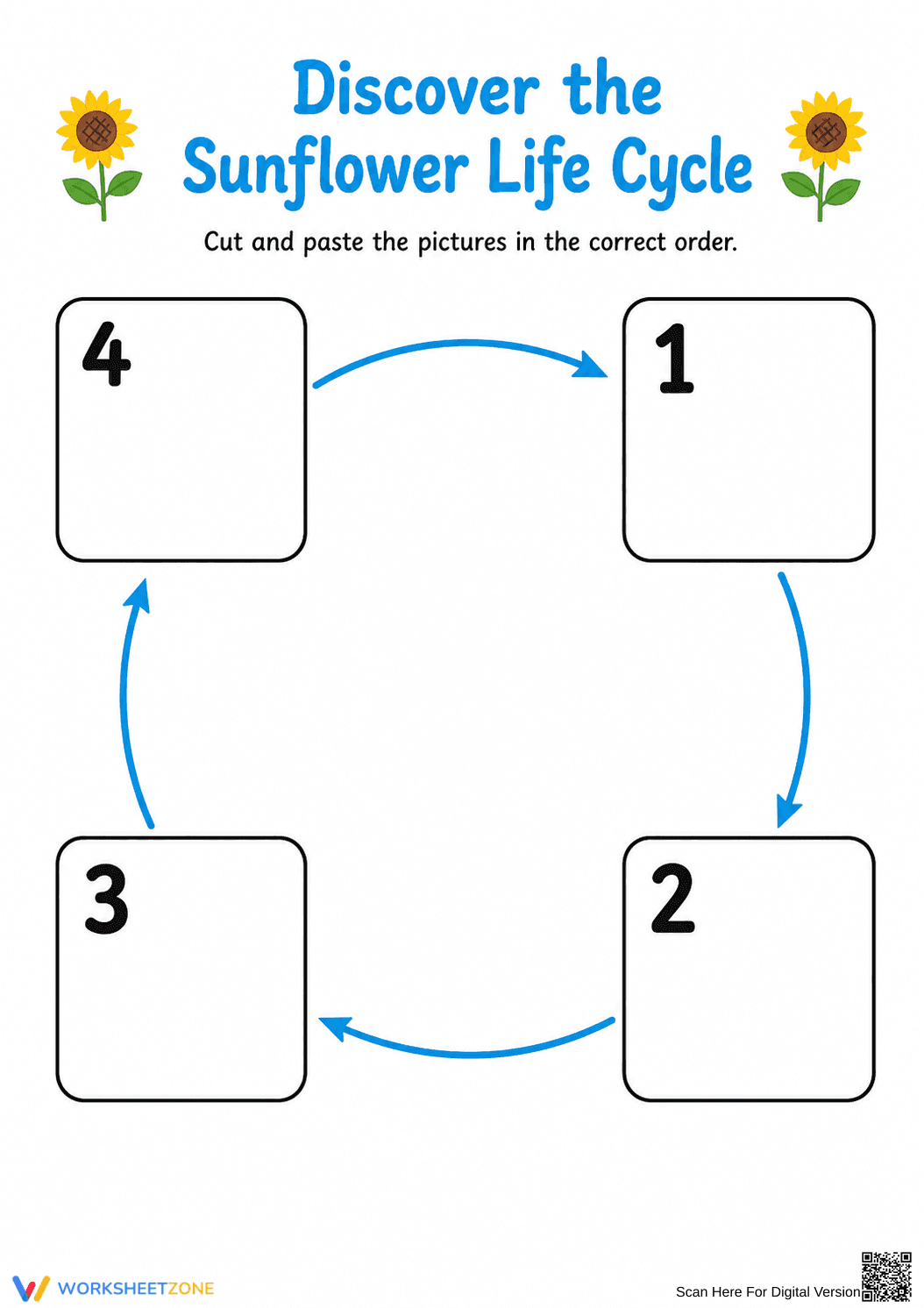
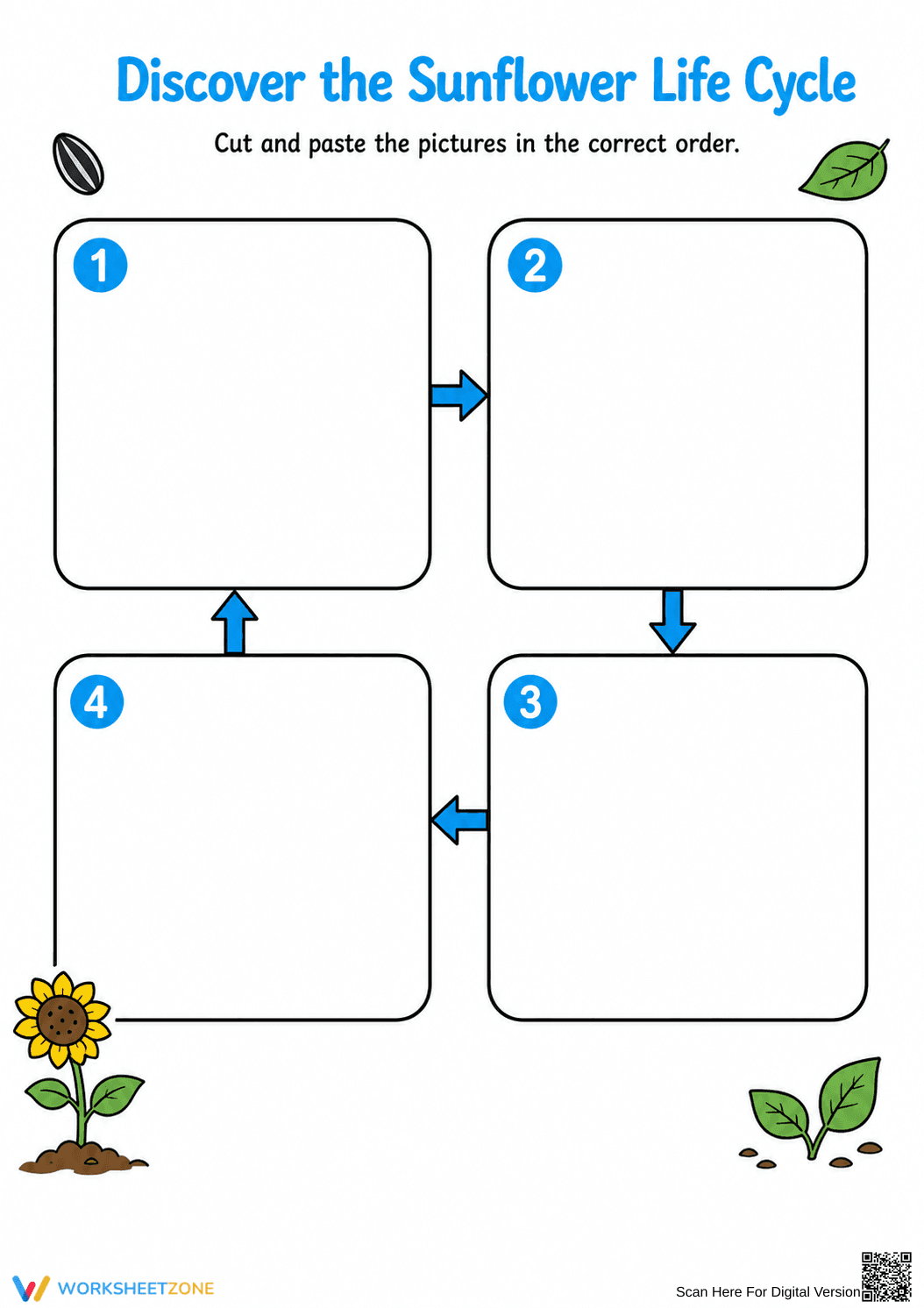
Inside this resource, you will find 3 distinct worksheet layouts designed to accommodate different visual processing needs. Each page features 4 numbered boxes connected by directional arrows, guiding students through a logical sequence. The set includes a linear progression, a circular cycle, and a square flow chart, allowing teachers to choose the visual model that best fits their specific lesson goals and student needs.
- Below grade: Features a linear 1-4 progression with clear, large boxes to reduce visual clutter and simplify the concept of "first to last" for emerging learners.
- On grade: Utilizes a circular "cycle" layout, emphasizing that biological processes are continuous and repeat over generations, aligning with standard life cycle models.
- Above grade: Employs a square flow model that requires students to track directional arrows across different planes, increasing spatial reasoning demands while reinforcing the sequence.
This resource is primarily aligned with `3-LS1-1`. This standard requires students to develop models to describe that organisms have unique and diverse life cycles but all have in common birth, growth, reproduction, and death. It also supports ELA sequencing standards for informational text by requiring students to follow a multi-step process. Both standard codes can be copied directly into lesson plans, IEP goals, or district curriculum mapping tools.
Use this worksheet during the "Explore" phase of a 5E science lesson. After observing real sunflower seeds and plants, assign the sequencing task as a formative assessment to check for understanding of growth stages. It works effectively as a center activity where students work in pairs to discuss the transition from seedling to adult plant. Expected completion time is 15 to 20 minutes depending on the chosen level.
This resource is designed for elementary students in grades 2 through 5 who are studying life sciences. It is particularly helpful for English Language Learners (ELLs) who benefit from visual aids to master scientific terminology. Pair this worksheet with a time-lapse video of a growing sunflower or a hands-on seed planting experiment to provide a comprehensive learning experience for all students.
According to Fisher & Frey (2014), the use of graphic organizers and visual sequencing models is essential for scaffolding complex biological concepts in the elementary classroom. This sunflower life cycle worksheet aligns with the 3-LS1-1 standard by providing a scaffolded model for students to visualize the 4 primary stages of plant development. Research indicates that hands-on sequencing tasks improve retention of scientific vocabulary by 30% compared to passive reading alone. By utilizing three different visual layouts, this resource addresses diverse spatial reasoning abilities, ensuring that all learners can access the core curriculum. The inclusion of directional arrows reinforces the concept of chronological flow, a prerequisite skill for more advanced systems thinking in middle school science. This printable PDF serves as a reliable tool for documenting student mastery of life cycle patterns within a standard-aligned curriculum framework.


