


























Views
Downloads

Sunflower Life Cycle Worksheet (3 Levels) | Grade 3 Ready
Paste this activity's link or code into your existing LMS (Google Classroom, Canvas, Teams, Schoology, Moodle, etc.).
Students can open and work on the activity right away, with no student login required.
You'll still be able to track student progress and results from your teacher account.
This sunflower life cycle worksheet helps students sequence the stages of plant growth from seed to mature flower. By cutting, pasting, and organizing the four developmental phases, learners build foundational science skills while reinforcing their understanding of how living organisms grow, reproduce, and change over time.
At a Glance
- Grade: 3 · Subject: Science
- Standard:
3-LS1-1— Develop models to describe that organisms have unique and diverse life cycles.- Skill Focus: Sequencing plant life cycles
- Format: 3 pages · 4 problems · PDF
- Best For: Differentiated independent science practice
- Time: 15–20 minutes
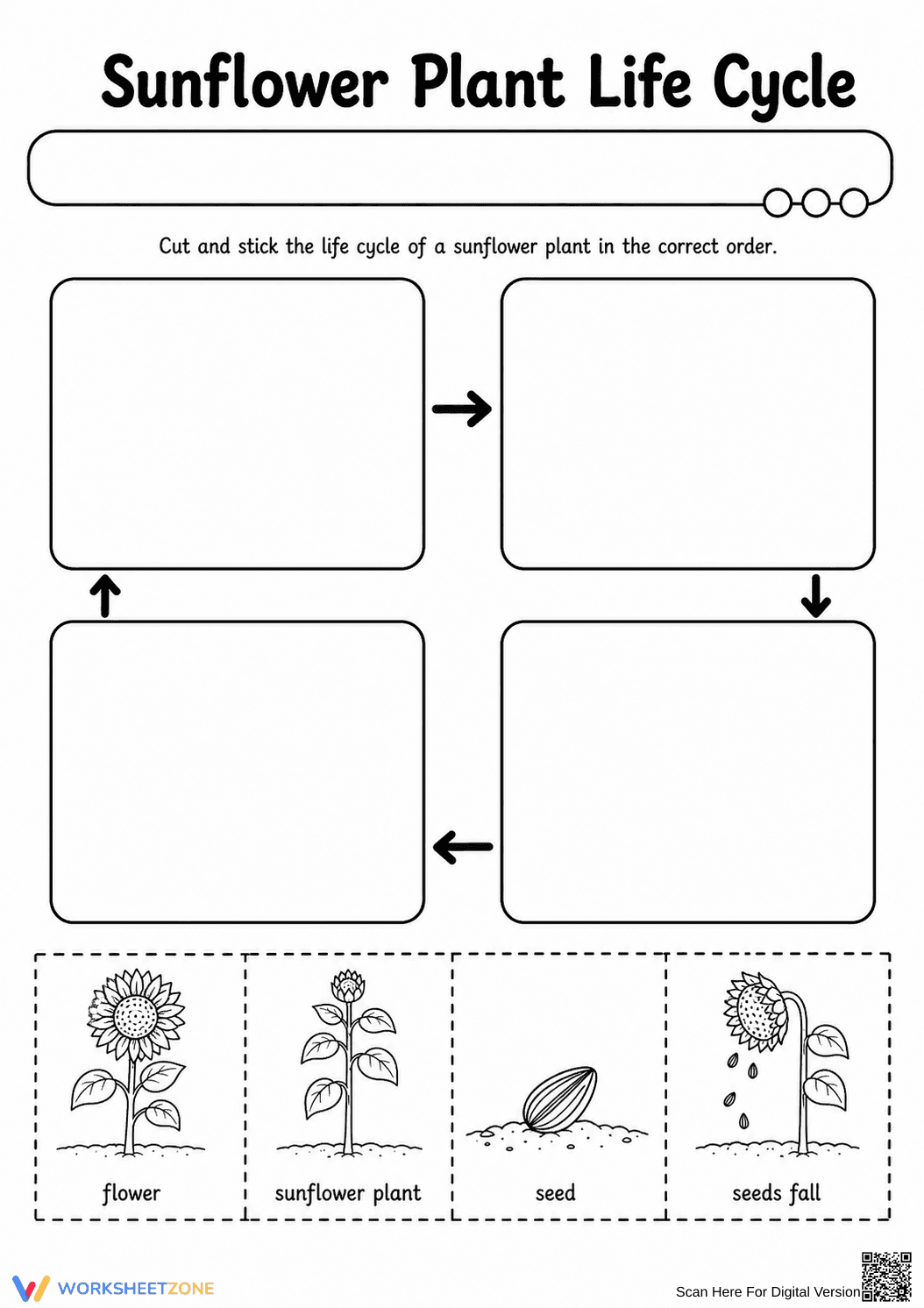
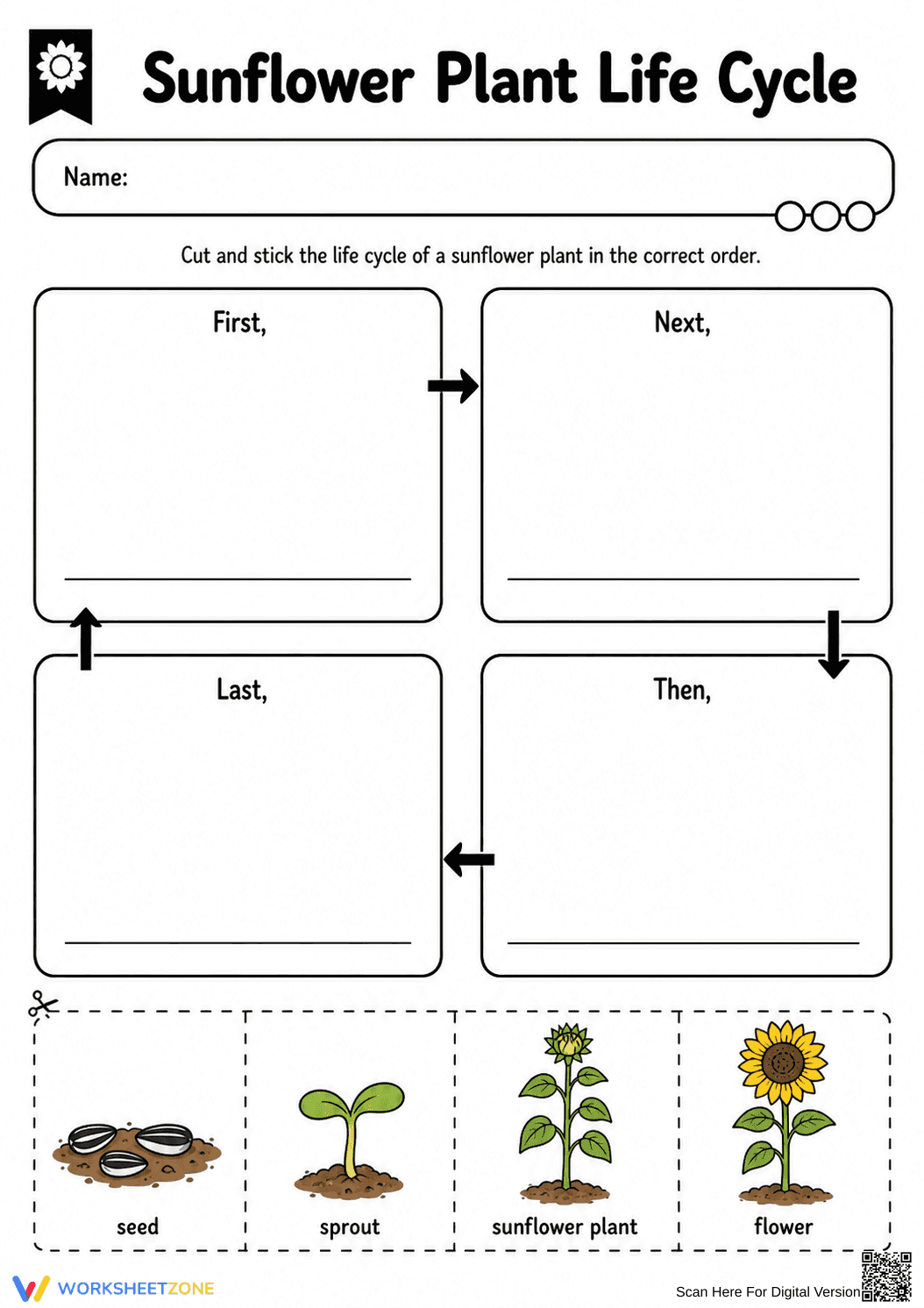
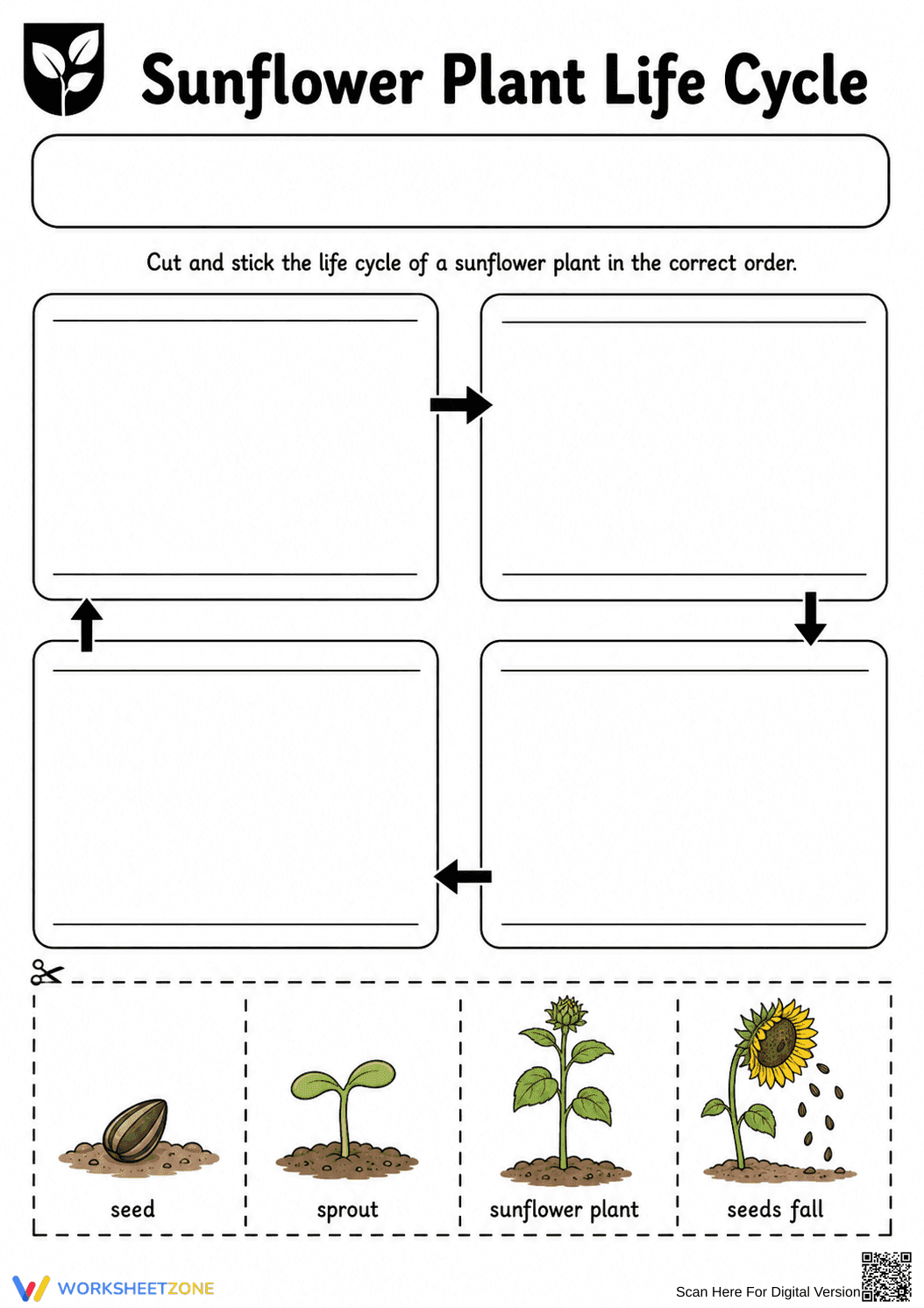
This resource includes three distinct pages designed to accommodate varying learner needs. Each page features a four-step sequencing task where students cut out images of a sunflower at different stages—seed, sprout, mature plant, and seed dispersal—and paste them into the correct cyclical order. The pages vary in their use of color, transition words, and writing prompts to provide appropriate scaffolding.
- Below grade: Features a black-and-white design with simple visual labels (flower, sunflower plant, seed, seeds fall) to minimize distractions and focus purely on the visual sequence.
- On grade: Full-color illustrations paired with explicit transition words (First, Next, Then, Last) in the sequencing boxes to guide students through the chronological progression.
- Above grade: Full-color illustrations with blank writing lines inside the sequencing boxes, requiring students to generate their own descriptive text or transition words for each stage.
All three versions are included.
This activity is aligned to the Next Generation Science Standards, specifically 3-LS1-1: Develop models to describe that organisms have unique and diverse life cycles but all have in common birth, growth, reproduction, and death. By arranging the stages of the sunflower, students are actively modeling this biological concept. Both standard codes can be copied directly into lesson plans, IEP goals, or district curriculum mapping tools.
Deploy this worksheet during the independent practice portion of a botany or life cycles unit. After direct instruction about how plants grow, distribute the leveled version to each student to check for understanding. As a formative assessment observation tip, watch how students handle the transition from mature plant to seeds falling—this reveals whether they grasp the cyclical nature of reproduction versus a simple linear timeline. Expected completion time is 15 to 20 minutes.
This resource is primarily designed for third-grade science students, though its differentiated nature makes it highly adaptable for second-grade introductions or fourth-grade review. The visual scaffolds support English Language Learners and students developing fine motor skills. It pairs perfectly with a hands-on seed planting activity or an anchor chart detailing the parts of a plant.
Effectively teaching biological processes requires instructional materials that reduce cognitive load. This differentiated activity supports standard 3-LS1-1 by having students develop models to describe organism life cycles through a hands-on sequencing task. According to an EdReports 2024 analysis, providing multiple entry points for modeling tasks significantly increases student comprehension of cyclical phenomena. By offering three distinct levels of scaffolding—ranging from basic visual matching to independent vocabulary generation—this worksheet ensures all learners can access the core concept of plant reproduction. Educators can rely on this structured approach to build foundational scientific literacy.


