


























Views
Downloads
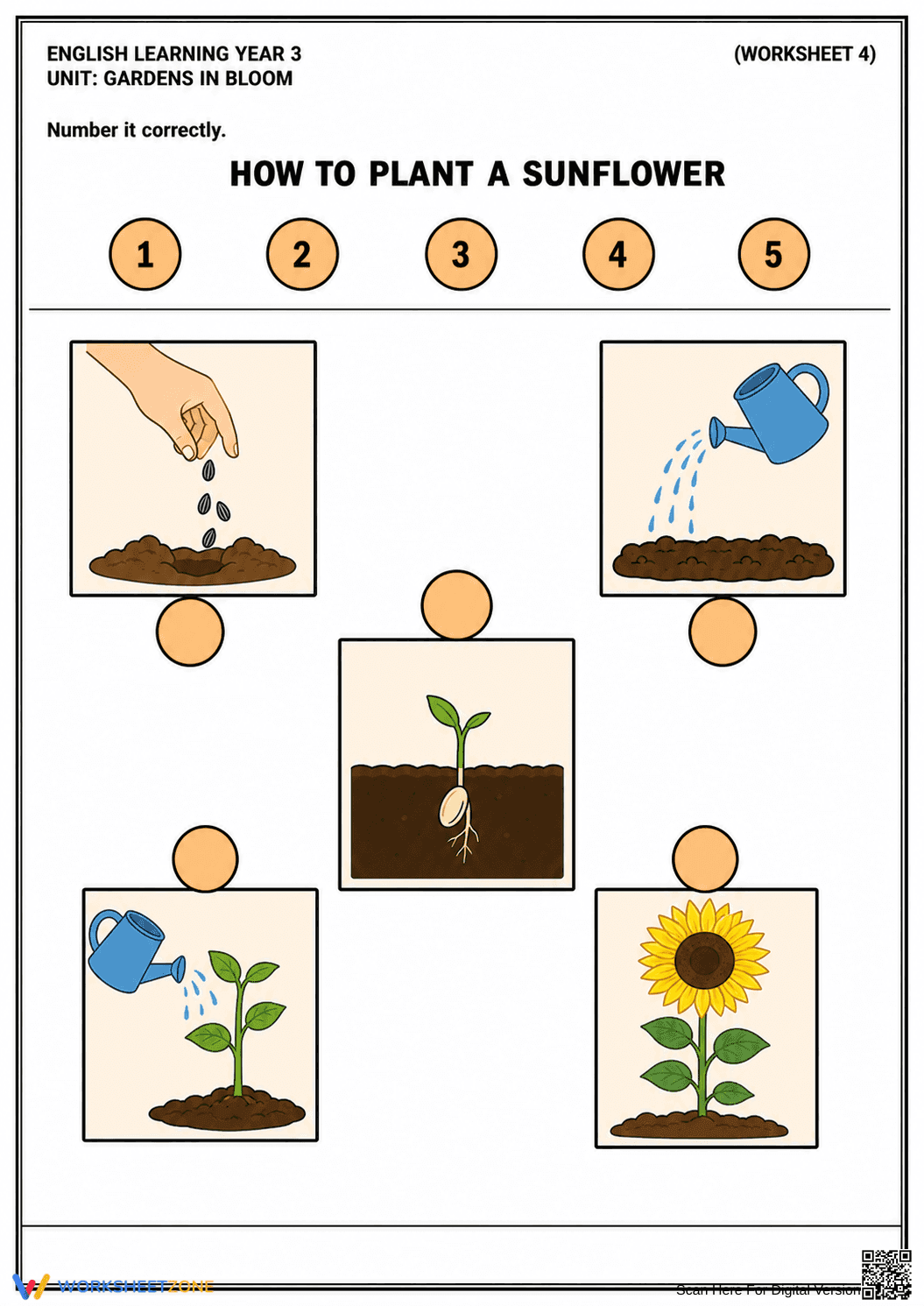

Sunflower Life Cycle Worksheet | Printable Grade 3 Science
Paste this activity's link or code into your existing LMS (Google Classroom, Canvas, Teams, Schoology, Moodle, etc.).
Students can open and work on the activity right away, with no student login required.
You'll still be able to track student progress and results from your teacher account.
This printable science worksheet helps students master the stages of plant growth by sequencing the life cycle of a sunflower. By analyzing visual cues and ordering five distinct developmental phases, young learners build foundational biology knowledge and strengthen their logical sequencing skills in one simple activity.
At a Glance
- Grade: 3 · Subject: Science
- Standard:
3-LS1-1— Sequence the developmental stages of a plant's life cycle- Skill Focus: Life Cycle Sequencing
- Format: 1 page · 5 problems · Answer key included · PDF
- Best For: Independent practice or ESL support
- Time: 10–15 minutes
Inside this resource, educators will find a single-page visual sequencing activity featuring five clear, engaging illustrations of a sunflower's growth process. Students are tasked with matching the numbers one through five to the correct images, which include sowing seeds, watering the soil, a sprouting seedling, continued watering, and a fully mature blooming sunflower. A complete answer key is provided to ensure quick and accurate grading.
This resource is designed for immediate classroom implementation with a highly efficient zero-prep workflow.
- Print (1 minute): Simply download the PDF and print the required number of copies. The black-and-white friendly design ensures crisp reproduction.
- Distribute (1 minute): Hand out the single-page activity. The visual instructions are self-explanatory, requiring minimal teacher setup.
- Review (3 minutes): Use the included answer key to quickly check student sequences or project the correct order for a whole-class self-correction session.
Total teacher preparation time is under two minutes, making this an excellent, reliable option for emergency sub plans or quick transitions.
This activity is directly aligned to 3-LS1-1: Develop models to describe that organisms have unique and diverse life cycles but all have in common birth, growth, reproduction, and death. It also supports basic chronological sequencing skills essential for early elementary cross-curricular learning. Both standard codes can be copied directly into lesson plans, IEP goals, or district curriculum mapping tools.
This worksheet serves as an excellent independent practice activity immediately following direct instruction on plant biology or spring gardening units. Teachers can also utilize it as a quick formative assessment; observe whether students correctly identify that watering the bare soil must precede the emergence of the seedling. Expected completion time ranges from 10 to 15 minutes, making it a perfect warm-up or cool-down task.
This resource is primarily designed for third-grade science students, but its heavy reliance on visual cues makes it exceptionally well-suited for English Language Learners (ELLs) and students requiring modified instructional materials. The clear, uncluttered layout minimizes cognitive overload. It pairs wonderfully with a hands-on seed planting activity or a read-aloud session featuring a book about gardens.
Mastering the chronological order of biological events is a critical stepping stone for early elementary science education. This activity targets 3-LS1-1, requiring students to sequence the developmental stages of a plant's life cycle through visual analysis. According to a recent EdReports 2024 review of elementary science curricula, integrating visual sequencing tasks significantly improves long-term retention of biological processes, particularly for students who struggle with text-heavy explanations. By physically matching numerical sequences to visual growth stages, learners solidify their understanding of cause and effect in nature. This targeted practice ensures that foundational concepts regarding birth, growth, and maturity are firmly established before students progress to more complex ecological systems in upper grades. The straightforward format provides immediate evidence of student comprehension.


