


























Views
Downloads
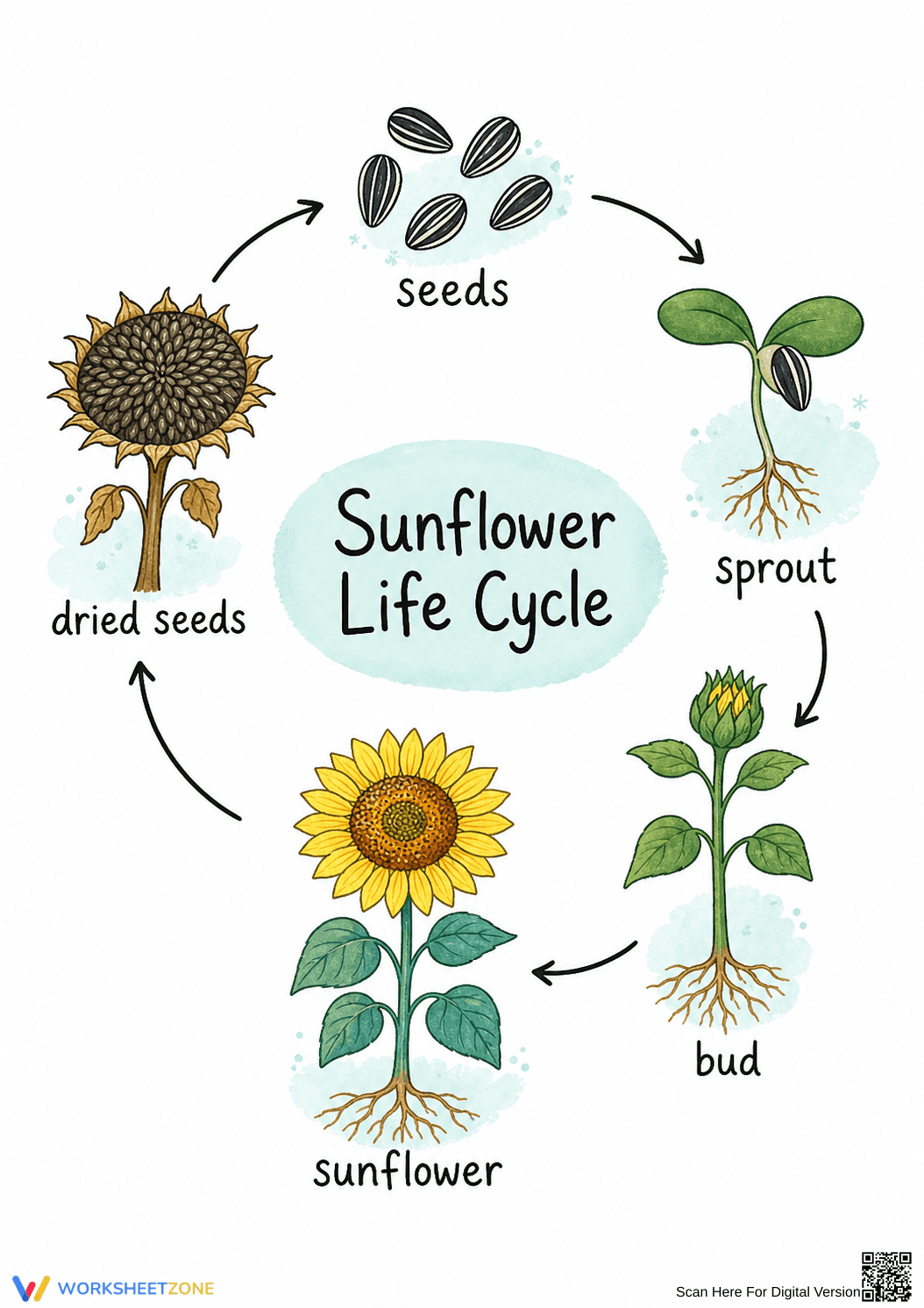

Printable Sunflower Life Cycle Worksheet | Grade 3 Science
Paste this activity's link or code into your existing LMS (Google Classroom, Canvas, Teams, Schoology, Moodle, etc.).
Students can open and work on the activity right away, with no student login required.
You'll still be able to track student progress and results from your teacher account.
This printable sunflower life cycle diagram provides students with a clear, visual model of plant growth and reproduction. By examining the five distinct stages from seed to mature plant, learners build foundational science vocabulary and understand the continuous nature of biological life cycles.
At a Glance
- Grade: 3 · Subject: Science
- Standard:
3-LS1-1— Develop models describing diverse organism life cycles- Skill Focus: Plant Life Cycles
- Format: 1 page · 5 stages · No answer key needed · PDF
- Best For: Visual reference and science centers
- Time: 10–15 minutes
This single-page resource features a beautifully illustrated, circular diagram detailing the five key stages of a sunflower's life. Students will trace the progression through seeds, sprout, bud, mature sunflower, and dried seeds. The clear directional arrows and simple, hand-drawn style illustrations make complex biological processes accessible, serving as an excellent anchor chart or interactive notebook insert.
- Print (1 minute): Easily print this single-page PDF in color or grayscale for immediate classroom use.
- Distribute (1 minute): Hand out to students as a reference guide or paste into science journals with zero teacher setup required.
- Review (5 minutes): Walk through the five stages together, prompting students to explain what happens between each illustrated step.
With under two minutes of total teacher prep time, this resource is highly effective for busy educators and makes a reliable addition to any science substitute plan.
Aligned to primary standard 3-LS1-1: Develop models to describe that organisms have unique and diverse life cycles but all have in common birth, growth, reproduction, and death. This visual model directly supports the standard by illustrating the continuous loop of plant reproduction. Both standard codes can be copied directly into lesson plans, IEP goals, or district curriculum mapping tools.
Use this diagram during direct instruction to introduce a new botany unit, projecting it on the smartboard while students follow along. Alternatively, place it in a science center where students can use it as a reference to create their own 3D life cycle models. As a formative assessment observation tip, ask students to cover the labels and verbally explain the transition from bud to dried seeds. Expected completion and review time ranges from 10 to 15 minutes.
This resource is designed for elementary science students, particularly those in third grade mastering life cycle concepts. The highly visual nature makes it an excellent differentiation tool for English Language Learners (ELLs) and visual learners who benefit from clear imagery paired with simple text. It pairs perfectly with hands-on seed planting activities or informational texts about plant biology.
Understanding biological progressions through visual models is a critical component of early science education. By mastering the Plant Life Cycles outlined in standard 3-LS1-1, students develop a foundational schema for how living organisms grow, reproduce, and sustain their species over time. According to a ScienceDirect TpT Analysis, integrating clear, sequential diagrams into elementary science instruction significantly improves vocabulary retention and conceptual understanding of cyclical processes. When students can visually trace the journey from a tiny seed to a sprouting plant, a blooming flower, and finally back to dried seeds, they internalize the continuous loop of nature. This visual approach ensures that abstract biological concepts become concrete, observable phenomena for young learners. Providing these structured visual aids supports long-term academic success in STEM disciplines, allowing educators to build a robust framework for future scientific inquiry and environmental awareness.


