These 2nd grade solid liquid gas worksheets give teachers a ready-to-print set of focused practice resources for one of the most conceptually uneven units in early elementary science — states of matter. Solids come easily to most second graders. Gases take genuine teaching. Each worksheet targets a specific skill: sorting real-world objects by state, describing observable properties in writing, or recording how a substance behaves when moved between containers, so students build the concrete mental categories they need before physical science becomes more abstract in third grade.
What's Inside the Set
The worksheets divide across four skill strands, each asking students to think about matter in a different way:
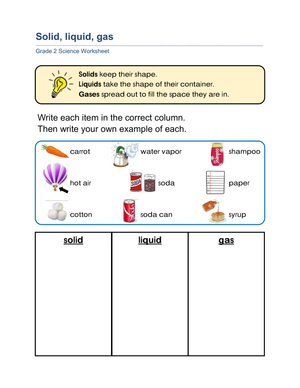
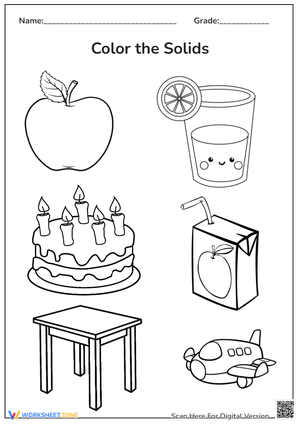
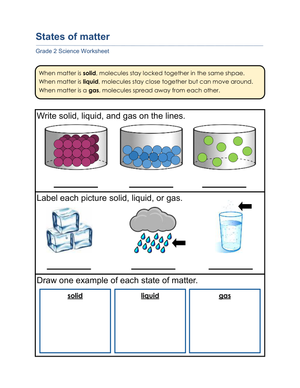
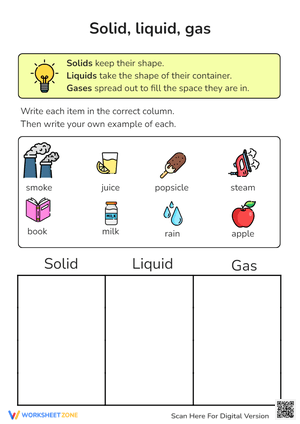
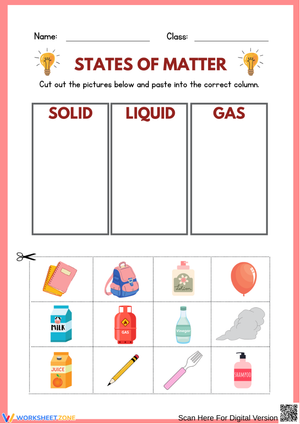
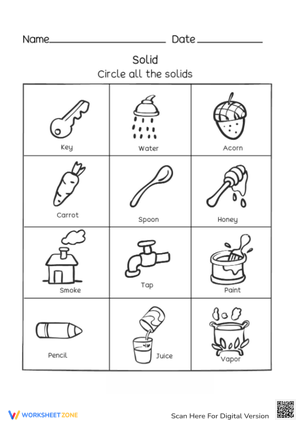
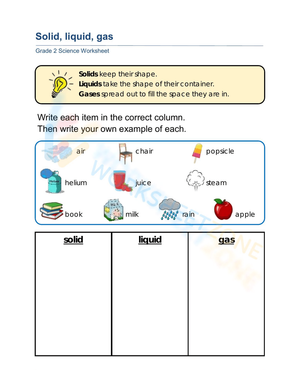
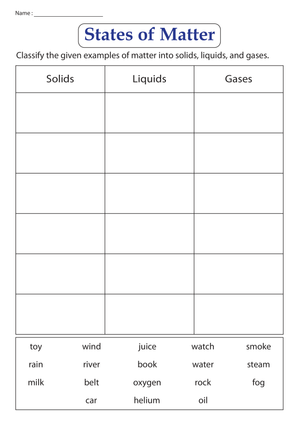
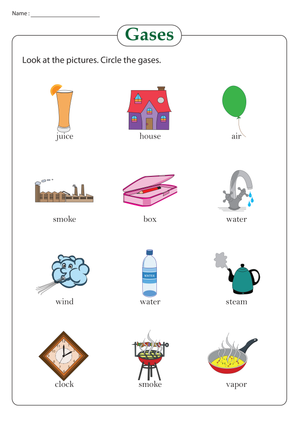
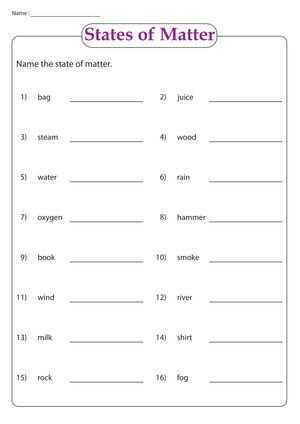
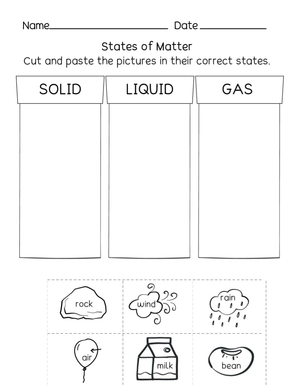
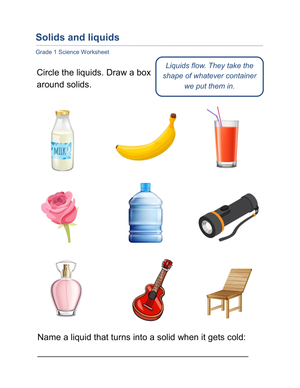
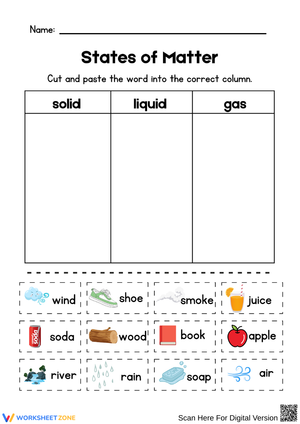
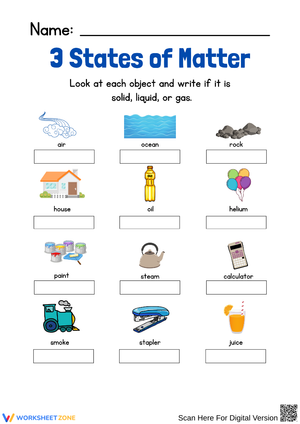
- Sorting and classifying: Students sort images of everyday objects — an ice cube, a juice box, steam rising from a kettle, a rubber ball — into solid, liquid, or gas categories. Several worksheets add a written justification line, requiring students to name one observable property that guided the sort rather than just circling an answer.
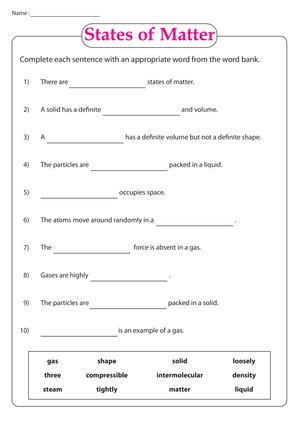
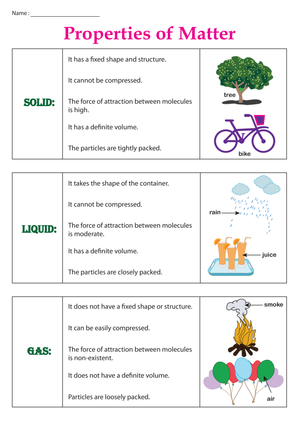
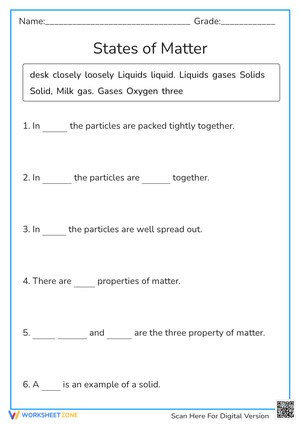
- Property description: Students select or write descriptive words (hard, flows, expands, keeps its shape) for each state of matter. This builds the vocabulary students need to explain their reasoning in science discussions, not only to complete a task.
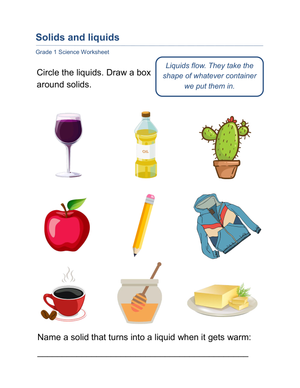
- Container-and-shape tasks: Students draw the same substance in two differently shaped containers, then mark whether it held its shape or adapted to the container. This directly targets the liquid-versus-solid distinction that trips up second graders most reliably.
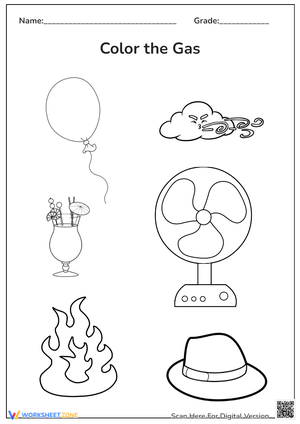
- Gas identification: Students identify objects that contain gas — an inflated basketball, a sealed soda bottle, the air in the classroom — and label them. These tasks require accepting that matter can be invisible, which is a harder conceptual step at this age than recognizing a solid or a liquid.
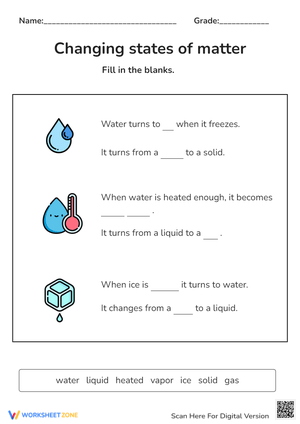
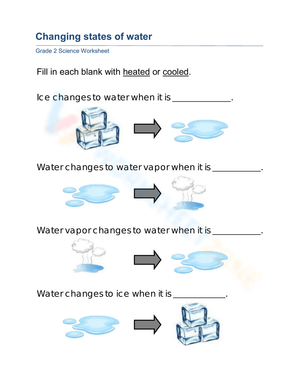
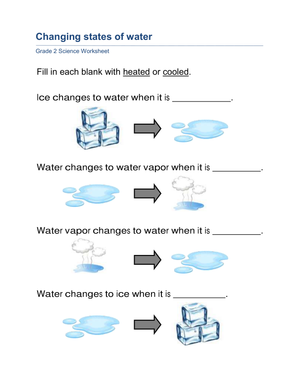
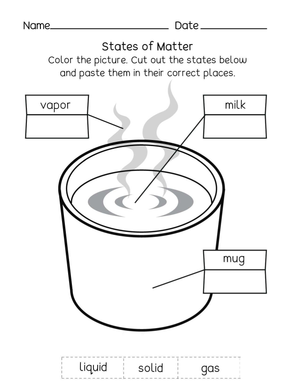
Several worksheets in the set use water as a through-line, presenting ice, liquid water, and steam as the same substance in different states. This gives teachers a natural bridge between the sorting tasks and a brief ice-melting demonstration before or after the worksheet work.
Where Students Reliably Go Wrong in the States of Matter Unit
The most persistent errors in this unit don't cluster around solids — most seven-year-olds walk into the unit already knowing that a rock keeps its shape. The predictable confusion lives with liquids and gases, and it follows recognizable patterns.
With liquids, the conservation-of-volume problem shows up fast. A student who correctly labels water as a liquid will still insist there's more water when it's poured from a narrow cup into a wide, shallow bowl, because the water level looks lower. This is a documented stage in Piagetian development — many second graders haven't crossed the conservation threshold yet. The container-and-shape worksheets don't resolve this in a single sitting, but they produce a written artifact teachers can return to. When a student has drawn the same amount of liquid filling two different container shapes, the worksheet becomes a reference point for a follow-up conversation rather than an abstract debate.
With gases, the error is more fundamental: students write "nothing" or leave the gas column entirely blank in sorting tasks. They understand that air exists in daily life, but they don't process it as matter. The gas-identification worksheets address this by pairing each gas example with a visible effect — the stretched rubber of a balloon, the carbonation bubbles in a sealed bottle — so students anchor the invisible substance to something observable.
One smaller but stubborn error: students call steam "smoke" and classify it as a solid. Asking "Does smoke keep a definite shape? Does it spread out to fill the room?" guides students to apply the property test rather than just correcting the label, and the steam worksheet gives them a place to write that reasoning out.
Building These Worksheets Into Your Weekly Science Block
The two-day sequence works well for most of the content-heavy worksheets in the set. On day one, run the hands-on demonstration — melt an ice cube, pour water between containers with different shapes, inflate a balloon and tie it off. On day two, hand out the corresponding worksheet as a structured processing activity before independent work. Students who watched the ice melt the previous afternoon can now draw and label what happened, moving the observation out of short-term memory and into something documented and revisable.
For science centers, the sorting worksheets function cleanly as a paired-student activity. Completed worksheets give teachers a fast scan of who sorted correctly and who guessed — a much clearer signal than circulating and asking during the demo. The 2nd grade solid liquid gas worksheets set also holds up as a Friday review tool during the last ten minutes of the science block: one worksheet, no new instruction, straightforward retrieval practice on the three categories before the weekend.
One honest limitation worth naming: the property-description worksheets frustrate students who read below grade level, because the written justification lines require more than drawing or circling. For those students, providing a word bank or allowing partner dictation before writing removes the language barrier without reducing the science thinking. The sorting and container tasks don't carry that barrier and run well at independent stations without modification.
Standard Alignment
This set addresses NGSS 2-PS1-1, which requires second graders to plan and conduct investigations to describe and classify different kinds of materials by their observable properties — hardness, flexibility, texture, and how a material behaves in or out of a container. The sorting and property-description worksheets target the classification goal directly. The container-and-shape tasks connect to the investigation component: students record what they observe when matter changes containers, not just recite definitions.
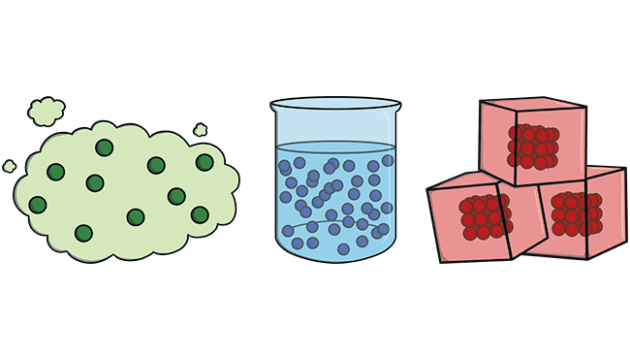
The deliberate restraint in these worksheets is worth noting. NGSS 2-PS1-1 precedes the 5th-grade work on physical and chemical change (5-PS1-4), so the vocabulary stays at the observable level — no particle diagrams, no molecular language. Second graders describe what they see and feel. That constraint is developmentally appropriate, and it keeps the standard within actual reach for this age group.
Matching the Set to Your Range of Learners
For students who need more support, the visual structure of the sorting worksheets carries a lot of the load — images rather than text, clear three-column layouts with labeled headers. Teachers can reduce the number of items to sort on any given worksheet, or pre-sort one column before copying so students only need to complete the remaining two. A simple reference card showing one image and one key property for each state — solid: keeps its shape; liquid: flows and takes the shape of its container; gas: spreads out to fill the space — gives students a check without requiring the teacher to be at the table.
For students who move through the basic sorting tasks quickly, the written-justification lines push thinking further. Ask those students to find a counterexample: an object that seems like it might be a liquid but is actually a solid, and write a brief argument for why. Oobleck — a cornstarch-and-water mixture that resists like a solid under pressure but flows like a liquid when relaxed — works as an extension discussion for this group. The 2nd grade solid liquid gas worksheets set doesn't cover non-Newtonian fluids, but a brief teacher-led conversation about why oobleck resists easy classification extends the same evidence-based reasoning the worksheets develop.
Frequently Asked Questions
How do these worksheets align with NGSS 2-PS1-1?
Each worksheet targets the observable-properties component of 2-PS1-1 — asking students to classify materials based on what they can see, touch, or detect. The container-and-shape tasks align most closely with the investigation component, since students record how a substance behaves rather than simply naming it. Completed worksheets serve as written evidence of student performance on this standard during a portfolio review or unit assessment.
What's the most effective way to help students accept that gas is real matter?
Inflate a balloon and tie it off. Ask students to squeeze it — they feel resistance. Then place it on a scale next to an identical deflated balloon; the inflated one registers more weight (barely, but measurably with a sensitive classroom scale). Ask: "If there's nothing inside, why does it push back? Why does it weigh more?" That physical experience makes the case before any worksheet does. The 2nd grade solid liquid gas worksheets gas-identification tasks work best right after this moment, giving students a place to name what they just felt and record it as evidence that gas is matter.
Can the sorting worksheets work as a pre-assessment before instruction begins?
Yes — and it's worth doing on day one before any teaching. The response pattern tells you a lot immediately: students who nail all three columns are ready to move into property description; students who get solids right but leave gas blank are in the majority for this age; students who mix up solids and liquids need the foundations covered more carefully before moving on. That sorting pattern shapes how much time to spend on each state during the unit.
How does the set handle the steam-versus-smoke confusion that comes up every year?
The steam worksheets steer students toward the answer through guided questions rather than correction: does steam keep a definite shape? Does it spread out to fill the space around it? Students apply the same observable-property test they've been using across the whole set, which reinforces the method rather than just fixing the specific label. The goal at this grade level is that students can use the test, not that they understand evaporation at a molecular level.












 Interactive Worksheet Maker
 Quiz Maker
 Word Search Maker
 Crossword Puzzle Maker
 Word Scramble Generator
 Sentence Scramble Generator
 Handwriting Worksheet Generator
 Name Tracing Generator
 Fill In The Blank Generator