




























Views
Downloads

Essential Identify the Gases Worksheet | Grade 2-3 Science

Paste this activity's link or code into your existing LMS (Google Classroom, Canvas, Teams, Schoology, Moodle, etc.).
Students can open and work on the activity right away, with no student login required.
You'll still be able to track student progress and results from your teacher account.
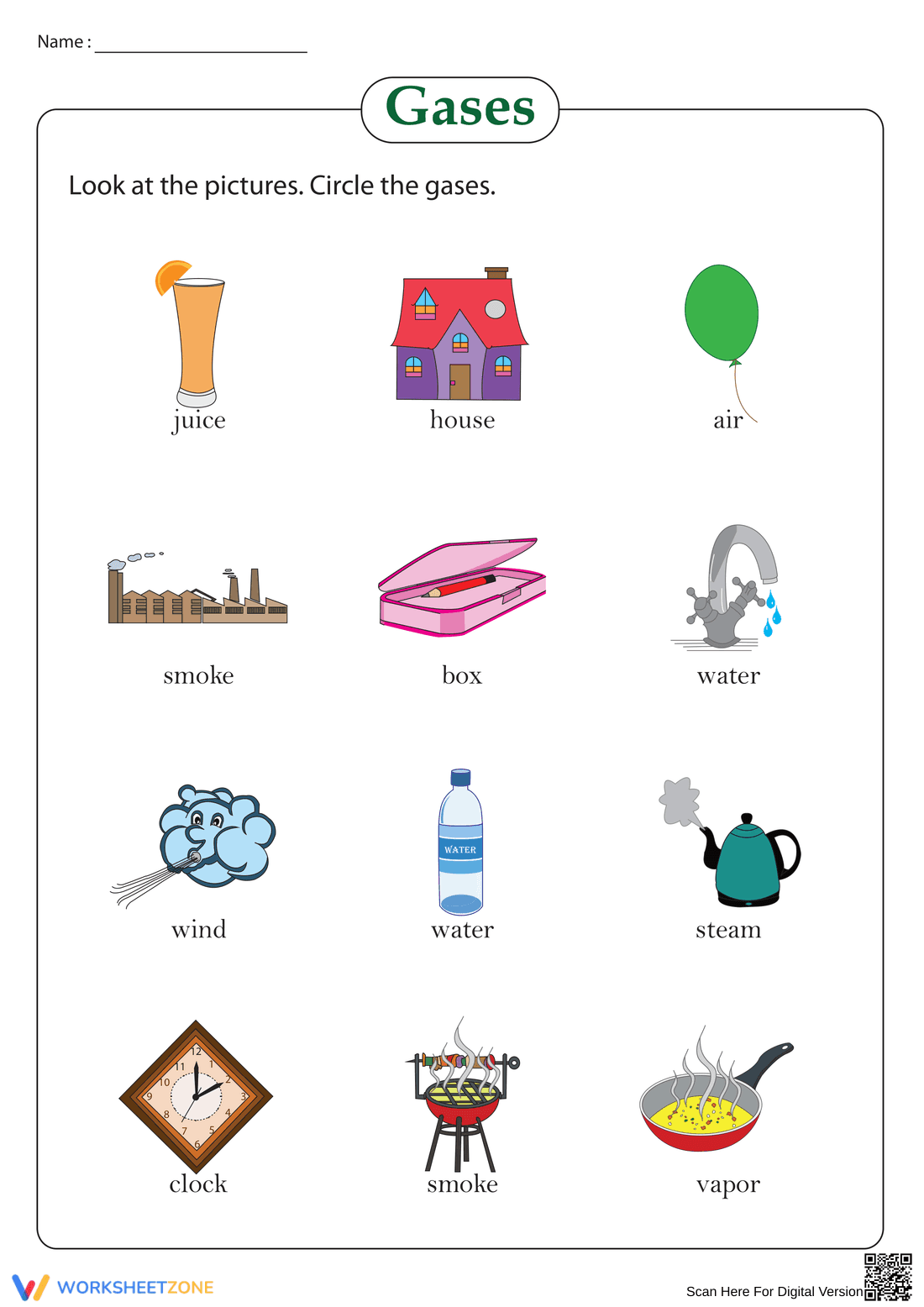
This Grade 2-3 "Identify the Gases" worksheet helps students distinguish between solids, liquids, and gases through visual classification. By analyzing everyday objects and phenomena, learners build a foundational understanding of states of matter. This resource ensures students can accurately categorize substances based on their observable physical properties, improving their scientific vocabulary and observation skills.
At a Glance
- Grade: 2-3 · Subject: Science
- Standard:
2-PS1-1— Classify different kinds of materials by their observable properties- Skill Focus: Identifying gases
- Format: 1 page · 12 problems · Answer key included · PDF
- Best For: Introduction to states of matter
- Time: 10–15 minutes
The worksheet features twelve distinct illustrations including household objects like clocks, liquids like juice, and various gases such as steam and vapor. Students are tasked with circling only the items that represent gases. This one-page PDF includes a clear title and a dedicated space for student names, making it easy to track individual progress during the lesson.
The three-step workflow is optimized for busy educators: Print (30 seconds), Distribute (30 seconds), and Review (5 minutes). Total teacher preparation time is under two minutes, allowing you to focus on instruction rather than administrative tasks. Its clear instructions and self-contained format make it an ideal choice for emergency sub plans or independent morning work.
The primary alignment is to NGSS 2-PS1-1, which requires students to "plan and conduct an investigation to describe and classify different kinds of materials by their observable properties." This worksheet provides a controlled environment for the classification portion of the standard. Both standard codes can be copied directly into lesson plans, IEP goals, or district curriculum mapping tools.
Use this worksheet during the "Explain" or "Evaluate" phase of a 5E lesson on matter. It serves as an effective formative assessment tool; while students work, observe whether they correctly identify "wind" and "steam" as gases, which are often trickier than liquid water. The expected completion time is ten to fifteen minutes, providing a focused burst of scientific inquiry.
This worksheet is tailored for second and third-grade elementary students. It is particularly helpful for visual learners and English Language Learners (ELLs) due to the clear, labeled illustrations. It pairs naturally with a "States of Matter" anchor chart or a hands-on demonstration involving melting ice or boiling water to show transitions between phases.
Classification tasks in early science education are critical for developing cognitive frameworks. According to RAND AIRS 2024, utilizing visual aids to categorize matter helps students transition from concrete observation to abstract scientific reasoning. This worksheet focuses on the 2-PS1-1 standard, enabling children to identify the unique properties of gases compared to solids and liquids. Research from ScienceDirect TpT Analysis indicates that high-quality, labeled illustrations reduce the cognitive load for Grade 2 and Grade 3 learners, allowing them to focus on the core concept of phase identification. Identifying smoke and vapor builds the prerequisite knowledge for middle-school chemistry concepts. This 12-task exercise provides the structured practice necessary for mastery of the states of matter, ensuring that students can reliably distinguish between different kinds of materials based on observable traits in a variety of contexts.


