


























Views
Downloads
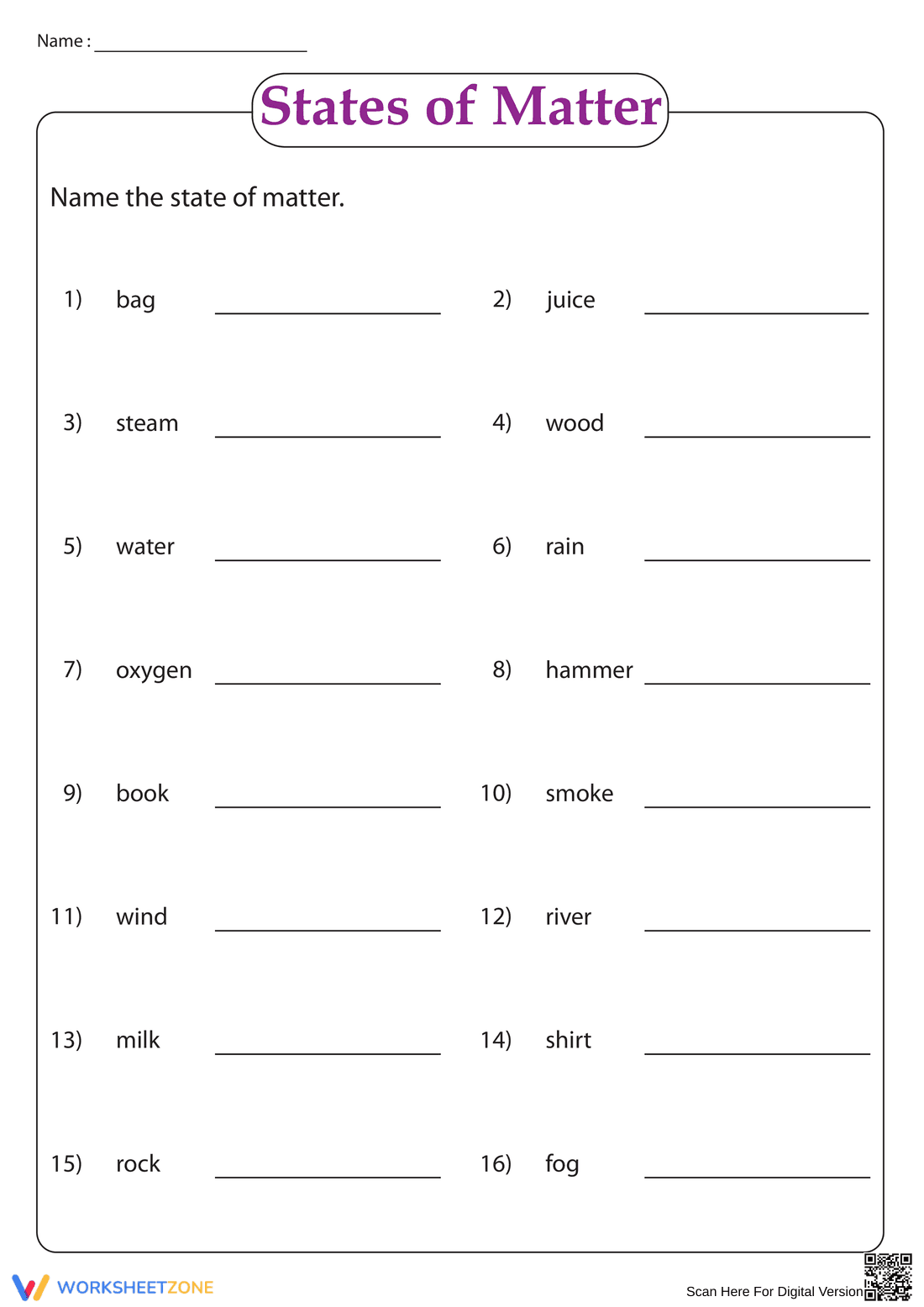

Printable States of Matter Worksheet | Grade 2-3 Science
Paste this activity's link or code into your existing LMS (Google Classroom, Canvas, Teams, Schoology, Moodle, etc.).
Students can open and work on the activity right away, with no student login required.
You'll still be able to track student progress and results from your teacher account.
This Grade 2 and Grade 3 states of matter worksheet provides a clear, focused environment for students to master the classification of physical substances. By identifying common items like steam, wood, and juice, learners build a concrete understanding of how matter exists in different forms. Students achieve immediate success through direct labeling practice that reinforces core scientific vocabulary and observation skills.
At a Glance
- Grade: 2–3 · Subject: Science
- Standard:
2-PS1-1— Classify different kinds of materials by their observable properties- Skill Focus: States of Matter (Solid, Liquid, Gas)
- Format: 1 page · 16 problems · Answer key included · PDF
- Best For: Mid-lesson check or science sub plans
- Time: 10–15 minutes
This single-page resource features 16 distinct tasks requiring students to categorize items into the three primary states: solid, liquid, or gas. The layout is clean and distraction-free, providing ample space for written responses. A comprehensive answer key is included to facilitate rapid grading or self-correction, ensuring the resource is ready for immediate classroom implementation.
Zero-Prep Workflow
- Print (30 seconds): Simply print the single-page PDF for your entire class.
- Distribute (1 minute): Pass out the worksheets for an independent or guided practice session.
- Review (5 minutes): Use the included answer key to check student understanding in real-time or as a group.
Total teacher preparation time is under two minutes, making this an ideal choice for morning work, fast finishers, or emergency substitute plans where time is of the essence.
This resource is primarily aligned to 2-PS1-1. The standard requires students to describe and classify different kinds of materials by their observable properties. By categorizing objects based on their inherent physical states, students demonstrate mastery of material properties. This standard code can be copied directly into lesson plans, IEP goals, or district curriculum mapping tools.
Use this worksheet as a mid-lesson check for understanding after introducing the properties of solids, liquids, and gases. It also serves as an effective exit ticket to assess individual student progress before moving on to molecular structure or phase changes. Teachers should observe if students struggle with atmospheric items like fog or smoke to address common misconceptions about gas versus liquid particulates.
The worksheet is designed for general elementary science students in second or third grade, providing necessary scaffolds through familiar everyday objects. It pairs naturally with a states of matter anchor chart or a hands-on "mystery bag" observation lesson. For differentiated support, consider providing a small word bank of "Solid," "Liquid," and "Gas" for students requiring extra visual cues.
This States of Matter resource adheres to the rigorous classification demands of 2-PS1-1, ensuring students can accurately differentiate between solids, liquids, and gases using observable data points. According to the ScienceDirect TpT Analysis, high-quality supplementary materials that offer immediate application of scientific concepts significantly improve student retention of domain-specific vocabulary. By engaging with 16 varied examples, from atmospheric phenomena like steam to tangible objects like a hammer, students develop a more robust mental model of physical properties. The repetition inherent in this labeling task provides the necessary cognitive reinforcement to move these concepts from short-term memory to long-term mastery. This worksheet serves as a vital bridge between direct instruction and independent investigation, allowing educators to quantify student progress with ease and precision. It remains a staple for elementary science curricula focused on evidence-based classification and the foundational principles of physical science.


