




























Views
Downloads


Essential Changing States of Water Worksheet | Grade 2

Paste this activity's link or code into your existing LMS (Google Classroom, Canvas, Teams, Schoology, Moodle, etc.).
Students can open and work on the activity right away, with no student login required.
You'll still be able to track student progress and results from your teacher account.
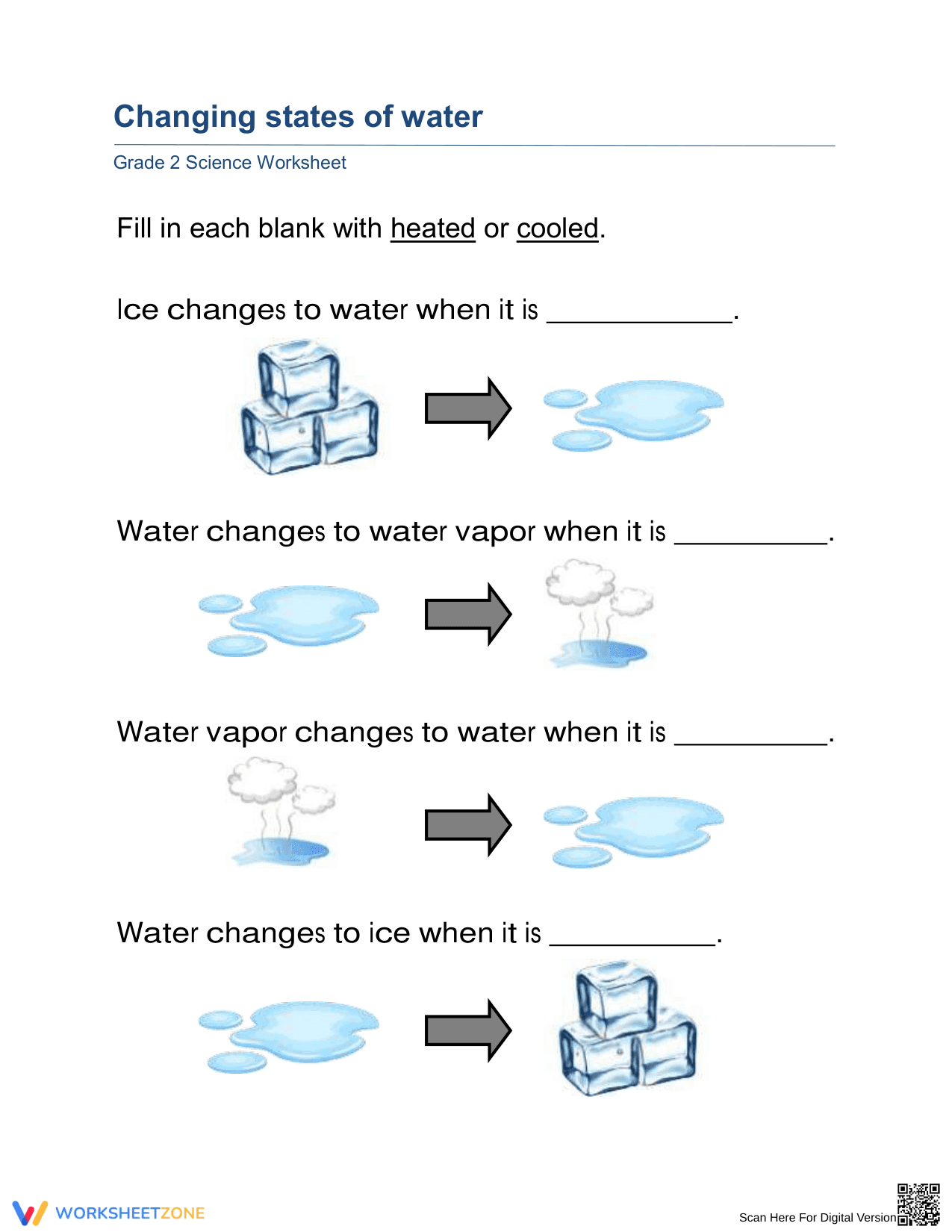
Students identify how thermal energy transfers cause water to change states. This Grade 2 science worksheet focuses on the observable transitions between ice, liquid water, and water vapor. By determining if heat is added or removed, learners build a foundational understanding of reversible phase changes and the properties of matter in different thermal conditions.
At a Glance
- Grade: 2 · Subject: Science
- Standard:
2-PS1-4— Construct an argument that changes caused by heating or cooling can be reversed- Skill Focus: Water phase changes (heating/cooling)
- Format: 1 page · 4 problems · Answer key included · PDF
- Best For: Independent practice and quick formative assessment
- Time: 10–15 minutes
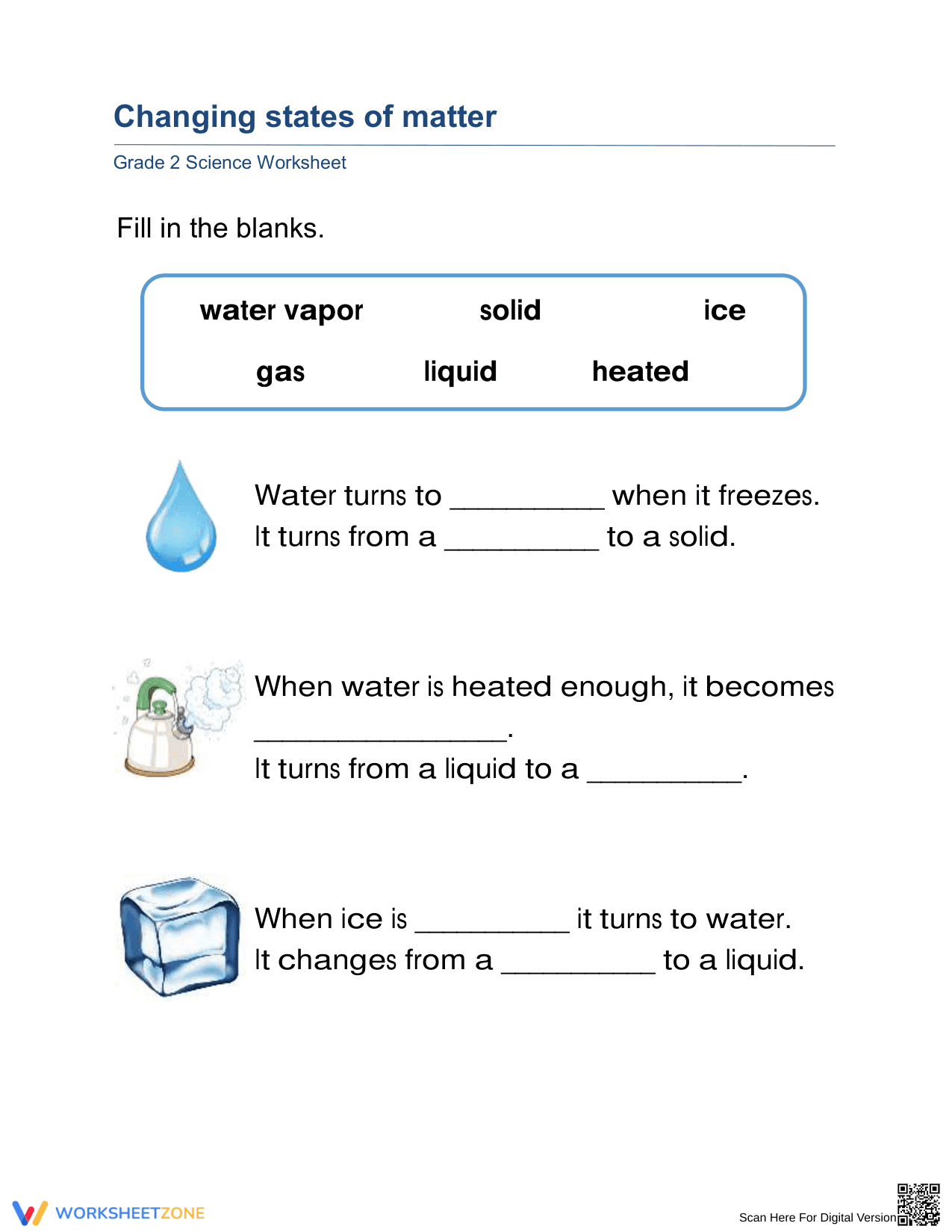
This single-page PDF features four clear diagrams illustrating the physical transformation of water. Each task provides a visual cue—such as ice cubes melting into a puddle or clouds forming steam—and requires students to select the correct thermodynamic process: "heated" or "cooled." The layout includes ample writing space and a focused word bank to support vocabulary acquisition.
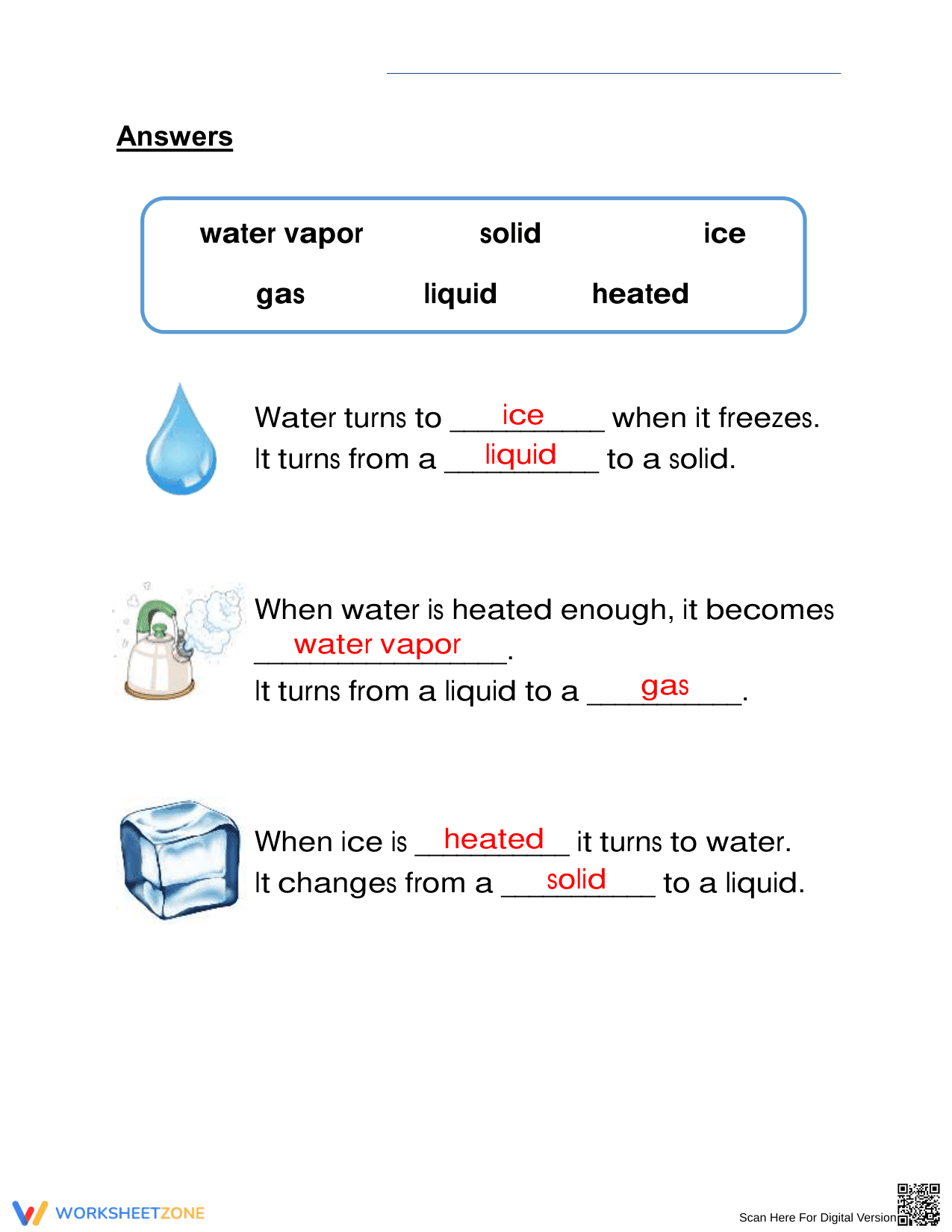
Integrating this resource into your science block requires minimal effort. First, print the single-page document (30 seconds). Next, distribute as a transition activity (1 minute). Finally, review with the answer key (30 seconds). Total prep is under two minutes, ideal for substitute plans.
Aligned to 2-PS1-4 — Construct an argument with evidence that some changes caused by heating or cooling can be reversed and some cannot. This resource ensures students gather evidence for reversible changes. This standard code can be copied directly into lesson plans, IEP goals, or district curriculum mapping tools.
Use this as a check for understanding after an ice lab. Alternatively, assign it as morning work before a water cycle lesson. Observe if students differentiate vapor from liquid to identify intervention needs.
Designed for second-grade students, this resource includes visual scaffolds for ELLs. It pairs naturally with an anchor chart on freezing points and direct instruction on molecular behavior during thermal energy transfer.
The efficacy of visual scaffolds and immediate feedback in elementary science is well-documented in the ScienceDirect TpT Analysis (2024), which emphasizes that structured practice on standard 2-PS1-4 significantly improves student retention of thermodynamic concepts. This worksheet leverages a targeted model by providing clear visual representations that bridge the gap between abstract phase changes and concrete observable events. By focusing on the specific student action of identifying heating or cooling as the catalyst for water's state changes, the material ensures that learners move beyond rote memorization toward a conceptual understanding of reversible physical changes. Research indicates that when students engage with high-frequency vocabulary like "heated" and "cooled" in a contextualized science environment, they are more likely to apply these terms accurately in subsequent laboratory observations. This 15-minute activity provides the high-leverage practice required for mastery of foundational physical science standards in early childhood education.


