




























Views
Downloads

Essential Solids and Liquids Worksheet | Grade 1-2 Science

Paste this activity's link or code into your existing LMS (Google Classroom, Canvas, Teams, Schoology, Moodle, etc.).
Students can open and work on the activity right away, with no student login required.
You'll still be able to track student progress and results from your teacher account.
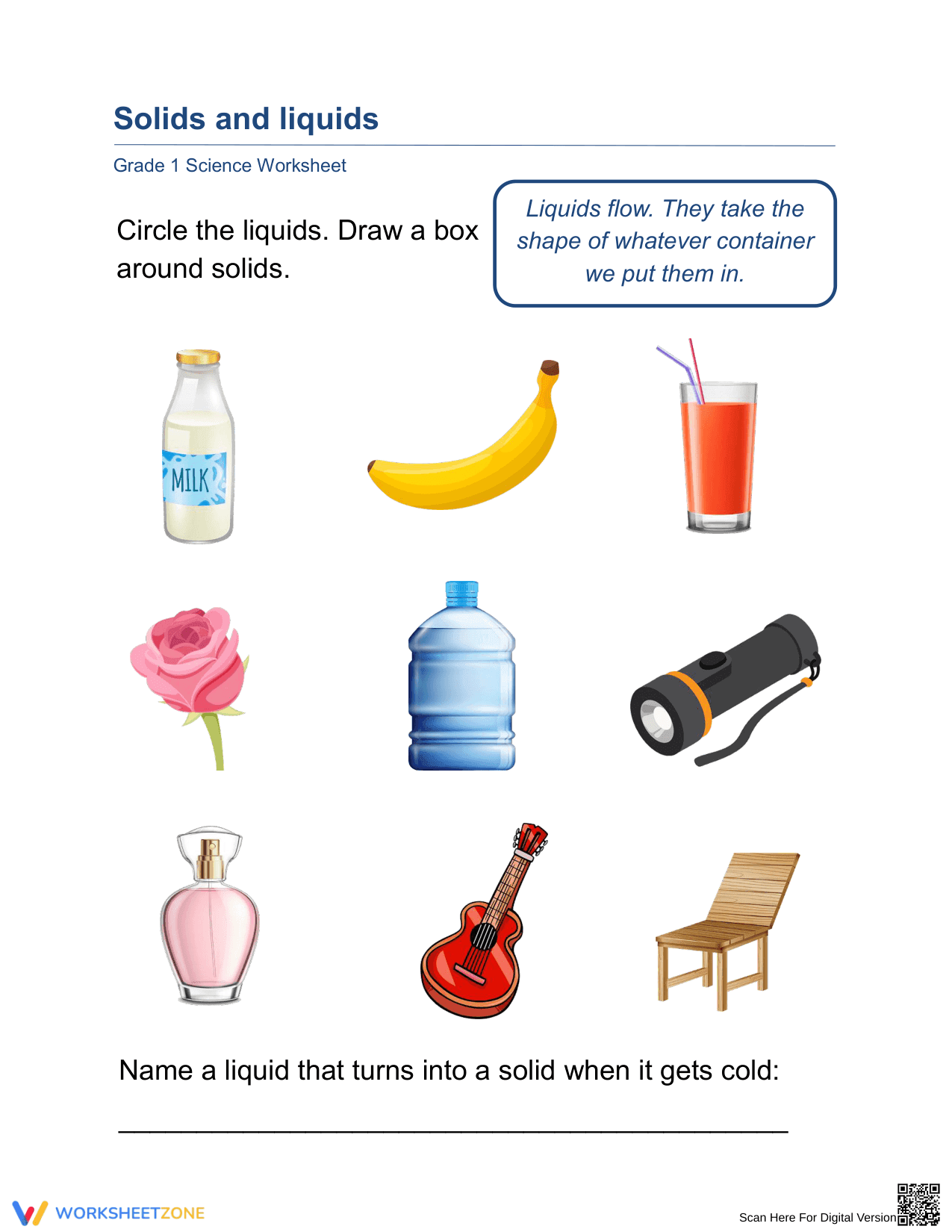
Students master the fundamental differences between matter states with this focused solids and liquids classification worksheet. By identifying observable properties and categorizing everyday objects, learners build the conceptual foundation necessary for advanced physical science. This resource ensures students can distinguish between stable solids and flowing liquids through active engagement and critical thinking.
At a Glance
- Grade: 1-2 · Subject: Science
- Standard:
2-PS1-1— Classify different materials based on their observable physical properties like shape and flow- Primary Skill Focus: States of Matter (Solids vs. Liquids)
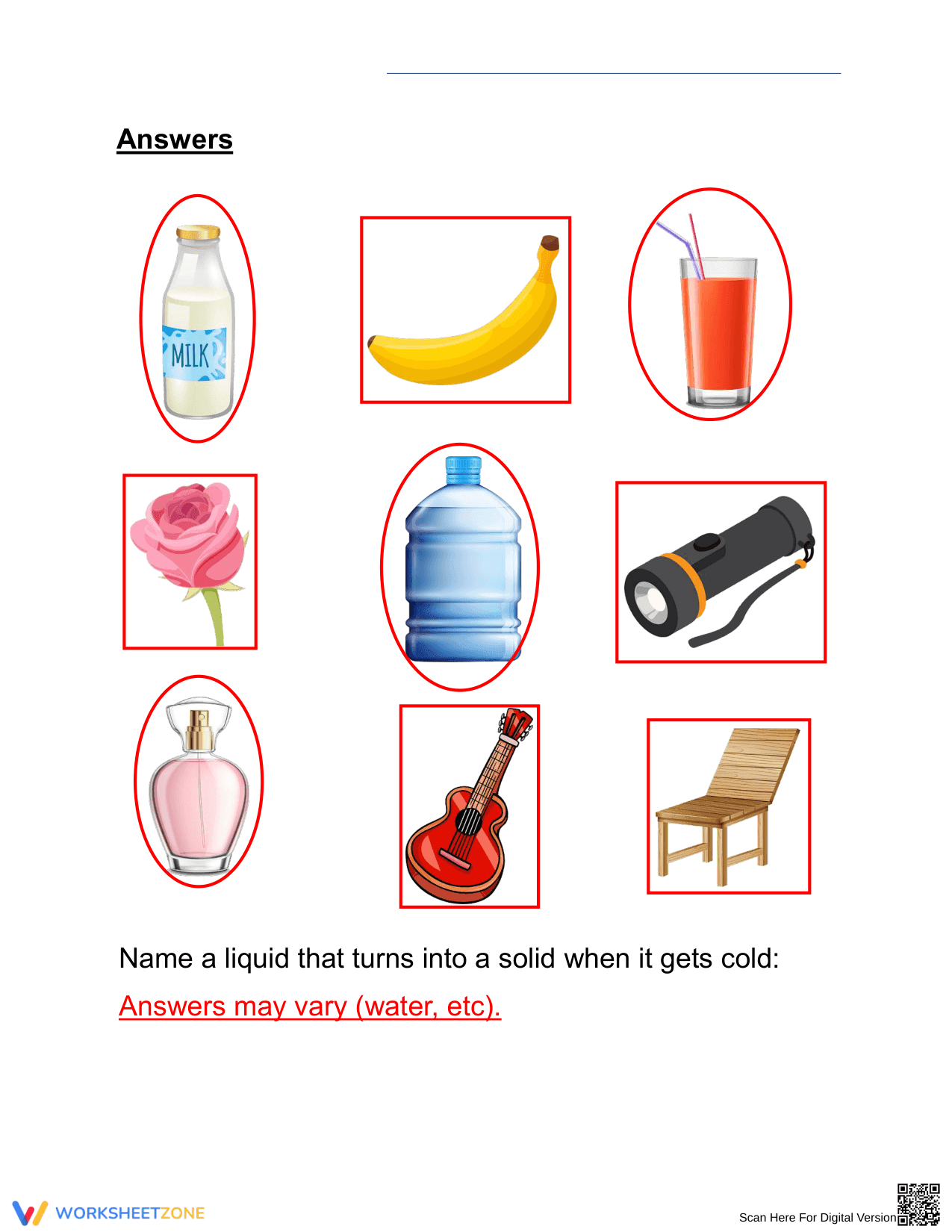
- Format: 1-page high-resolution PDF · 10 targeted problems · Full answer key included · Digital ready
- Best For: Independent student practice and elementary science centers
- Time: 10–15 minutes
What's Inside
This single-page PDF features 10 distinct challenges designed to reinforce state-of-matter concepts. The primary task includes 9 high-quality illustrations of common objects—ranging from juice and milk to guitars and chairs—requiring students to apply classification rules. A concluding open-ended prompt encourages higher-order thinking by asking students to identify substances that undergo phase changes when cooled. A complete answer key is provided for rapid grading.
Zero-Prep Workflow
The zero-prep design integrates into your science block in under 2 minutes. Step one: Print the single-page PDF (30 seconds). Step two: Distribute during your 'Matter' unit or as a quick morning work task (30 seconds). Step three: Review results using the included key for immediate formative feedback (60 seconds). This streamlined workflow makes it an ideal choice for substitute lesson plans or last-minute reinforcement.
Standards Alignment
Aligned to `2-PS1-1`, this worksheet supports the requirement for students to plan and conduct investigations to describe and classify different kinds of materials by their observable properties. It specifically targets the crosscutting concept of patterns, as students must recognize the repeating characteristics of solids and liquids across various items. Both standard codes can be copied directly into lesson plans, IEP goals, or district curriculum mapping tools.
How to Use It
Use this worksheet as a 'check for understanding' immediately following a hands-on exploration of containers and shapes. During the activity, observe if students use the 'flow' or 'fixed shape' criteria to justify their choices. It also functions perfectly as an exit ticket or a standalone homework assignment to involve parents in identifying states of matter in the home. Expect completion in approximately 12 minutes.
Who It's For
Designed for primary learners in first and second grade, this resource features visual scaffolds to support emerging readers and English Language Learners. It pairs naturally with anchor charts describing the properties of matter or a directed reading passage about phase changes. The clear illustrations ensure that the scientific concept remains the primary focus for all learners regardless of reading level.
According to the RAND AIRS 2024 report, high-quality visual aids in primary science education significantly improve the retention of abstract concepts like molecular states. This worksheet leverages that research by providing concrete, relatable examples that bridge the gap between observation and classification. By requiring students to physically differentiate between objects—using circles for liquids and boxes for solids—it activates kinesthetic learning pathways and reinforces the 2-PS1-1 standard's focus on observable properties. Fisher & Frey (2014) emphasize that such guided practice is essential for students to internalize the domain-specific vocabulary of the physical sciences. This resource provides the necessary structure for students to move from simple naming to the critical analysis of material behaviors, ensuring they meet grade-level benchmarks for scientific literacy. The inclusion of a phase-change question further challenges students to consider the temporal nature of matter states, a key component of NGSS-aligned curriculum frameworks.


