


























Views
Downloads

Printable Grade 1 Solids and Liquids Science Worksheet
Paste this activity's link or code into your existing LMS (Google Classroom, Canvas, Teams, Schoology, Moodle, etc.).
Students can open and work on the activity right away, with no student login required.
You'll still be able to track student progress and results from your teacher account.
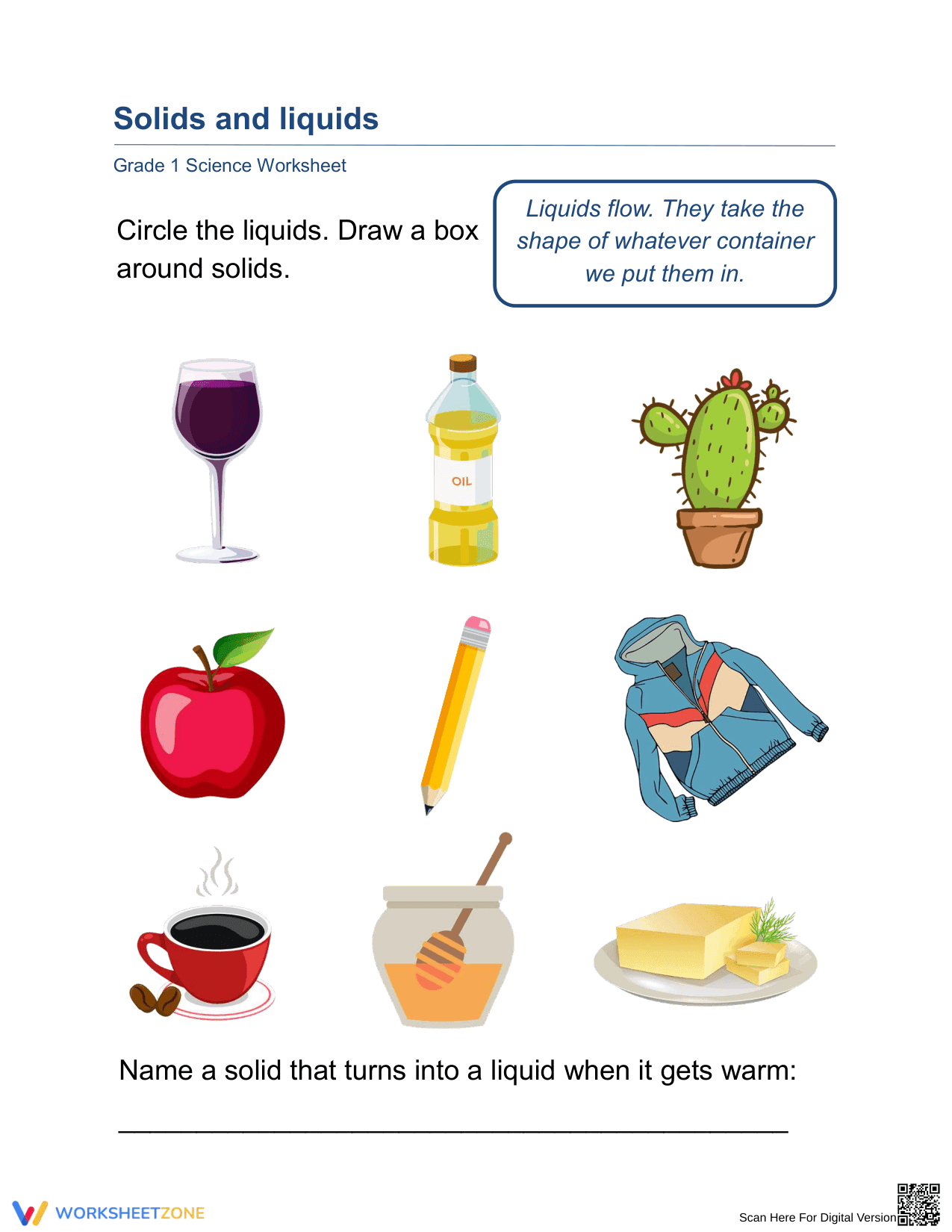
This worksheet helps first-grade students master the fundamental classification of solids and liquids through visual identification. By observing real-world objects like pencils and honey, learners develop a concrete understanding of how different states of matter behave in containers. It is an essential tool for building early scientific literacy and observational skills.
At a Glance
- Grade: 1 · Subject: Science
- Standard:
2-PS1-1— Classify different kinds of materials by their observable properties.- Skill Focus: Distinguishing solids from liquids
- Format: 1 page · 10 problems · Answer key included · PDF
- Best For: Independent practice or formative assessment
- Time: 10–15 minutes
What's Inside
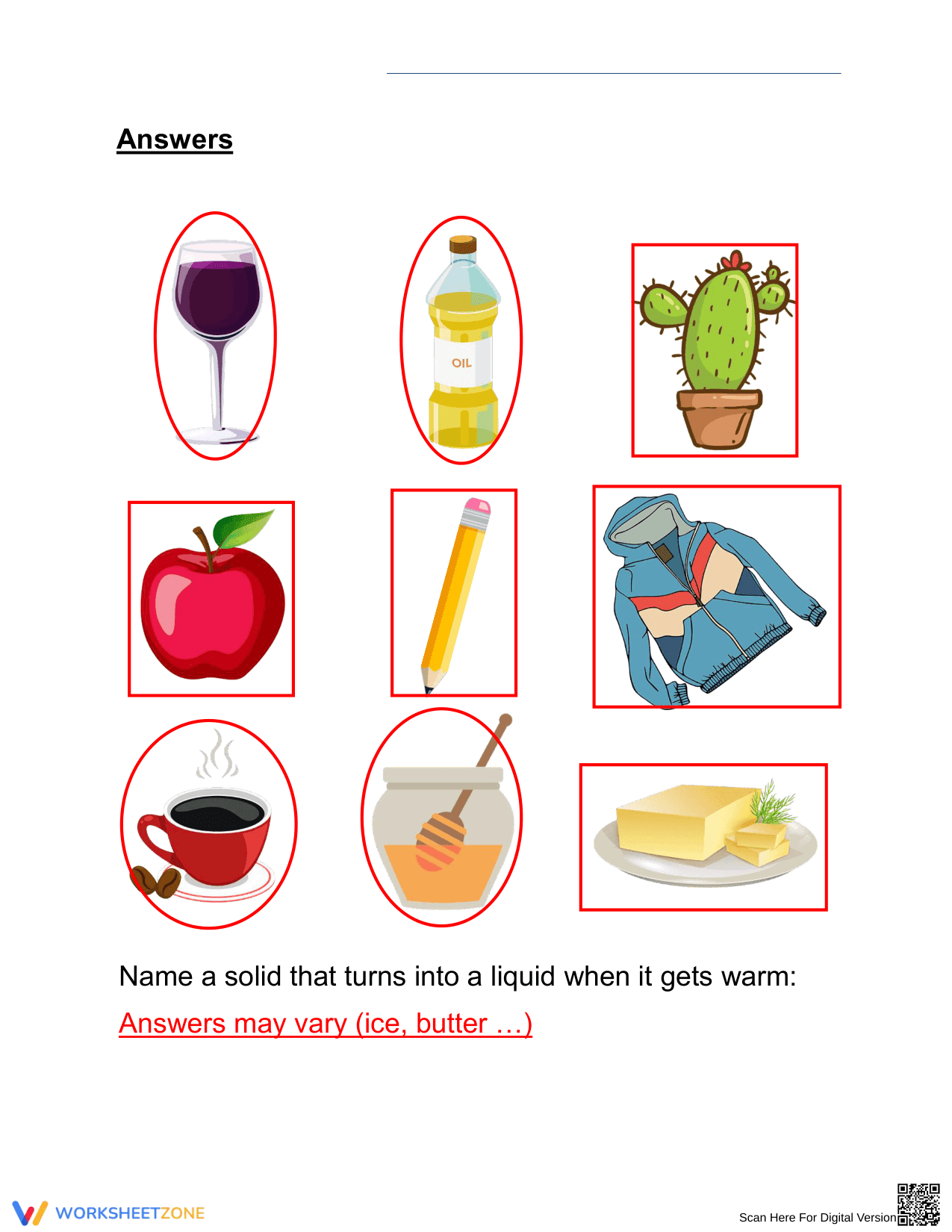
The worksheet contains nine clear illustrations for students to categorize using specific symbols: circles for liquids and boxes for solids. It features a helpful definition box explaining that liquids take the shape of their container. The page concludes with a critical-thinking prompt about phase changes, specifically focusing on solids that melt when warmed. A full answer key is provided.
Zero-Prep Workflow
- Print: Select the single-page PDF and print copies for your entire class (30 seconds).
- Distribute: Hand out the sheets for a quick science warm-up or as a lesson consolidation activity (1 minute).
- Review: Discuss the answers as a group to clarify misconceptions about viscous liquids like honey or transitioning materials like butter (5 minutes).
This streamlined process requires under 2 minutes of teacher preparation, making it an ideal choice for sub plans or emergency lesson fillers.
Standards Alignment
This activity aligns with `2-PS1-1`, which requires students to classify materials by observable properties. By distinguishing between rigid solids and flowing liquids, students demonstrate mastery of the foundational concepts of physical science. This standard code can be copied directly into lesson plans, IEP goals, or district curriculum mapping tools to ensure instructional alignment.
How to Use It
Use this worksheet during the 'Explain' or 'Elaborate' phase of a 5E science lesson. It serves as an excellent formative assessment to check for understanding before moving on to gases. Teachers should observe whether students correctly identify honey as a liquid, as its viscosity often challenges early learners. Completion typically takes between 10 and 15 minutes.
Who It's For
This resource is designed for Grade 1 and Grade 2 students learning basic chemistry. It provides visual scaffolding for English Language Learners and students with IEPs by using clear, recognizable images. Pair this worksheet with a physical 'sink or float' activity or a passage about the properties of matter to create a comprehensive science lesson.
According to a RAND AIRS 2024 analysis of science instruction, early exposure to material classification through multi-modal exercises significantly improves long-term retention of physical science concepts. This worksheet specifically addresses the `2-PS1-1` standard by requiring students to apply the plain-English skill of distinguishing solids from liquids based on their observable physical characteristics. Research suggests that using illustrated items from daily life, such as fruit and clothing, helps young learners bridge the gap between abstract definitions and concrete reality. By engaging with 10 distinct tasks that involve both classification and predictive reasoning about temperature changes, students build a robust mental model of matter. This targeted practice ensures that learners are prepared for more complex investigations into chemical properties in later elementary grades. The inclusion of a clear definition box further supports literacy development within the science curriculum.


