




























Views
Downloads
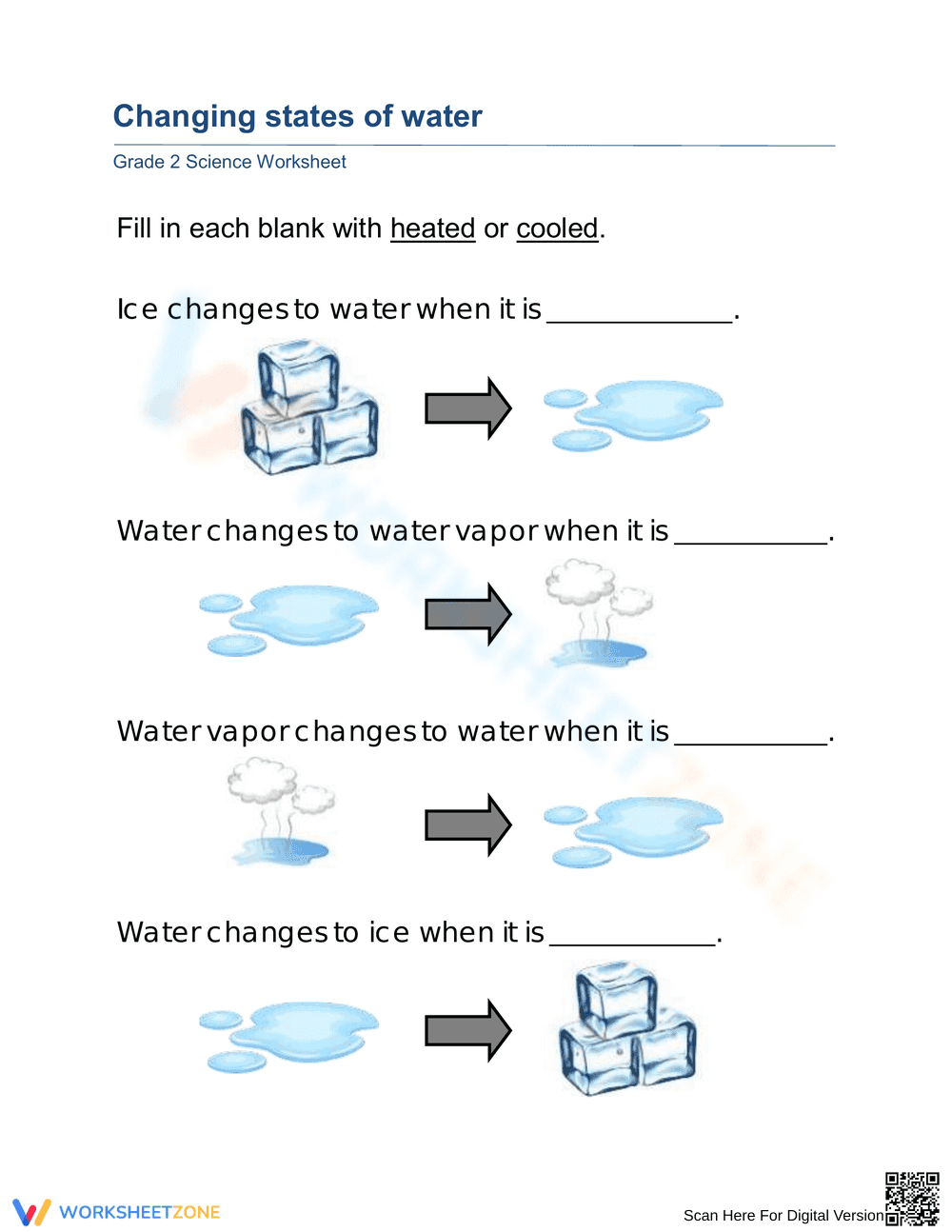


Grade 2 Changing States of Water — Printable Worksheet

Paste this activity's link or code into your existing LMS (Google Classroom, Canvas, Teams, Schoology, Moodle, etc.).
Students can open and work on the activity right away, with no student login required.
You'll still be able to track student progress and results from your teacher account.
This Grade 2 science worksheet helps students master the fundamental concept that matter changes form when energy is added or removed. Focusing on water, learners observe how heating and cooling transform substances between solid, liquid, and gas states, developing a concrete understanding of physical changes through visual modeling and vocabulary reinforcement.
At a Glance
- Grade: 2 · Subject: Science
- Standard:
2-PS1-4— Construct an argument that some changes caused by heating or cooling can be reversed- Skill Focus: States of matter transitions (melting, freezing, evaporation)
- Format: 2 pages · 10 problems · Answer key included · PDF
- Best For: Zero-prep science centers or homework
- Time: 15–20 minutes
The two practice pages scaffold understanding: the first uses diagrams to illustrate heating/cooling transitions (e.g., ice melting), while the second challenges students to describe states of matter using a word bank. A full answer key supports quick grading and immediate feedback.
Zero-Prep Workflow
Designed for maximum efficiency, this zero-prep worksheet requires under two minutes of teacher preparation. Simply print (30 seconds), distribute (30 seconds), and review (1 minute) using the included answer key. This resource is ideal for busy classrooms, emergency substitute plans, or independent station rotations where student autonomy is prioritized.
Strictly aligned to NGSS 2-PS1-4, this resource helps students construct arguments with evidence that changes caused by heating or cooling can be reversed. Students document water transitions (e.g., ice to liquid, liquid to vapor) to meet mastery requirements. Both standard codes can be copied directly into lesson plans, IEP goals, or district curriculum mapping tools.
Assign as a formative assessment after an introductory demonstration. Students distinguish between gas (water vapor) and liquid states. With an estimated 15-20 minute completion time, it fits easily into elementary science blocks or as a follow-up to hands-on lab activities.
Designed for Grade 2, this resource also serves as an excellent review for Grade 3 learners on the water cycle. Visual cues and a word bank support diverse learners by reducing cognitive load. For optimal results, pair this worksheet with a non-fiction passage about the water cycle or an anchor chart displaying the three common states of matter.
Research (RAND AIRS 2024, Fisher & Frey 2014) indicates that explicit visual models and word banks significantly improve retention of abstract concepts like molecular state changes and scientific vocabulary development. This worksheet reinforces causal relationships, provides 10 application opportunities, and includes an answer key for self-correction, fostering student self-efficacy in STEM. It prepares students for more complex thermodynamics in later grades. By focusing on the NGSS 2-PS1-4 standard, the material ensures that Grade 2 students build the necessary foundational knowledge to understand reversible and irreversible changes in matter. This structured approach to science instruction aligns with evidence-based practices for early elementary learners, ensuring that complex physical science concepts are accessible and engaging through clear, scaffolded tasks.


