


























Views
Downloads
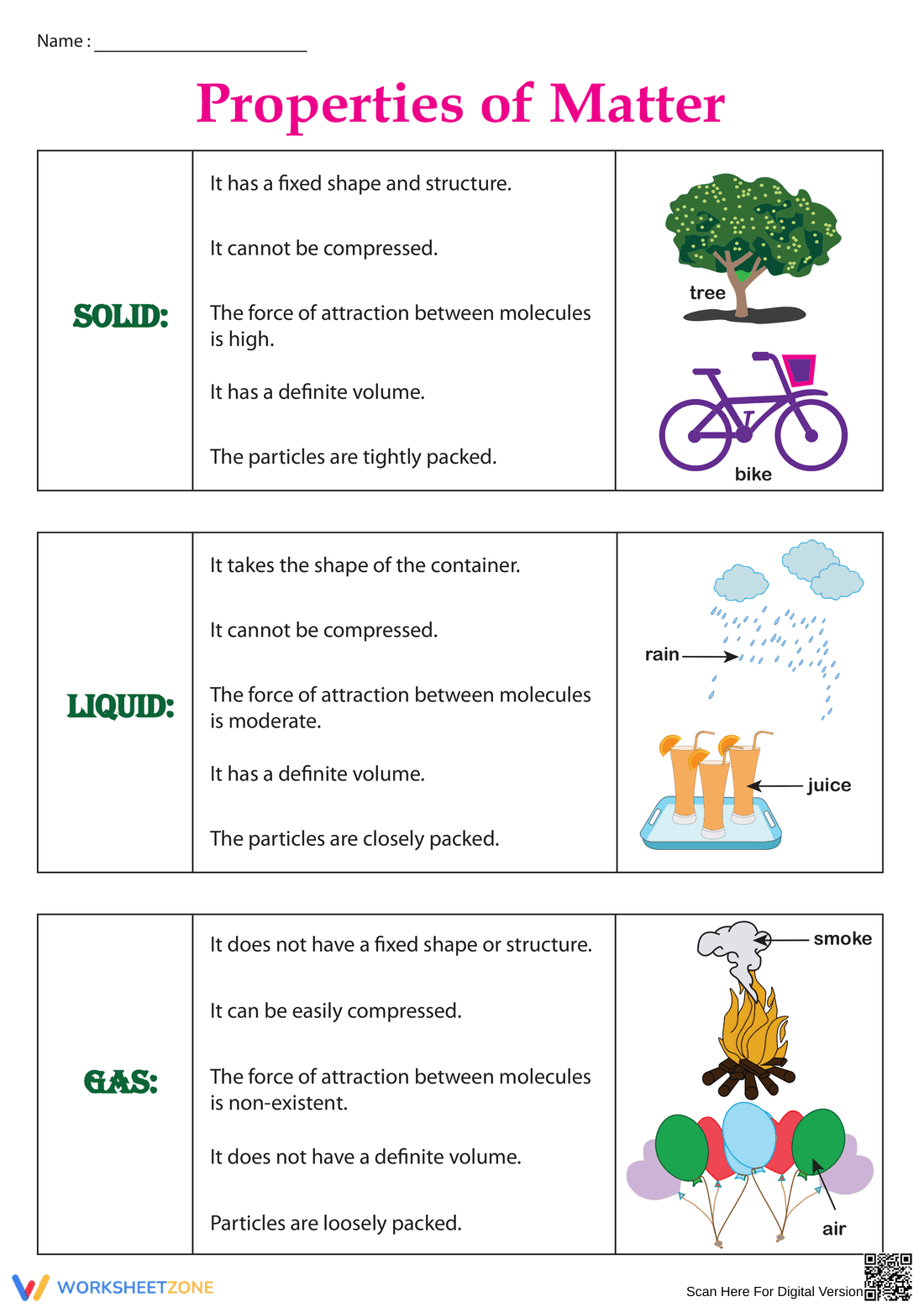

Printable Properties of Matter Chart | Grade 2-3 Science
Paste this activity's link or code into your existing LMS (Google Classroom, Canvas, Teams, Schoology, Moodle, etc.).
Students can open and work on the activity right away, with no student login required.
You'll still be able to track student progress and results from your teacher account.
This printable properties of matter chart provides students with a clear, visual summary of solids, liquids, and gases. By categorizing matter through observable traits like shape, volume, and particle arrangement, this resource helps young learners distinguish between different states. It is an ideal reference tool for science notebooks or classroom displays during introductory physical science units.
At a Glance
- Grade: 2-3 · Subject: Science
- Standard:
2-PS1-1— Classify different kinds of materials by their observable properties- Skill Focus: Identifying states of matter
- Format: 1 page · 0 problems · Reference chart · PDF
- Best For: Science notebooks and classroom reference
- Time: 5–10 minutes
This one-page reference document features three distinct sections dedicated to solids, liquids, and gases. Each section includes five key descriptive properties—shape, compressibility, molecular attraction, volume, and particle packing—accompanied by relatable illustrations like trees, rain, and air balloons. The layout is designed for quick scanning and easy comprehension by elementary students.
Using this resource requires minimal effort for maximum impact. Simply print the high-resolution PDF (30 seconds), distribute it to students for their science journals (1 minute), and review the core definitions as a whole-class activity (2 minutes). Total teacher preparation time is well under two minutes, making it a reliable choice for unexpected sub plans or quick lesson transitions.
This chart is aligned with 2-PS1-1, which requires students to "plan and conduct an investigation to describe and classify different kinds of materials by their observable properties." It specifically addresses the disciplinary core idea PS1.A regarding the structure and properties of matter. The standard code can be copied directly into lesson plans, IEP goals, or district curriculum mapping tools.
Introduce the chart during the "Explain" phase of a 5E lesson to consolidate vocabulary after a hands-on exploration of different substances. Alternatively, use it as a formative assessment tool by asking students to identify a new object (like a pencil) and match its traits to one of the categories on the chart. Completion of the initial review typically takes five to ten minutes.
This resource is designed for Grade 2 and Grade 3 students beginning their journey into physical science. It is especially helpful for English Language Learners (ELLs) and visual learners due to the clear icon-to-text mapping. It pairs naturally with a hands-on sorting activity involving physical samples of solids, liquids, and gases.
The structural organization of this properties of matter chart aligns with evidence-based instructional practices for elementary science. According to RAND AIRS 2024, the use of visual organizers and summary charts significantly enhances student retention of complex scientific concepts by reducing cognitive load during the initial acquisition of domain-specific vocabulary. By explicitly defining the physical characteristics of solids, liquids, and gases—such as fixed shape versus container-dependent volume—this resource provides the scaffolding necessary for students to meet NGSS 2-PS1-1 performance expectations. Research suggests that providing students with a consistent "anchor" document during the classification of materials leads to higher accuracy in distinguishing between states of matter, particularly when dealing with non-obvious examples like gases or highly viscous liquids. This chart serves as a foundational cognitive map for 2nd and 3rd-grade learners, facilitating the transition from observation to scientific classification.


