




























Views
Downloads
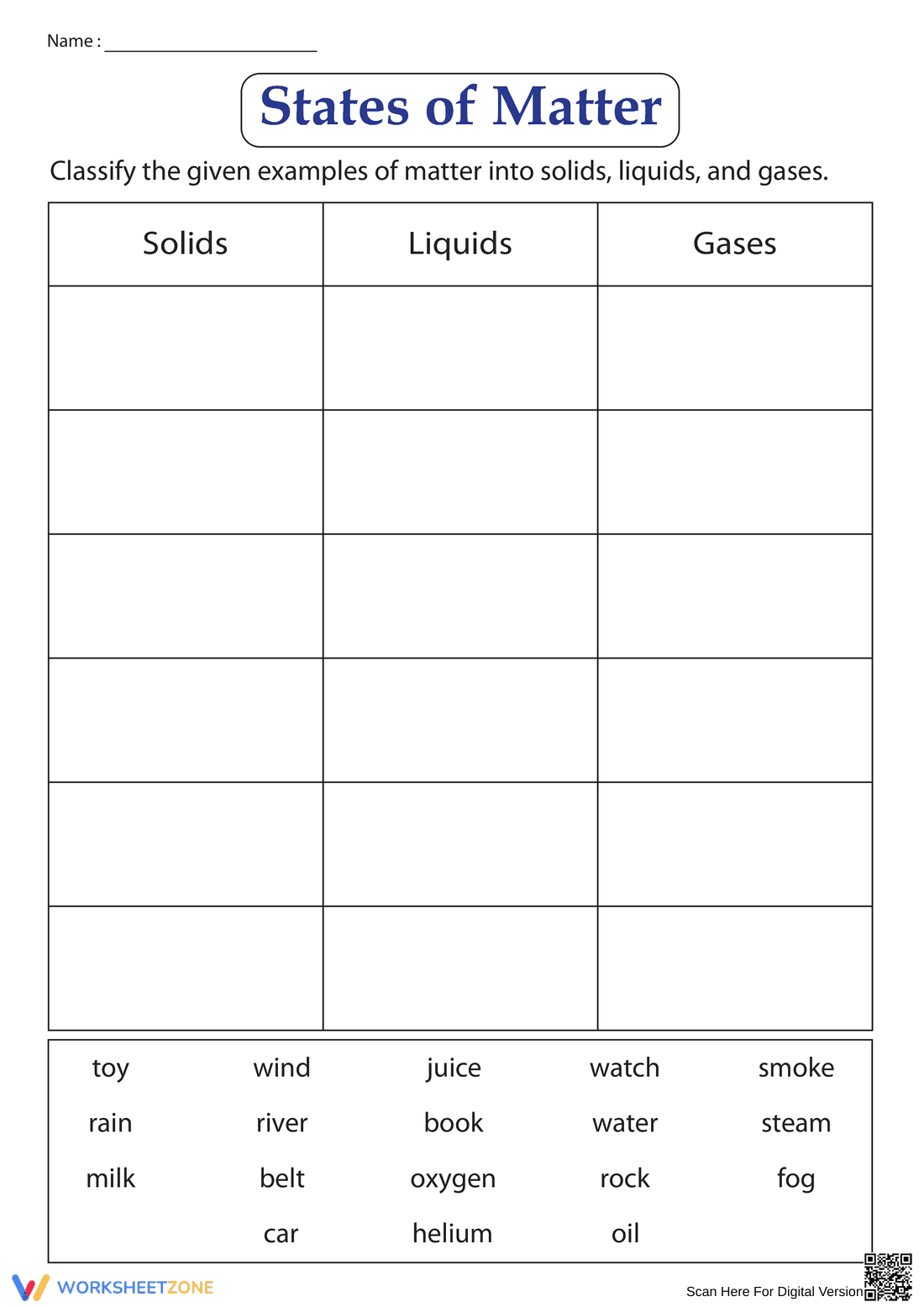

Essential States of Matter Sort Printable: Grade 2-3 Science

Paste this activity's link or code into your existing LMS (Google Classroom, Canvas, Teams, Schoology, Moodle, etc.).
Students can open and work on the activity right away, with no student login required.
You'll still be able to track student progress and results from your teacher account.
Classify 18 examples of matter into solids, liquids, and gases with this focused science worksheet. Students build fundamental physical science literacy by identifying the states of everyday objects and substances. This activity ensures learners can distinguish between materials based on observable physical properties, leading to mastery of basic classification systems and scientific inquiry.
At a Glance
- Grade: 2-3 · Subject: Science
- Standard:
2-PS1-1— Classify different kinds of materials by their observable physical properties- Skill Focus: States of Matter Classification
- Format: 1 page · 18 problems · Answer key included · PDF
- Best For: Independent practice and quick formative assessment
- Time: 15–20 minutes
This one-page PDF features a robust word bank containing 18 diverse examples of matter, ranging from common household objects like a "toy" and "book" to natural phenomena like "fog" and "river." The clear three-column table provides organized space for students to write each term under the correct heading: Solids, Liquids, or Gases. A comprehensive answer key is included for rapid grading or student self-checking.
Zero-Prep Workflow
- Print (30 seconds): Select the page and print copies for your entire class.
- Distribute (1 minute): Hand out the worksheets as a warm-up or exit ticket.
- Review (5 minutes): Use the included answer key to verify understanding or display for whole-class review.
Teacher preparation time is under 2 minutes, making this an ideal resource for sub plans or supplementing a physical science unit.
Standards Alignment
This activity is primary aligned to 2-PS1-1, which requires students to classify different kinds of materials by their observable properties. By sorting items like helium, oil, and rock, students demonstrate an understanding of the defining characteristics of each state of matter. The standard code can be copied directly into lesson plans, IEP goals, or district curriculum mapping tools.
How to Use It
Introduce the worksheet during the "Explain" or "Elaborate" phase of a 5E science lesson to reinforce vocabulary. For a formative assessment tip, observe students as they categorize "fog" and "steam" to identify misconceptions about the gaseous state versus aerosolized liquids. The expected completion time ranges from 15 to 20 minutes depending on writing speed.
Who It's For
Designed for students in 2nd and 3rd grade exploring physical science. The clear structure supports English Language Learners by providing a bank of familiar nouns to sort. This resource pairs naturally with a classroom anchor chart detailing the properties of particles in solids, liquids, and gases.
According to the RAND AIRS 2024 report on elementary science literacy, structured classification tasks are essential for developing categorical reasoning. This Grade 2-3 states of matter worksheet utilizes an 18-item word bank to build proficiency in 2-PS1-1. By requiring students to discriminate between solids, liquids, and gases across various contexts—including atmospheric conditions and manufactured goods—the worksheet reinforces the conceptual boundaries of physical states. Fisher & Frey (2014) emphasize that such scaffolded sorting activities bridge the gap between initial observation and the complex data analysis skills required in middle school science. This resource provides a high-leverage opportunity for formative assessment, allowing educators to pinpoint specific student misunderstandings regarding the transitional properties of substances like smoke or fog.


