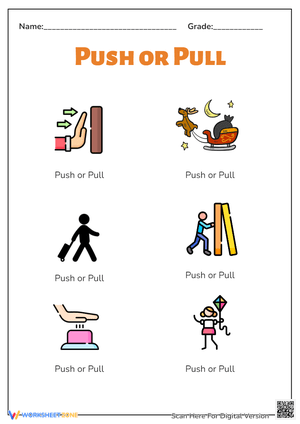
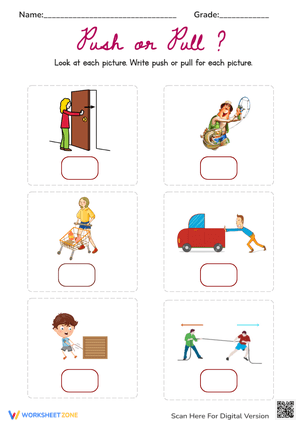
These 2nd grade forces motion and machines printable worksheets give teachers something a brief class demo alone rarely delivers: a written record of what each student actually understood. The set covers push and pull identification, motion change practice, and simple machine recognition across formats that vary enough to keep 7- and 8-year-olds engaged without requiring extensive setup or explanation from the teacher.
The Specific Skills Targeted Across the Set
Each worksheet targets one of the core ideas in a forces and motion unit: that a push or pull is a force, that forces change how objects move, and that simple machines help people apply forces more efficiently. The skills practiced across the set include:
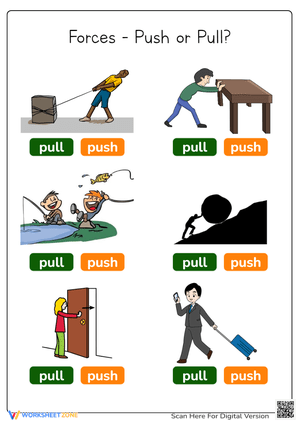
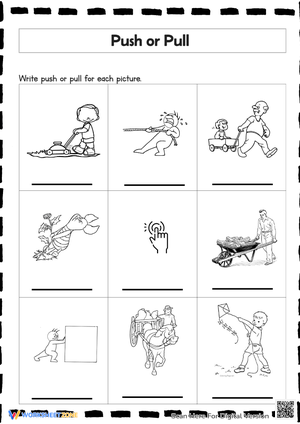
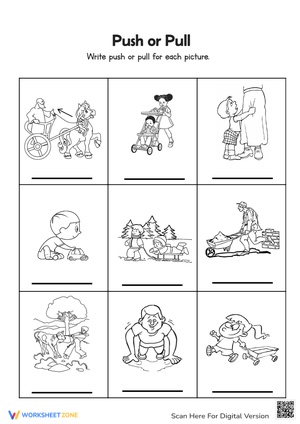
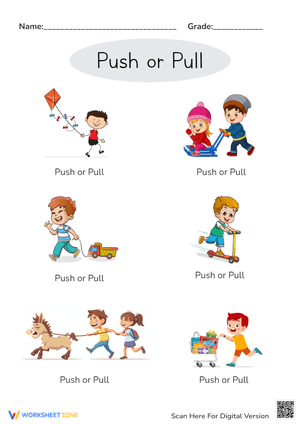
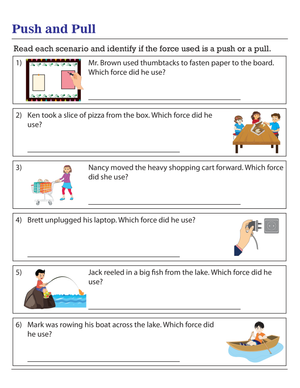
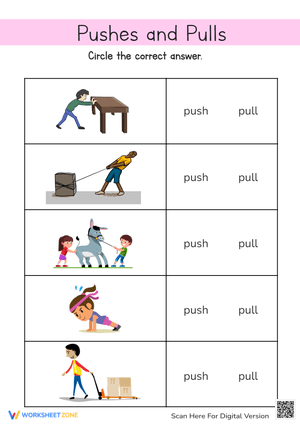
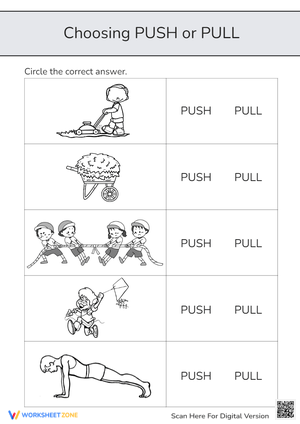
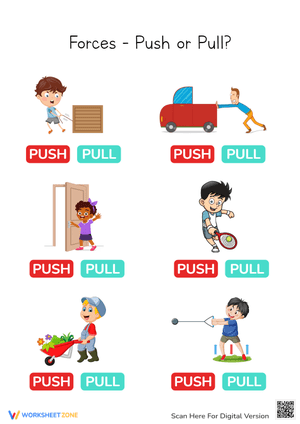
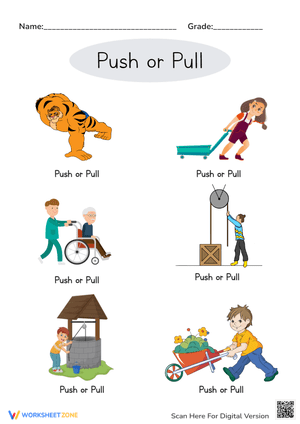
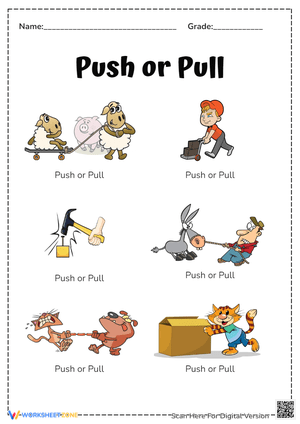
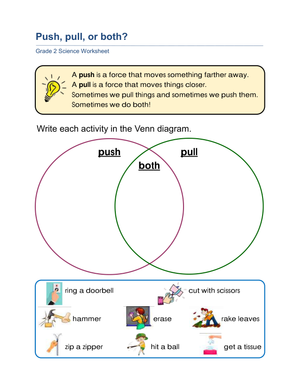
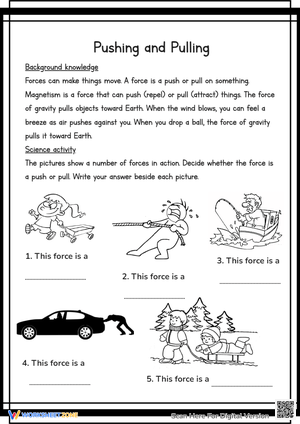
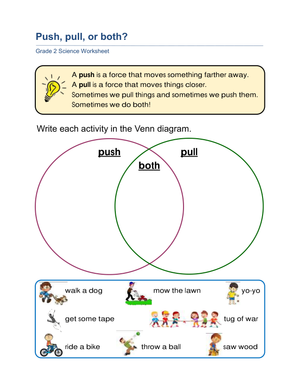
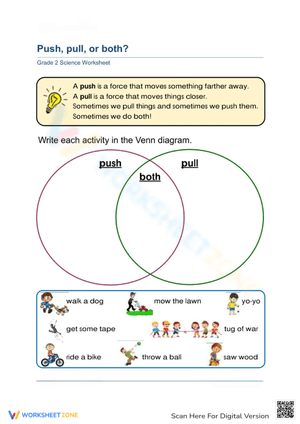
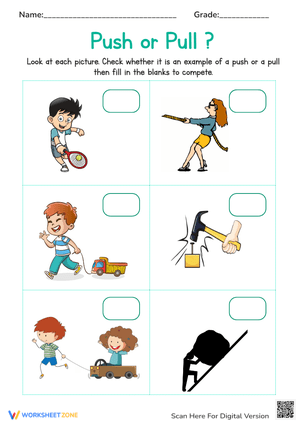
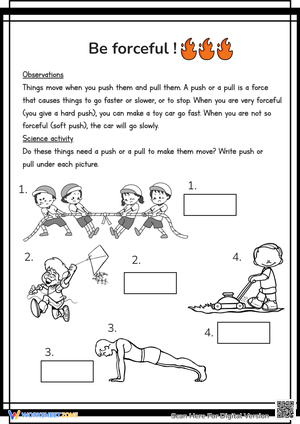
- Push and pull sorting: Students look at pictures of everyday actions — a child kicking a ball, an adult opening a refrigerator, someone dragging a sled — and label each as a push, a pull, or both.
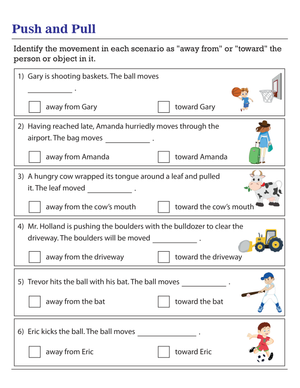
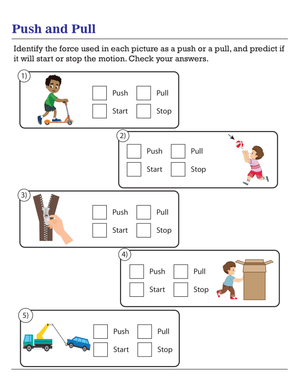
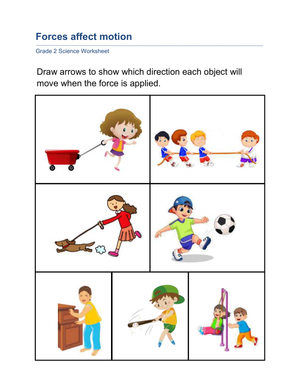
- Motion change identification: Students examine before-and-after scenarios and mark whether a force caused an object to start moving, stop moving, speed up, slow down, or change direction.
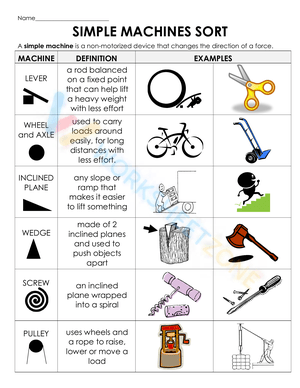
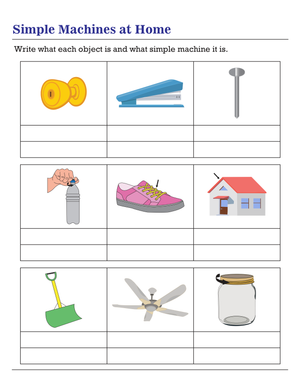
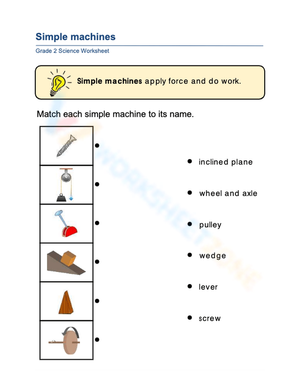
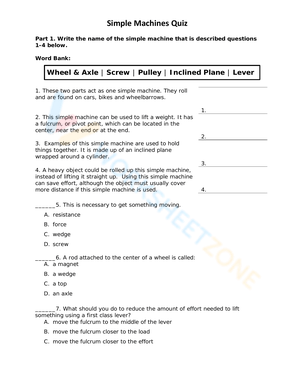
- Simple machine matching and labeling: Students connect real-world objects — a ramp at a loading dock, a pair of scissors, a flagpole pulley, a jar lid — to the correct category: inclined plane, wedge, lever, wheel and axle, pulley, or screw.
- Cause-and-effect recording: Short observation sheets ask students to draw or write what happened when a force was applied, building the habit of connecting a cause to its observable result.
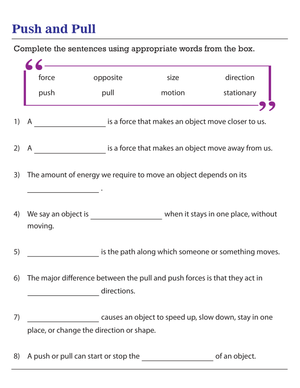
- Vocabulary in context: Students complete sentences or label diagrams using terms like force, direction, speed, and motion — always anchored to a picture or scenario rather than presented as isolated definitions.
The format mix — sorting, matching, labeling, circling, and short written responses — keeps the cognitive demand at a level where most 2nd graders can show what they know without getting stuck on the writing itself.
Mistakes Students Make That These Worksheets Help You Catch
The push/pull distinction looks straightforward from the outside, but in actual student work the picture is messier. The most common error is over-relying on "toward the body equals pull, away from the body equals push." A student who has internalized that rule will correctly label pulling a wagon but will mis-sort closing a door — because the hand moves toward the body while the door is being pushed shut. These worksheets surface that confusion quickly because they deliberately include actions where the labeling is not obvious from body position alone.
Simple machine vocabulary produces its own layer of errors. Students who can point to a ramp in a photograph and explain how it helps move a heavy box will still write "it's just a slide" when asked to name it. The inclined plane label feels arbitrary to them at first. The same pattern shows up with wheel and axle: students understand that a doorknob turns and opens the door, but they do not see it as a machine until they connect the small rotation of the knob to the larger motion that moves the latch. Labeling worksheets that ask students to explain what the machine does — not just identify it — make this connection visible in their answers in a way that a quick oral question usually does not.
On motion change questions, the direction/speed confusion is the one to watch most carefully. When a ball bounces off a wall, it changes direction and slows down, and students will pick one at random. Items that isolate a single variable — a ball rolling straight into a wall and stopping, as opposed to ricocheting off at an angle — help students understand that a force can produce more than one effect at the same time.
How to Build These Worksheets Into Your Lesson Sequence
The most effective use of these resources is right after a hands-on demonstration, not before. When students have just watched a toy car roll down a ramp and across a flat surface, the worksheet becomes a place to organize and name what they saw — not a task asking them to imagine something abstract. Keeping the ramp and car visible on the demonstration table while students work produces noticeably more accurate responses and stronger science talk during the debrief. That pairing — materials in view, worksheet in hand — takes almost no extra planning and makes a real difference in response quality.
For centers, pair each worksheet with a small tub of objects: marbles, a ruler as a lever, a small inclined plane made from a hardcover book and a piece of cardboard, a pencil sharpener to demonstrate the screw. Students test first, then record. This keeps the paper from feeling disconnected from the science. For exit tickets, pull three or four items from a mixed-review worksheet — one push/pull item, one motion-change item, one simple machine identification — and you have a focused formative check that takes about four minutes to collect and skim before the next period.
Sub plans and early-finisher tubs are where no-prep printables earn their place in the file drawer. Choose worksheets with clear visual directions and picture-based tasks so that a substitute or a student working independently does not need the unit vocabulary pre-taught to attempt the worksheet. The simpler sorting and matching worksheets also work well as Monday warm-ups after a week away from the unit — a quick reset before instruction picks back up.
Standard Alignment
A well-chosen set of 2nd grade forces motion and machines printable worksheets maps directly onto two NGSS performance expectations that anchor this unit. 2-PS2-1 asks students to plan and conduct investigations comparing the effects of different strengths and directions of pushes and pulls on the motion of an object. The push/pull sorting and motion-change worksheets give students a paper-based complement to those investigations — a place to record observations and name what they noticed before or after an activity. 2-PS2-2 asks students to analyze data to determine whether a design solution changes the speed or direction of an object with a push or pull. The cause-and-effect recording sheets and ramp-comparison observation worksheets address that standard directly. Both expectations assume students are working with real objects, so these worksheets function best as documentation of hands-on work, not as a replacement for it.
Adjusting the Worksheets for a Range of Learners
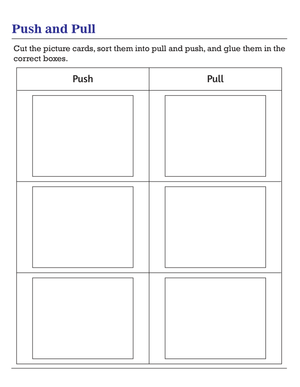
For students still building reading fluency, choose worksheets that rely heavily on pictures, circling, and matching rather than extended written responses. Cut-and-paste sorts — where students clip a picture of a lever or a wedge and place it in the correct column — reduce the reading demand while keeping the science thinking intact. Sentence frames on recording sheets ("The ball _____ because the force _____") let students demonstrate understanding without stalling on how to begin writing.
For students ready for more, the most effective extension is not a longer worksheet but a harder question on the same one: "Name another object in this room that works the same way," or "What would happen to the car's motion if you pushed it twice as hard?" These prompts require application and prediction without needing separate materials. They also produce answers worth discussing — a student who writes "the pencil sharpener is a screw" is doing different science thinking than a student who simply circles a matching picture.
Students receiving additional language support benefit most when these 2nd grade forces motion and machines printable worksheets are completed after a vocabulary preview — a quick picture walk through the key terms with home-language labels where available. Partner reading of directions before independent work also reduces procedural questions mid-activity and keeps the focus on the science.
Frequently Asked Questions
At what point in the unit should teachers introduce these worksheets?
After at least one hands-on exploration, not before. Once students have pushed a toy car, tested a ramp, or sorted classroom objects into push and pull piles, they have concrete experiences to anchor the paper work. Beginning the unit with worksheets before students have touched any materials produces more guessing and less accurate vocabulary use — the words don't stick yet because they aren't connected to anything physical.
Do these work for classrooms that are short on dedicated science time?
Yes. Each worksheet is focused enough to complete in a 10-to-15-minute block, which means they fit into the pockets of time that often get borrowed from science — the last 12 minutes before specials, the quiet block after lunch. Teachers who cannot dedicate a full science period every day have used the set across two weeks by attaching one worksheet to each short lesson or transition block without losing instructional continuity.
How reliable are these worksheets as assessment tools?
For informal, formative purposes, they are reliable. A push/pull sort completed without errors tells you that student is ready to go deeper into motion changes. A labeling worksheet where a student consistently writes "ramp" instead of "inclined plane" tells you the vocabulary needs reinforcement even if the underlying concept is solid. As a standalone summative measure, one worksheet is too narrow — but a short set of three or four mixed-review worksheets completed over a week gives enough data to make confident instructional decisions. Pulling out 2nd grade forces motion and machines printable worksheets as unit-end review also gives students a concrete sense of how far their thinking has moved since the first lesson.
Can these be used with students who have IEPs or 504 plans?
Most accommodations common at the 2nd grade level — extended time, reduced items per worksheet, verbal response in place of written, partner work — apply naturally to this format. The picture-heavy tasks require no modification for many visual learners. For students with fine motor challenges, pointing and verbal labeling instead of writing is an easy swap that preserves the science thinking without creating a barrier. Teachers have also projected individual worksheets on a shared screen and completed them as a whole class when that setup better meets documented requirements.












 Interactive Worksheet Maker
 Quiz Maker
 Word Search Maker
 Crossword Puzzle Maker
 Word Scramble Generator
 Sentence Scramble Generator
 Handwriting Worksheet Generator
 Name Tracing Generator
 Fill In The Blank Generator