These wise mind pdf worksheets for 12th grade give counselors, advisory teachers, and senior seminar instructors a concrete way to bring DBT's three-mind model into the classroom before emotional pressure peaks — not after. Each worksheet moves students through Marsha Linehan's framework of Emotion Mind, Reasonable Mind, and the integrative Wise Mind state that holds both, using situations seniors actually face: college decision paralysis in February, a rupture with a teammate during the final season, or the complicated social grief that builds in the months before graduation. The language stays accessible without losing conceptual accuracy, so classroom teachers can facilitate these exercises without clinical training.
What the Set Covers
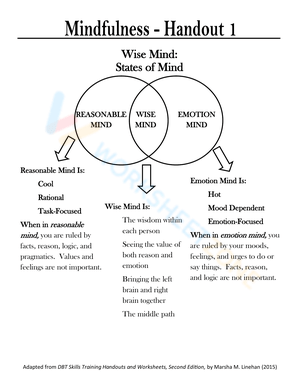
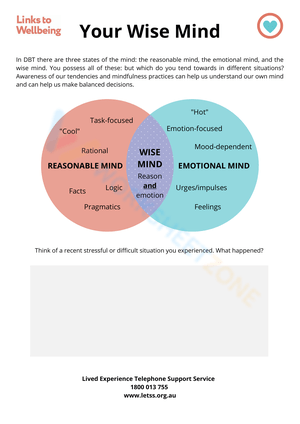
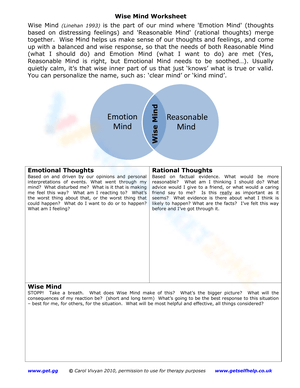
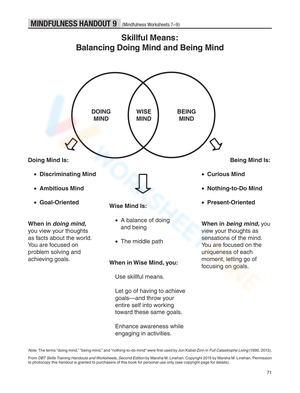
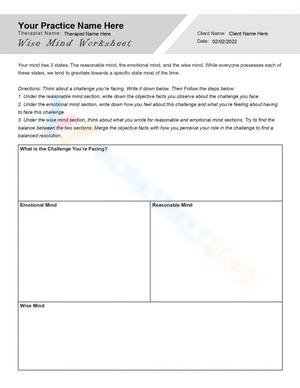
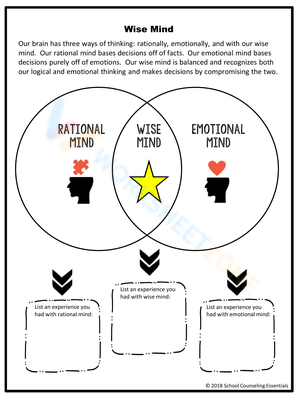
The worksheets move through the model in deliberate sequence. Earlier exercises ask students to sort situations into Emotion Mind or Reasonable Mind responses — naming the pull of each state before attempting any synthesis. Later exercises introduce the center-circle diagram Linehan uses in DBT Skills Training: students plot a specific decision or conflict on the visual and write out what Wise Mind awareness would actually change about their current thinking. Cross-curricular extension prompts are built into the set as well, allowing teachers to apply the framework to literature or historical decision-making rather than limiting the work to personal reflection.
- Identifying Emotion Mind and Reasonable Mind triggers in realistic senior-year scenarios
- Distinguishing emotional data (how I feel about this) from factual data (what is actually true)
- Writing a Wise Mind response to a high-stakes situation after articulating each mind-state separately
- Analyzing a fictional character's or historical figure's decision through the three-mind lens
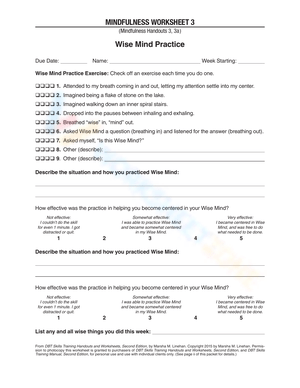
- Reflecting on a past decision and naming which mind was driving the outcome — and what a synthesis would have looked like
Senior Year Is When This Framework Earns Its Place
DBT concepts surface at various points in a K–12 SEL sequence, but the Wise Mind framework belongs specifically in 12th grade for a clear developmental reason: seniors are the youngest population expected to make consequential, largely irreversible adult decisions under real time pressure. Choosing a college, ending a long-term relationship before leaving town, navigating a financial aid appeal — these are not simulated exercises. When Emotion Mind is fully activated and Reasonable Mind gets dismissed, the decisions made in that final semester carry real weight. The framework gives students a precise language for an internal conflict they are already living but often cannot name or slow down long enough to examine.
How to Work These Worksheets Into Your Week
The most effective placement is the first ten minutes of advisory or senior seminar, used consistently from October onward — before graduation anxiety spikes, not in reaction to it. Teachers who wait until April, when college decisions are final and peer conflicts are climbing, find that students arrive with so much active Emotion Mind that the sorting exercises produce frustration rather than clarity. Starting early builds the metacognitive habit; by spring, students can name their mind-state mid-conflict rather than only in retrospect, which is when the framework actually does its work.
For restorative conversations after a classroom or hallway conflict, the set provides a useful structure. Asking each student to complete the identification worksheet independently — before they sit together — gives both parties something concrete to share rather than a re-escalation of the original argument. It slows the process down in a way that feels purposeful, not punitive, and it shifts the conversation from restatement of grievances to description of competing mind-states.
The wise mind pdf worksheets for 12th grade also work as a pre-writing frame for college application essays. Students drafting "a challenge I overcame" responses often write entirely from Emotion Mind — all feeling, no reflection on what actually shifted in their thinking. Running the Wise Mind worksheet before the first draft helps them access the synthesis that college essays reward: not just "this was hard" but "here is what I understood once I could see past the emotional response."
Mistakes Students Make That These Worksheets Help You Catch
The most consistent error is students treating Wise Mind as a synonym for "calm down and think logically." They understand the concept as suppressing emotion in favor of reason — which is the Reasonable Mind position, not the synthesis. On worksheets that ask for a Wise Mind response, these students produce answers that are flat and policy-like: factually correct, emotionally absent, and missing the integrative move entirely. The answer reads like a procedure rather than a human decision. Catching this before it calcifies into the student's working definition of the framework is worth a whole-class discussion using anonymized examples from earlier worksheet responses.
A second pattern: students fill out the Reasonable Mind column with post-hoc rationalizations of choices they already made from Emotion Mind. The worksheet looks complete — boxes filled, full sentences — but the "logical reasons" listed are not actual logic. They are emotional preference restated in a formal register. A student who writes "it makes practical sense to stay close to home for college because I will be less stressed" may be doing Reasonable Mind work, or may be repackaging a fear of leaving into the syntax of a rational argument. The distinction matters, and the worksheet makes it visible in a way a verbal conversation rarely does.
Differentiating the Set Across a Mixed-Ability Classroom
For students who find the abstract three-mind model confusing on first contact, work through one scenario as a class before assigning independent work — narrate which mind is active and why, then let students attempt a parallel situation on their own. That brief modeled walkthrough reduces the ambiguity that produces avoidance rather than engagement. Students who need more processing time also benefit from having the reflection prompts framed as optional writing rather than required sentences; the thinking often happens even when writing feels like the barrier.
Students who move through the model quickly benefit most from the cross-curricular extension tasks. Applying the three-mind lens to Lincoln's cabinet debates during the Emancipation Proclamation deliberations, or to a character in a senior AP Literature text, pushes them to use the framework analytically — a different cognitive demand than using it personally, and one that engages students who underperform on purely self-reflective tasks. For students already receiving clinical DBT services outside school, the vocabulary and visual structure of these worksheets match what their provider uses, which means classroom practice reinforces that outside work rather than introducing a competing model.
Standard Alignment
The set aligns with CASEL's Self-Awareness and Self-Management competency domains, specifically the indicators for identifying and labeling emotions, demonstrating self-discipline, and managing emotional responses under stress. In states with codified SEL standards, this material maps directly to Illinois ISBE SEL Standard Goal 1 (develop self-awareness and self-management skills to achieve school and life success) and New York SEL Benchmark Standard 1, both of which address the metacognitive and emotional regulation skills these exercises target. For schools operating under PBIS frameworks, the worksheets support Tier 1 universal skill-building at the secondary level — proactive regulation work, not crisis response.
Frequently Asked Questions
Do classroom teachers need counseling training to facilitate these exercises?
No. A brief review of the three-mind model — roughly ten minutes of reading — gives most advisory or senior seminar teachers enough background to run the worksheets confidently. The exercises do not ask teachers to provide therapy; they ask teachers to create structured reflection time and name what students are working on. If a student's responses reveal significant distress, the same referral pathway that applies to any personal writing assignment applies here.
How long does each worksheet take to complete?
Most students finish each worksheet in 12 to 20 minutes. The sorting and identification exercises in earlier worksheets move faster; the synthesis and open-ended reflection prompts in later ones take longer because students are generating original writing rather than selecting from options. Building five minutes of partner or class discussion into the follow-up deepens retention considerably — students who explain their Wise Mind response to a peer retain the framework longer than those who complete the worksheet and immediately move on.
Are these appropriate for students without a mental health diagnosis?
The wise mind pdf worksheets for 12th grade function as a universal intervention, not a clinical one. The skill of integrating emotional data with reasoned thinking is something every senior needs, particularly during the decision-heavy months of the final year. Framing the worksheets as decision-making tools — rather than emotional health check-ins — also reduces the resistance some seniors bring to SEL activities. Students who would dismiss a "feelings worksheet" often engage fully with one that asks them to map the logic and the emotion in a real decision they are currently weighing.
Can the framework extend into academic subject areas?
It holds up well in English Literature and History in particular. In a senior English class, the wise mind pdf worksheets for 12th grade can be adapted so students analyze a character's choices: what is Hamlet acting from in Act III, and what would a Wise Mind response have required him to acknowledge? In History, the same lens applies to political turning points where leaders were operating from one mind-state rather than the integrative center. These applications give students additional practice repetitions with the model without requiring additional SEL class time.












 Interactive Worksheet Maker
 Quiz Maker
 Word Search Maker
 Crossword Puzzle Maker
 Word Scramble Generator
 Sentence Scramble Generator
 Handwriting Worksheet Generator
 Name Tracing Generator
 Fill In The Blank Generator