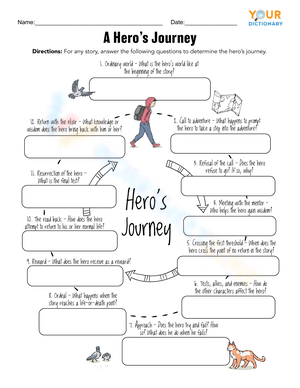
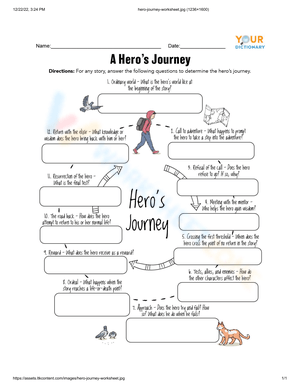
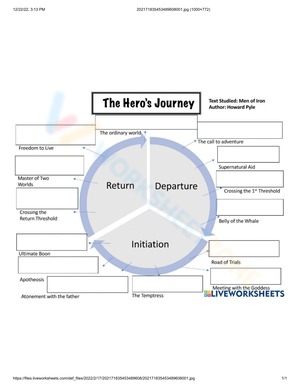
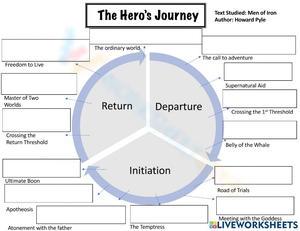
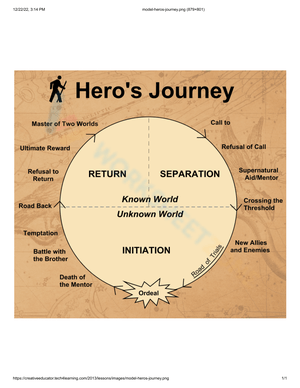
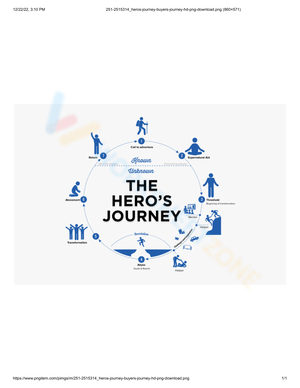
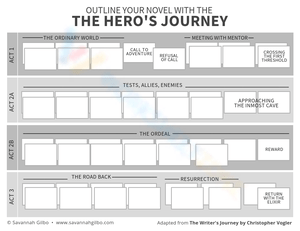
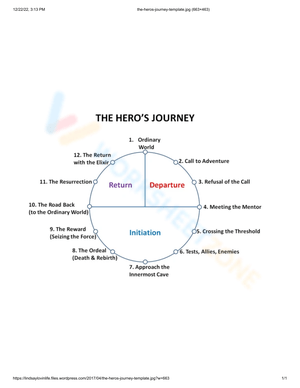
These heros journey worksheets pdf for 12th grade give teachers a structured set of resources for moving students past stage identification and into the kind of literary analysis college courses will expect from them. Each worksheet targets a specific layer of Campbell's monomyth — not just labeling "The Road Back" or "Return with the Elixir," but asking students to argue what it means when an author skips a stage, collapses two stages together, or places the Resurrection before the Ordeal.
Concepts in Each Worksheet
The set covers all twelve stages of the monomyth, but the emphasis at senior level is on the transitions between stages rather than the stages themselves. Students annotate their chosen text for the moment the Ordinary World stops being ordinary — which is often not the same as the formal Call to Adventure — and they explain what distinguishes the two. They track the Mentor's symbolic function separately from the Mentor's plot function. And they engage directly with the question of whether the hero's Reward at the Ordeal is what the hero wanted, what the hero needed, or whether those two things are the same.
Archetype analysis runs through the entire set. Each worksheet includes a section for identifying the Threshold Guardian, Shape-shifter, Trickster, and Shadow, then writing a paragraph explaining how each one externalizes an internal conflict the hero hasn't yet resolved. This isn't a checklist exercise; students are asked to connect each archetype to a specific moment of hesitation or failure in the hero's arc. By the end of the set, students should be able to name the psychological function of every major character in the text — not just describe what they do.
The Stage Most Students Misread
Across most 12th-grade classrooms, students navigate the early stages of the monomyth with relative confidence. The Atonement with the Father, however, reliably stops them. The problem isn't that students miss it — it's that they read it literally. When the "father" in a text is a mentor figure, a rival, a corrupted institution, or an internalized belief system, students default to "there's no father here" and move on. A worksheet that prompts them to define what authority the hero is reconciling with — rather than which character carries the father label — produces noticeably more precise analysis. It also opens the conversation about why Campbell placed this stage at the emotional core of the journey even in myths where the father is absent or irrelevant to the plot.
The distinction between the Ordeal as physical climax and the Atonement as emotional climax is worth real classroom time. Students who understand that distinction start to see why some of the most admired novels feel emotionally unresolved even after the hero survives the Ordeal — the deeper reckoning hasn't happened yet. That's a genuinely sophisticated literary observation, and the worksheets build toward it through the earlier stages rather than announcing it in advance.
How to Build These Worksheets Into Your Lesson Plans
The most productive use pattern is to introduce the full monomyth framework with a film students already know — most seniors have seen enough of Get Out or The Dark Knight to map the stages without having to track new plot — and then transition to the literary text once students are fluent in the vocabulary. The worksheets support that approach: each worksheet can function as independent practice on a single stage or be used in sequence across a full unit. Heros journey worksheets pdf for 12th grade work best when students treat them as a living document, returning to earlier entries and revising as they read deeper into the text. That iterative process — annotating, reading more, going back — mirrors the way professional literary critics approach a novel.
For teachers planning a comparative essay unit, the set supports parallel mapping: students track two protagonists from different literary periods on side-by-side worksheets, then use the comparison to argue something about how historical context shapes what a "hero" is allowed to be. That's an AP-level writing move, and the analytical groundwork these worksheets build gives students the evidence base to pull it off.
Frequent Student Errors Worth Watching For
The most common error at this level isn't misidentifying stages — it's treating the monomyth as a checklist rather than a lens. Students who mapped the journey in a previous grade often approach the worksheet with the goal of filling every box. When a stage seems absent, they invent it. Watch for answers on the Refusal of the Call section that describe any moment of doubt as a refusal, even when the character never seriously considers rejecting the call. In Hamlet, the Refusal is a genuine structural feature that runs across most of the play; in some texts there is no meaningful refusal, and the correct analysis is to name that absence and explain what it reveals about the hero's character — not to force a hesitation into the framework.
A second error is conflating the Shadow archetype with the story's antagonist. Students write "Iago is the Shadow" and stop there, without asking whether the Shadow externalizes something already present in Othello. The worksheet section on archetypes is built to push past that surface reading by requiring students to connect each archetype to a specific internal state of the hero — not just the character's external role in the plot.
Standard Alignment
These worksheets align most directly with CCSS.ELA-LITERACY.RL.11-12.3, which requires students to analyze the impact of an author's choices regarding how to develop and relate elements of a story, and CCSS.ELA-LITERACY.RL.11-12.9, which asks students to demonstrate knowledge of foundational literary works across historical periods. In classroom terms, the monomyth framework gives students the analytical vocabulary to fulfill RL.11-12.3 — they are not just identifying story elements but arguing why an author made specific structural decisions. The comparative element built into several worksheets directly serves RL.11-12.9 by placing texts from different historical periods in conversation and asking students to account for the differences.
Adjusting the Worksheets for a Range of Learners
For students who are still building their analytical vocabulary, providing a worked example from a familiar film before they apply the framework to the assigned novel significantly reduces friction. The worksheets support that transition: the archetype and stage sections use consistent prompts throughout the set, so moving from a familiar text to an unfamiliar one is a content shift, not a task shift. Heros journey worksheets pdf for 12th grade also lend themselves to partner work at the identification stage — two students comparing what they each labeled as the Crossing of the First Threshold in the same novel will almost always produce a more precise answer together than either would alone, and the discrepancy itself is productive discussion material.
Advanced students can be pushed further by asking them to find the points where Campbell's model breaks — texts that deliberately refuse the Return, heroes who return with nothing, or antiheroes whose Elixir harms rather than heals the Ordinary World. A student who can articulate why No Country for Old Men withholds the conventional Resurrection has moved beyond the worksheet prompts into genuine critical thinking, and the set is built to surface that ceiling early enough for teachers to act on it.
Frequently Asked Questions
Are these worksheets usable with any text, or built around specific novels?
The worksheets are text-neutral. The prompts reference stages and archetypes by function, not by character names, so they apply equally to a Shakespeare play, a contemporary memoir, or a film. Teachers have used them with everything from Beowulf to Their Eyes Were Watching God without modification.
How do these resources fit into an AP Literature and Composition course?
The monomyth framework aligns directly with the AP Literature focus on author's choices and narrative structure. Students who have worked through the set develop the habit of asking why an author placed a particular structural moment where they did — which is exactly the analytical move that distinguishes strong AP essay responses. Heros journey worksheets pdf for 12th grade are a productive foundation for the structural and comparative analysis that appears on both the open-response and essay portions of the AP exam.
Do students need prior knowledge of Joseph Campbell before starting?
No. Each worksheet includes a brief reference section defining the relevant stage and its psychological function. Teachers who want to go deeper can pair the worksheets with selections from The Hero with a Thousand Faces or resources from the Joseph Campbell Foundation, but the worksheets function independently without that background reading. Most 12th graders arrive with some exposure to the framework from earlier grades; what they need is practice applying it with more precision, which is what the prompts are built to demand.
What's the practical difference between Campbell's 17-stage model and Vogler's 12-stage version?
Vogler condensed and renamed several of Campbell's stages for a screenwriting audience, which makes his model more immediately intuitive for students who have grown up watching films. Campbell's fuller version gives more analytical surface area — particularly around the stages Vogler collapsed — and is worth the added complexity at the senior level. The worksheets use Vogler's 12-stage structure as the primary framework but flag the Campbell equivalents where the naming diverges significantly, so teachers can decide how much of that conceptual history to bring into the unit.












 Interactive Worksheet Maker
 Quiz Maker
 Word Search Maker
 Crossword Puzzle Maker
 Word Scramble Generator
 Sentence Scramble Generator
 Handwriting Worksheet Generator
 Name Tracing Generator
 Fill In The Blank Generator