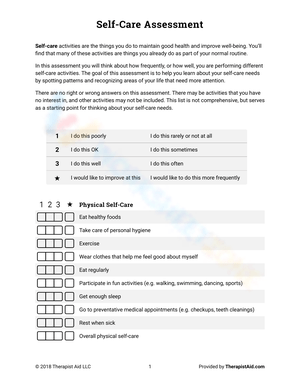
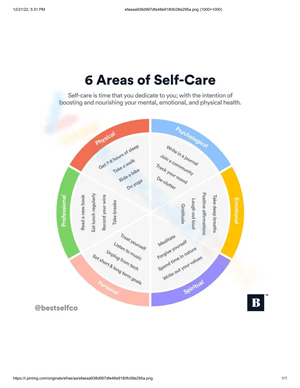
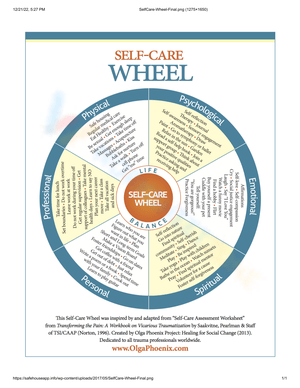
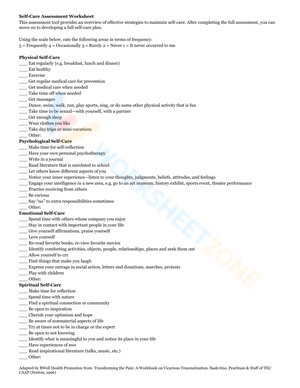
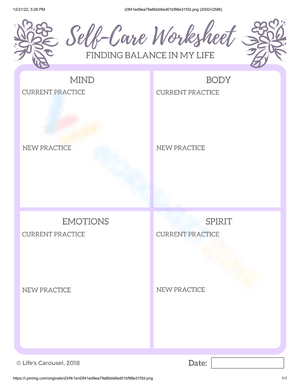
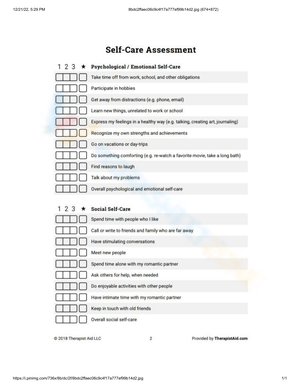
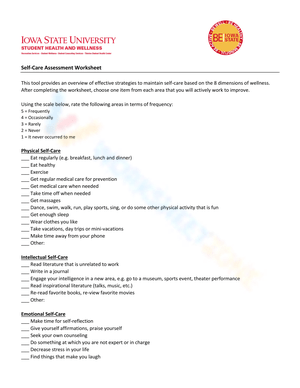
12th grade self care assessment printable worksheets give teachers a structured way to open conversations about well-being that seniors rarely start on their own. Each worksheet covers a specific domain — sleep, nutrition, stress response, emotional regulation, social connection — so students can identify which area is creating the most friction, rather than defaulting to "everything is stressful" as an explanation. Teachers get a ready-to-use set and a window into how their students are actually holding up at the most pressure-loaded stretch of K-12.
What Each Worksheet Covers
The set addresses five domains that research and direct classroom observation consistently flag as the breaking points of senior year:
- Sleep and recovery — tracks not just duration but quality, asking whether students wake rested and whether caffeine use is masking a deficit they haven't consciously acknowledged
- Nutrition and energy — moves past "are you eating?" to ask about meal timing, what students reach for during late study sessions, and whether energy crashes correspond to academic slumps
- Stress identification — asks students to map current obligations against how each one makes them feel, separating productive pressure from the kind that depletes without producing results
- Emotional check-in — prompts students to name specific emotions rather than defaulting to "stressed" or "fine," a distinction that matters because those two words call for completely different responses
- Social boundaries — asks students to evaluate their relationships for reciprocity: who in their circle restores them, and who consistently drains them
Used consistently across a semester, 12th grade self care assessment printable worksheets move students from a vague sense of being overwhelmed to a specific account of which domain is most depleted — and that specificity is what makes any follow-through possible.
Where Student Self-Reports Go Wrong
The most common error isn't dishonesty — it's selective perception. Seniors who are struggling the most often rate their sleep highest because eight hours is what they know they're supposed to report, not what they're actually getting. A student who describes falling asleep at their desk twice during the week will still write "7–8 hours" if that's what the weekly average comes to. These worksheets address this by pairing the raw number with follow-up questions about daytime fatigue and caffeine dependence, which surfaces the gap between the reported figure and the lived experience.
A second pattern: students conflate avoidance with rest. In the emotional and social sections, this shows up as a student marking "I relaxed this week" when they mean three hours of phone-scrolling to avoid a college essay. The reflection prompts specifically ask how the student felt after the activity — which forces the distinction between genuine recovery and distraction that feeds anxiety. A third error worth watching: students who rate their social well-being high because they're constantly surrounded by peers, without registering that none of those interactions involve real reciprocity or quiet. The social boundaries worksheet asks them to name which specific relationships leave them feeling steadier versus more depleted — a question most 17-year-olds have never been asked to answer in writing.
How to Build These Worksheets Into Your Lesson Plans
The natural entry points for 12th grade self care assessment printable worksheets are the transitions — not the quiet middle of a unit, but the moments when stress levels shift visibly. The first week of second semester, right after college application deadlines pass, is when many seniors crash emotionally. The adrenaline that carried them through fall disappears, and what remains is exhaustion they hadn't been registering. Dropping a worksheet into that window gives students a structured reason to pause before the AP sprint begins.
A Monday morning check-in cadence works well in advisory or senior seminar periods. Five to seven minutes at the week's start — students complete the relevant section, write one goal based on what they noticed, and move on. The low time cost matters here. Seniors respond poorly to anything that feels like another obligation, so keeping the entry point brief and private preserves their willingness to engage honestly. The full-set assessment, covering all five domains, fits better as a quarterly exercise: once in September to establish a baseline, once before midterms, and once after spring break when senioritis and anxiety tend to peak simultaneously. More frequent use of the full set produces faster, less reflective responses — the quarterly rhythm gives students enough time between uses that the prompts feel fresh.
Differentiating the Set Across the Range of Students You Actually Have
Students who already have a counselor or an established emotional vocabulary move through the reflection-heavy worksheets quickly and often write detailed, specific answers. For them, the more useful challenge is the social boundaries section, where prompts push past feelings-identification into evaluating actual relationship patterns over time — a more demanding cognitive task. These students benefit from the optional extension prompts within each worksheet, which ask them to connect observations across multiple weeks rather than treating each session as isolated.
Students with no prior exposure to emotional vocabulary, or students who default to "I'm fine" as a blanket self-report, respond better to the checklist-heavy format of the stress identification and sleep worksheets. Those provide enough structure that students don't freeze — they mark, rank, and circle before doing any open-ended writing. A brief norm-setting conversation before the first use — making clear that these aren't graded and that personal details stay with the student — measurably increases the specificity of what this group writes. One practical note: resist the impulse to push every student toward the journaling sections. For some students, a thoroughly completed checklist is the more honest data point.
Standard Alignment
These worksheets align with ASCA (American School Counselor Association) Mindsets and Behaviors standards, specifically B-SMS 7, which addresses identifying long- and short-term goals, and B-SMS 9, which addresses personal safety and wellness. In classroom terms, this places them most naturally in senior seminar, advisory, and health education contexts rather than core academic courses — which accurately reflects where they actually get used. Schools running a senior transition or college-readiness curriculum will find the fit clearest there. Where state SEL standards apply, the emotional regulation and social connection worksheets map directly to self-awareness and relationship skills competencies at the 12th-grade level.
Frequently Asked Questions
How often should students complete these assessments?
Single-domain worksheets — sleep, stress identification, nutrition — work well as a brief weekly or biweekly check-in in an advisory block. The full-set review, where students work through all five domains, fits better quarterly: early fall to establish a baseline, before midterm exams, and late March or early April when the post-application slump and AP preparation overlap. Using the full set more frequently tends to produce quicker, less thoughtful responses as the exercise becomes routine.
What should I do if a student's responses suggest serious distress?
These worksheets are not diagnostic instruments. If a student's responses suggest persistent sleep disruption, marked social withdrawal, or any language that points toward hopelessness, follow your school's established mental health referral protocol immediately. Connect the student with a guidance counselor or school psychologist. A quiet, private word acknowledging that you noticed and are connecting them with support goes further than addressing it in the classroom context. Do not wait to see if it resolves on its own.
Are these useful for students who don't appear to be struggling?
High-achieving seniors are often the students who most need 12th grade self care assessment printable worksheets and are the least likely to seek support independently. Many of them have built performance habits that mask accumulating depletion — they keep producing results right up until they can't. Using the set as standard practice for the whole class, rather than as a visible response to struggle, removes the stigma and makes it more likely this group engages honestly. The preventive value is often greater than the reactive one.
How do I protect student privacy during the activity?
Before students begin, make it explicit that their specific answers stay with them — they do not share worksheets with the teacher or with peers unless they choose to. One approach that works well: ask students to complete the assessment privately, then write a single general observation about what they noticed, and hand in only that summary if collection is needed. Students who know their detailed self-report stays private write more honest, specific answers — which is the only version of this exercise that produces anything genuinely useful.












 Interactive Worksheet Maker
 Quiz Maker
 Word Search Maker
 Crossword Puzzle Maker
 Word Scramble Generator
 Sentence Scramble Generator
 Handwriting Worksheet Generator
 Name Tracing Generator
 Fill In The Blank Generator