


























Views
Downloads

Printable Social Reflection Worksheet | Grades 9-12
Paste this activity's link or code into your existing LMS (Google Classroom, Canvas, Teams, Schoology, Moodle, etc.).
Students can open and work on the activity right away, with no student login required.
You'll still be able to track student progress and results from your teacher account.
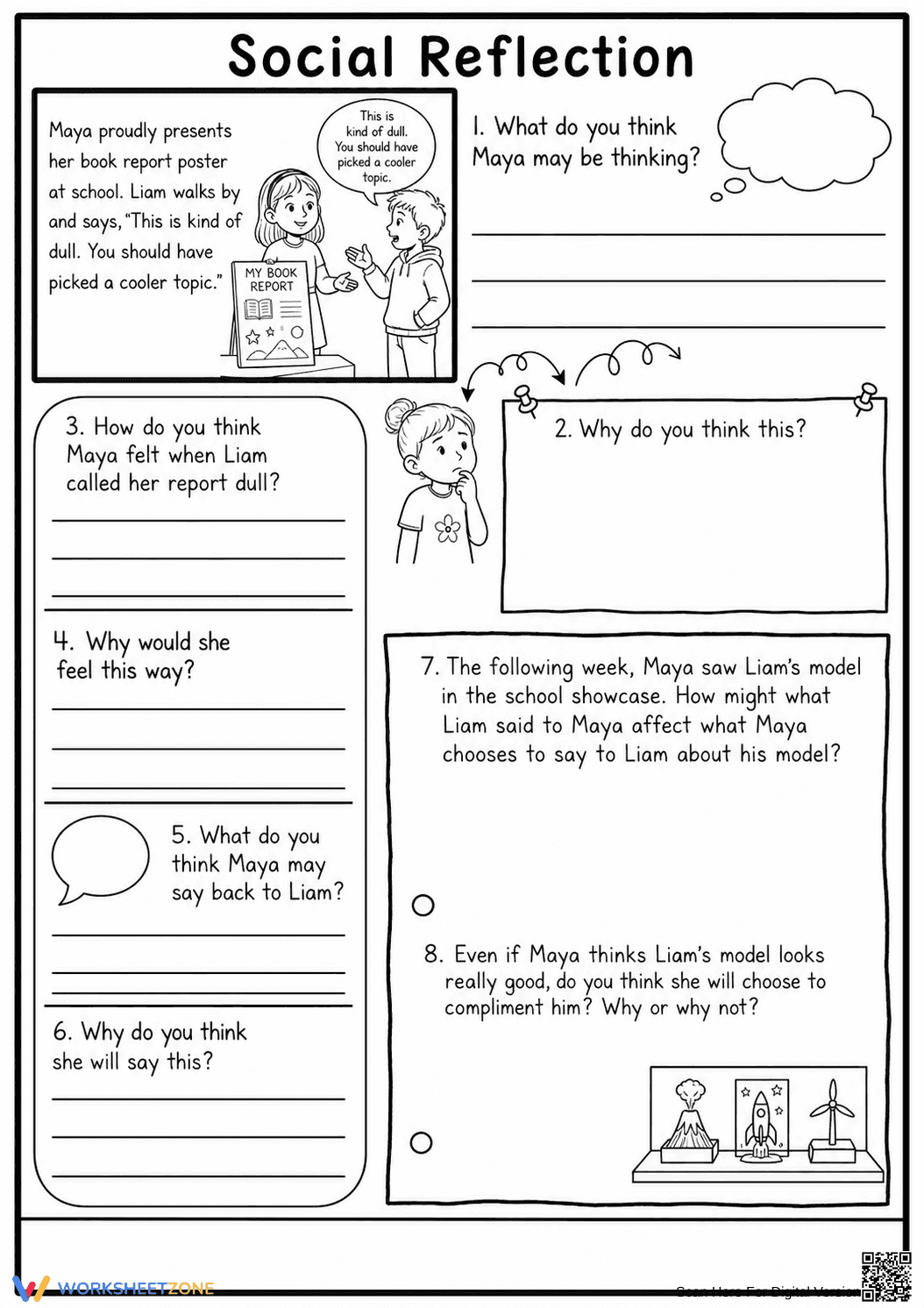
This high school social reflection worksheet helps students build empathy and perspective-taking skills by analyzing a relatable peer conflict. By examining a scenario where a student receives unprompted criticism, learners practice identifying emotional impacts and predicting how negative interactions shape future relationships and communication.
At a Glance
- Grade: 9-12 · Subject: Social Skills
- Standard:
CCSS.ELA-LITERACY.SL.9-10.1— Participate effectively in collaborative discussions and peer interactions- Skill Focus: Empathy and Perspective-Taking
- Format: 1 page · 8 problems · PDF
- Best For: Advisory periods or SEL blocks
- Time: 15–20 minutes
This single-page resource features a realistic scenario followed by eight reflection prompts. Students identify the immediate thoughts and feelings of the targeted student, Maya. The questions increase in complexity, asking learners to analyze the reasons for her emotional response, predict her retaliation, and evaluate how this interaction alters her willingness to engage with Liam in the future. The open-ended format encourages critical thinking.
Designed for immediate implementation, this resource requires minimal setup:
- Print (1 minute): Ink-efficient and ready to copy for an entire class.
- Distribute (1 minute): Hand out as a bell-ringer or advisory activity.
- Review (3 minutes): Use the scenario to spark a whole-class discussion on diverse perspectives.
With under two minutes of total teacher prep time, this worksheet is an excellent addition to any emergency sub plan or dedicated social-emotional learning curriculum.
This activity aligns with CCSS.ELA-LITERACY.SL.9-10.1: Initiate and participate effectively in collaborative discussions on grades 9-10 topics, building on others' ideas. It supports broader SEL frameworks focused on social awareness. Both standard codes can be copied directly into lesson plans, IEP goals, or district curriculum mapping tools.
Use this worksheet during an advisory period before direct instruction on conflict resolution to pre-assess empathy skills. Alternatively, assign it as an independent reflection after a classroom disagreement. As a formative assessment observation tip, listen to peer discussions during the review phase to gauge their ability to validate differing emotional responses. Expected completion time is 15 to 20 minutes.
Designed for Grades 9-12 students developing social awareness and peer communication skills. It benefits teens in social skills groups or restorative justice programs needing concrete scenarios to practice perspective-taking. Pair this worksheet with an anchor chart detailing emotional vocabulary or a lesson on constructive feedback.
Integrating structured empathy exercises into the secondary curriculum is essential for fostering a supportive school climate and developing mature communication habits. This resource targets CCSS.ELA-LITERACY.SL.9-10.1, helping students participate effectively in collaborative discussions and peer interactions by analyzing the emotional weight of their words. According to a comprehensive EdReports 2024 analysis, instructional materials that embed explicit social-emotional reflection within academic tasks significantly improve both peer relationship quality and overall classroom engagement. By systematically breaking down a single peer conflict into eight distinct analytical steps, this worksheet prevents cognitive overload while maximizing emotional processing. Students who regularly engage in this type of guided perspective-taking demonstrate a marked decrease in impulsive negative reactions and an increased capacity for restorative dialogue. This evidence-based approach ensures that social skills instruction remains rigorous, relevant, and directly applicable to students' daily lives.


