


























Views
Downloads

Interpreting Social Cues Worksheet | Grade 9-12 Ready
Paste this activity's link or code into your existing LMS (Google Classroom, Canvas, Teams, Schoology, Moodle, etc.).
Students can open and work on the activity right away, with no student login required.
You'll still be able to track student progress and results from your teacher account.
This social-emotional learning worksheet helps high school students master the art of perspective-taking by analyzing a common classroom conflict. By distinguishing between internal thoughts and external dialogue, learners develop the empathy and self-regulation required for successful interpersonal interactions in academic and professional settings.
At a Glance
- Grade: 9-12 · Subject: Social Skills
- Standard:
CCSS.ELA-LITERACY.SL.9-10.1— Initiate and participate effectively in a range of collaborative discussions- Skill Focus: Perspective-taking
- Format: 1 page · 2 problems · No answer key · PDF
- Best For: Social-emotional learning and behavior intervention
- Time: 10–15 minutes
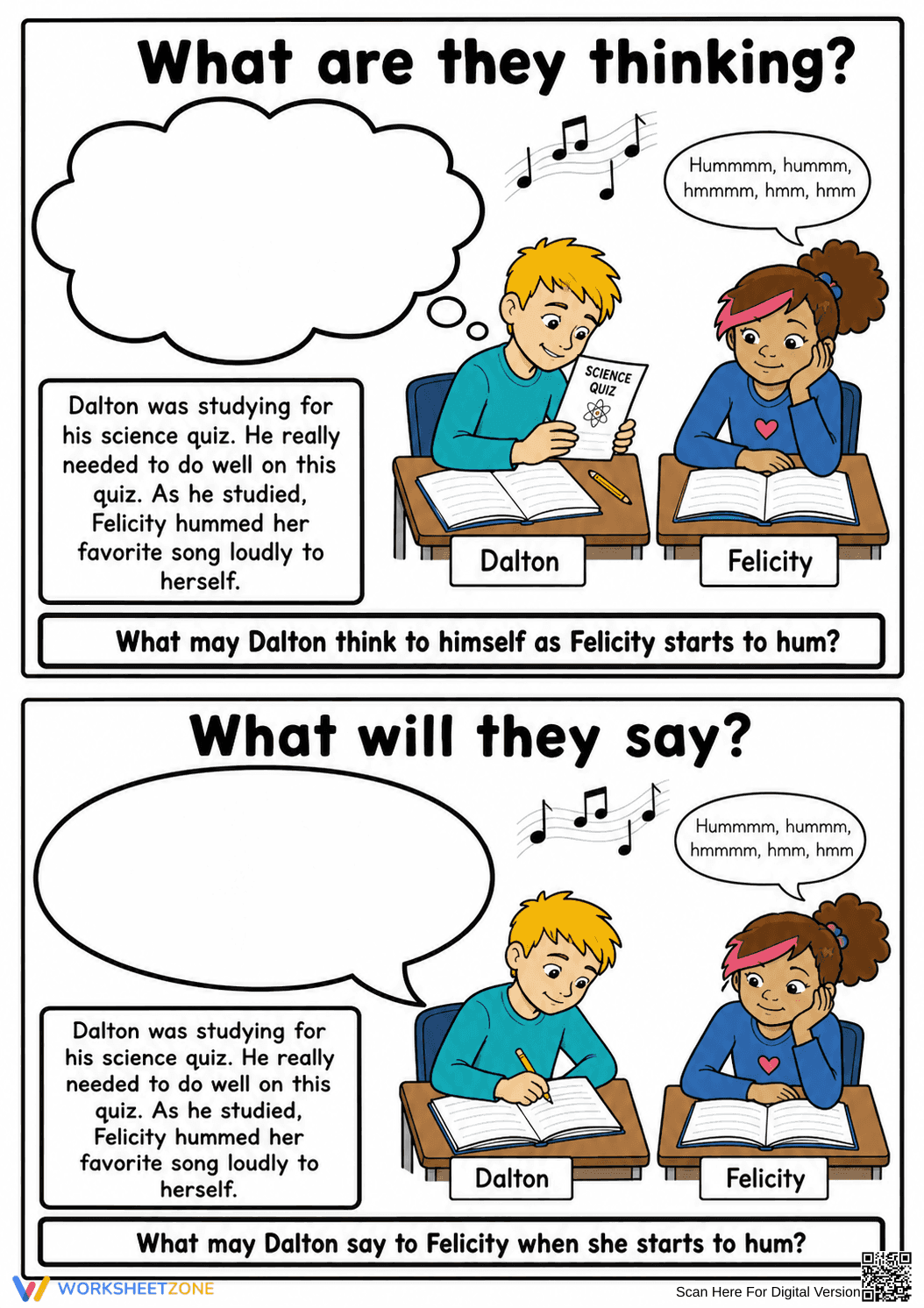
The worksheet features a single-page layout divided into two critical reflective tasks. It presents a relatable scenario involving two students, Dalton and Felicity, where a distraction occurs during study time. Students must fill in a large thought bubble to represent internal processing and a speech bubble to represent appropriate social communication. The clear illustrations provide visual context to support inference.
Zero-Prep Workflow:
- Print (30 seconds): Download the PDF and print copies for your social skills group or entire class.
- Distribute (30 seconds): Hand out the worksheet as a bell-ringer or a transition activity during behavior intervention blocks.
- Review (1 minute): Facilitate a brief discussion on the difference between what we think and what we say to maintain positive relationships.
This resource aligns with CCSS.ELA-LITERACY.SL.9-10.1, which requires students to initiate and participate effectively in a range of collaborative discussions with diverse partners. By practicing perspective-taking, students prepare to build on others' ideas and express their own clearly and persuasively. Both standard codes can be copied directly into lesson plans, IEP goals, or district curriculum mapping tools.
Use this worksheet during a small-group social skills lesson to model appropriate conflict resolution. It serves as an excellent formative assessment tool; observe whether students can identify Dalton's likely frustration without resorting to aggressive dialogue. It is best used after a direct instruction lesson on "Social Filters" or "Theory of Mind." Expected completion time ranges from 10 to 15 minutes.
This activity is designed for high school students, particularly those in social skills training, counseling groups, or students with IEP goals related to social-emotional regulation. It pairs naturally with an anchor chart on "Think It vs. Say It" or a video lesson on reading non-verbal body language to provide a comprehensive instructional experience.
According to Fisher & Frey (2014), the development of social-emotional competence is foundational to academic success, as students must be able to navigate complex social environments to engage in collaborative learning. This worksheet targets the specific skill of perspective-taking, which is a core component of the CCSS.ELA-LITERACY.SL.9-10.1 standard. By requiring students to articulate both internal thoughts and external speech, the activity reinforces the concept of a social filter, a critical executive function for adolescents. Research from the NAEP suggests that students with higher social-emotional awareness demonstrate better engagement in classroom discussions and higher overall literacy outcomes. This 1-page printable provides a structured, low-stakes environment for teens to practice these high-stakes social maneuvers. The scenario-based approach ensures that the abstract concept of empathy is grounded in a concrete, relatable experience, allowing for immediate application in the school environment.


