


























Views
Downloads
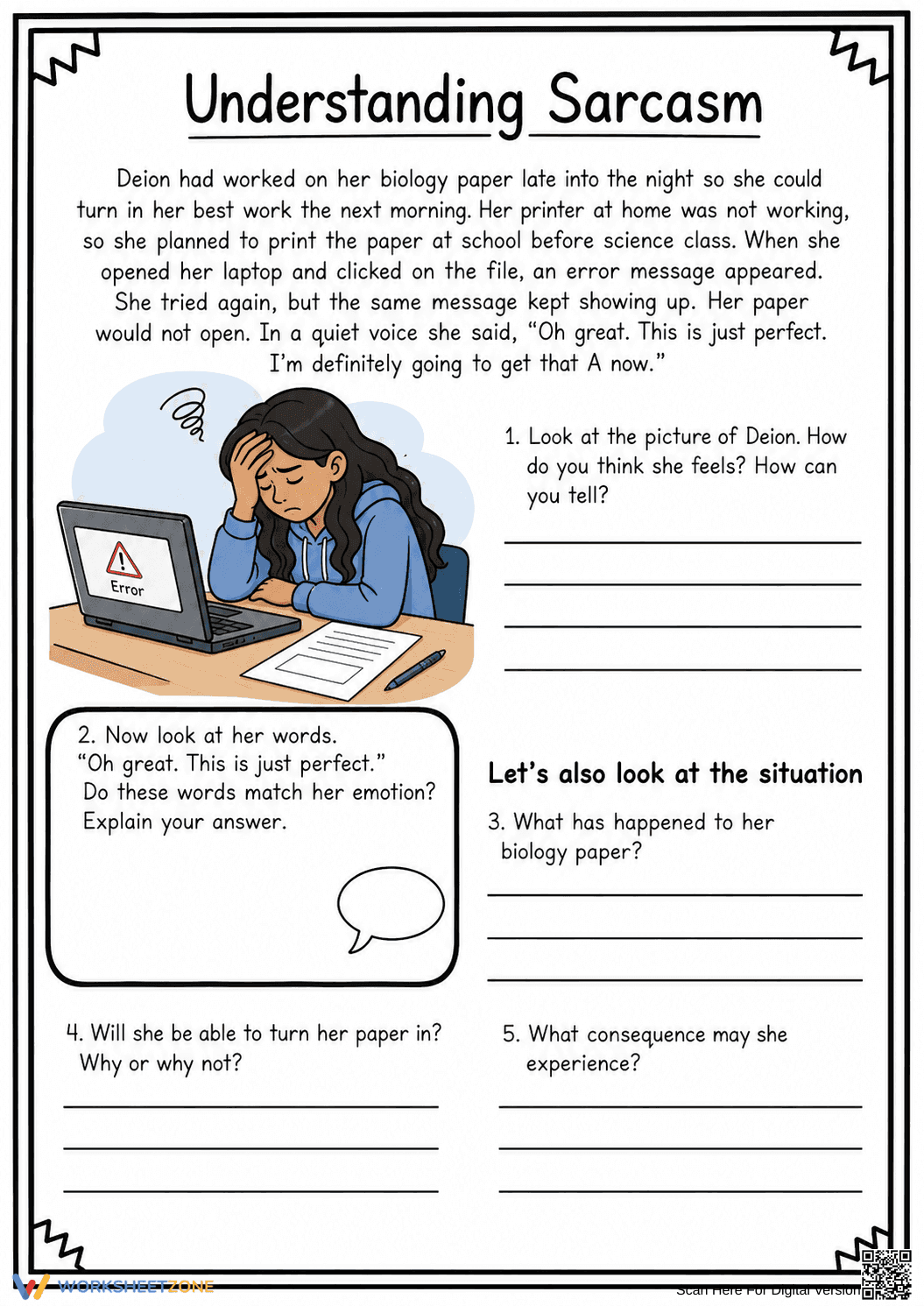

Understanding Sarcasm Worksheet | Grade 9-12 Printable
Paste this activity's link or code into your existing LMS (Google Classroom, Canvas, Teams, Schoology, Moodle, etc.).
Students can open and work on the activity right away, with no student login required.
You'll still be able to track student progress and results from your teacher account.
This high school English and social skills worksheet helps students decode non-literal language by analyzing a relatable scenario. Students read a short narrative about a frustrating computer error and evaluate the character's sarcastic response. By examining the disconnect between spoken words and actual emotions, learners build essential inferencing skills.
At a Glance
- Grade: 9 · Subject: English
- Standard:
CCSS.ELA-LITERACY.L.9-10.5— Interpret figures of speech and nuances in context- Skill Focus: Understanding sarcasm
- Format: 1 page · 5 problems · Answer key included · PDF
- Best For: Independent practice and social skills
- Time: 15–20 minutes
This single-page resource features a brief narrative paired with a visual cue of a frustrated student. It includes five short-answer questions guiding learners through a structured analysis. Students identify the character's true feelings based on visual evidence, contrast those feelings with her spoken dialogue, and predict logical consequences. A complete answer key is included to support quick grading.
Designed for immediate classroom implementation, this resource requires virtually no teacher setup:
- Print (1 minute): The single-page layout is highly visual and prints cleanly in black and white or color.
- Distribute (1 minute): Hand out the scenario to students as a bell-ringer or standalone activity.
- Review (3 minutes): Use the included answer key to quickly check comprehension or guide a whole-class discussion on tone.
With under two minutes of total prep time, this worksheet is an excellent addition to any emergency sub plan or last-minute lesson adjustment.
This activity is directly aligned to CCSS.ELA-LITERACY.L.9-10.5, requiring students to demonstrate understanding of figurative language, word relationships, and nuances in word meanings. It specifically targets the ability to interpret non-literal language and tone in context. Both standard codes can be copied directly into lesson plans, IEP goals, or district curriculum mapping tools.
Deploy this worksheet during a figurative language unit or as a targeted intervention for pragmatic social skills. It works exceptionally well as an independent warm-up before direct instruction on irony. Alternatively, use it in a small-group setting where students debate the character's true intentions. Expected completion time is 15 to 20 minutes. As a formative assessment tip, observe how students answer question two; if they struggle to articulate why the words do not match the emotion, they may need additional modeling.
This resource is primarily designed for high school students in grades 9 through 12 who are refining their literary analysis and social-emotional skills. It provides excellent differentiation for neurodivergent learners or English Language Learners who benefit from explicit instruction in pragmatic language and non-literal communication. Pair this worksheet with a short video clip demonstrating sarcastic tone to provide a multi-sensory learning experience.
Mastering non-literal language is a critical component of advanced reading comprehension and effective interpersonal communication for high school learners. Aligned with CCSS.ELA-LITERACY.L.9-10.5, this resource challenges students to interpret figures of speech and nuances in context by analyzing the gap between literal statements and intended meaning. According to Fisher & Frey (2014), explicit instruction in pragmatic language and tone significantly improves students' ability to navigate complex texts and real-world social interactions. By breaking down a sarcastic remark into observable visual cues, situational context, and spoken dialogue, educators can demystify abstract linguistic concepts that often confuse developing readers. This targeted practice ensures learners develop the cognitive flexibility required to infer meaning accurately, ultimately strengthening both their academic literary analysis skills and their everyday emotional intelligence in diverse communicative settings.


