


























Views
Downloads

Essential Social Responses Worksheet | Grade 3 Social Skills
Paste this activity's link or code into your existing LMS (Google Classroom, Canvas, Teams, Schoology, Moodle, etc.).
Students can open and work on the activity right away, with no student login required.
You'll still be able to track student progress and results from your teacher account.
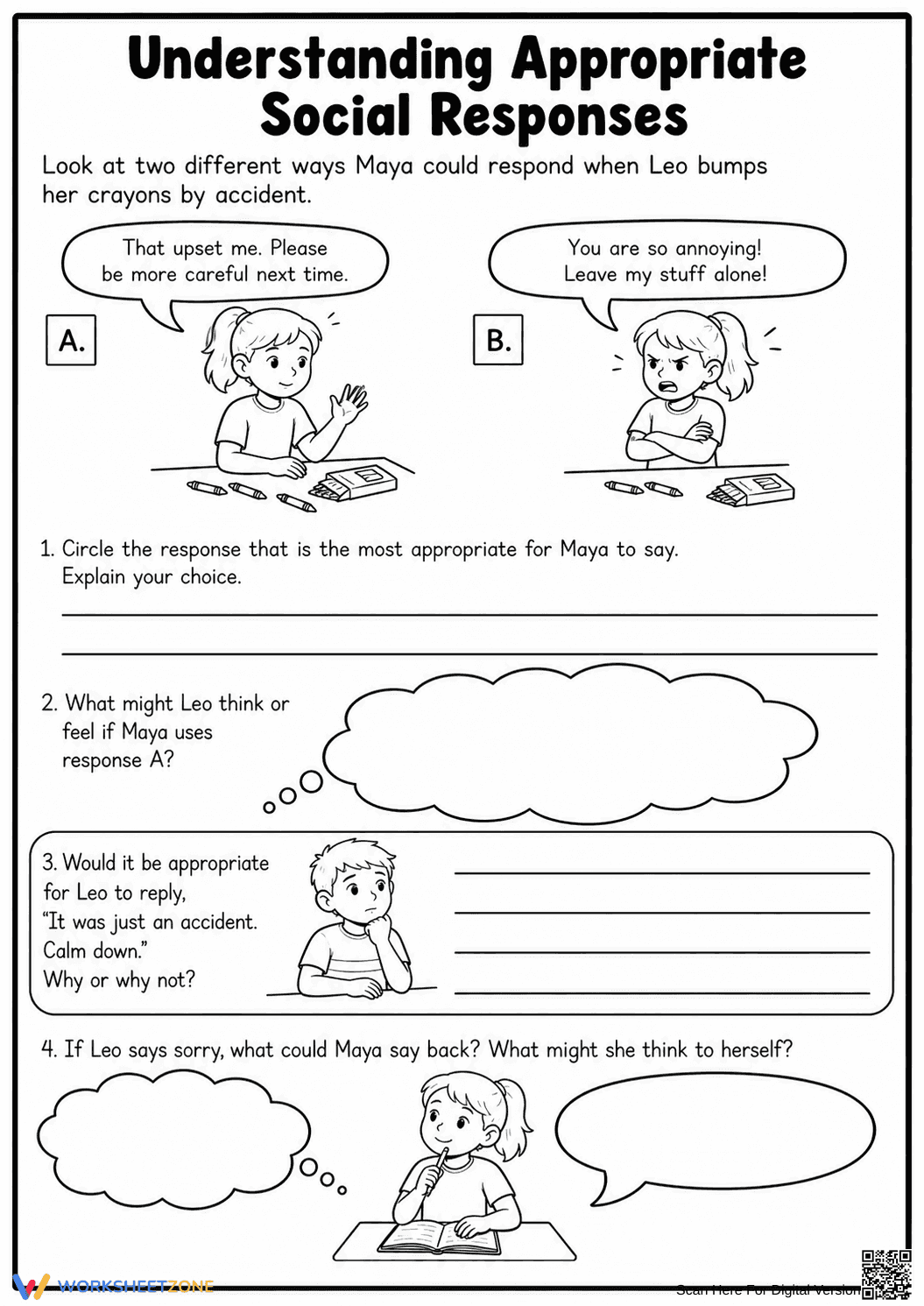
This social reflection worksheet helps students identify and practice appropriate responses to common interpersonal conflicts. By analyzing a scenario involving a peer bumping into their belongings, learners develop the emotional intelligence needed to communicate feelings respectfully. This resource ensures students understand the difference between reactive anger and constructive dialogue in a classroom setting.
At a Glance
- Grade: 3 · Subject: Social Skills
- Standard:
CCSS.ELA-LITERACY.SL.3.1— Engage effectively in collaborative discussions and express ideas clearly- Skill Focus: Social-Emotional Reflection
- Format: 1 page · 4 problems · Answer key included · PDF
- Best For: Small group social-emotional learning sessions
- Time: 15–20 minutes
The worksheet features a relatable scenario with two distinct response options illustrated with clear character expressions. It includes 4 structured tasks: a multiple-choice selection with written justification, a perspective-taking thought bubble exercise, a critical thinking prompt regarding peer replies, and a final creative application task for internal and external dialogue. The layout is clean and student-friendly.
Skill Progression
- Guided practice: Students evaluate two pre-written responses to determine which is more respectful and explain their reasoning using provided lines.
- Supported practice: Learners move to perspective-taking by inferring the feelings of others based on the chosen social interaction.
- Independent practice: The final task requires students to generate their own dialogue and internal thoughts, completing the gradual-release model of social skill acquisition.
This sequence follows the I Do, We Do, You Do instructional framework for behavioral modeling.
Standards Alignment
This resource aligns with `CCSS.ELA-LITERACY.SL.3.1`, which requires students to engage effectively in a range of collaborative discussions. It specifically addresses the sub-skill of following agreed-upon rules for discussions and carrying out assigned roles by teaching students how to respond to peers appropriately. Both standard codes can be copied directly into lesson plans, IEP goals, or district curriculum mapping tools.
How to Use It
Use this worksheet during a morning meeting or as a follow-up to a lesson on empathy. It works well as a formative assessment; observe if students can distinguish between "I-statements" and "You-statements" during the explanation phase. Expect students to spend 15 to 20 minutes completing the written reflections and discussing their answers with a partner to reinforce the concepts.
Who It's For
This is designed for elementary students in grades 2 through 4, particularly those working on conflict resolution or social-emotional goals. It is an excellent pairing for a classroom anchor chart on "Big Problems vs. Small Problems" or a direct instruction lesson on perspective-taking and self-regulation during peer interactions.
Research from Fisher & Frey (2014) emphasizes that social-emotional learning is most effective when integrated with literacy tasks that require students to justify their reasoning. This worksheet applies that principle by asking students to not only choose a response but also explain the reasoning behind social cues. By aligning with CCSS.ELA-LITERACY.SL.3.1, the resource bridges the gap between behavioral expectations and academic communication standards. Students who practice these scenarios in a low-stakes, printable format are better equipped to handle real-world peer interactions with empathy and self-regulation. According to recent NAEP data, students with strong interpersonal communication skills show higher engagement in collaborative academic tasks. This 1-page PDF provides a structured framework for developing those essential competencies through 4 targeted reflection prompts that focus on the impact of words on others.


