


























Views
Downloads
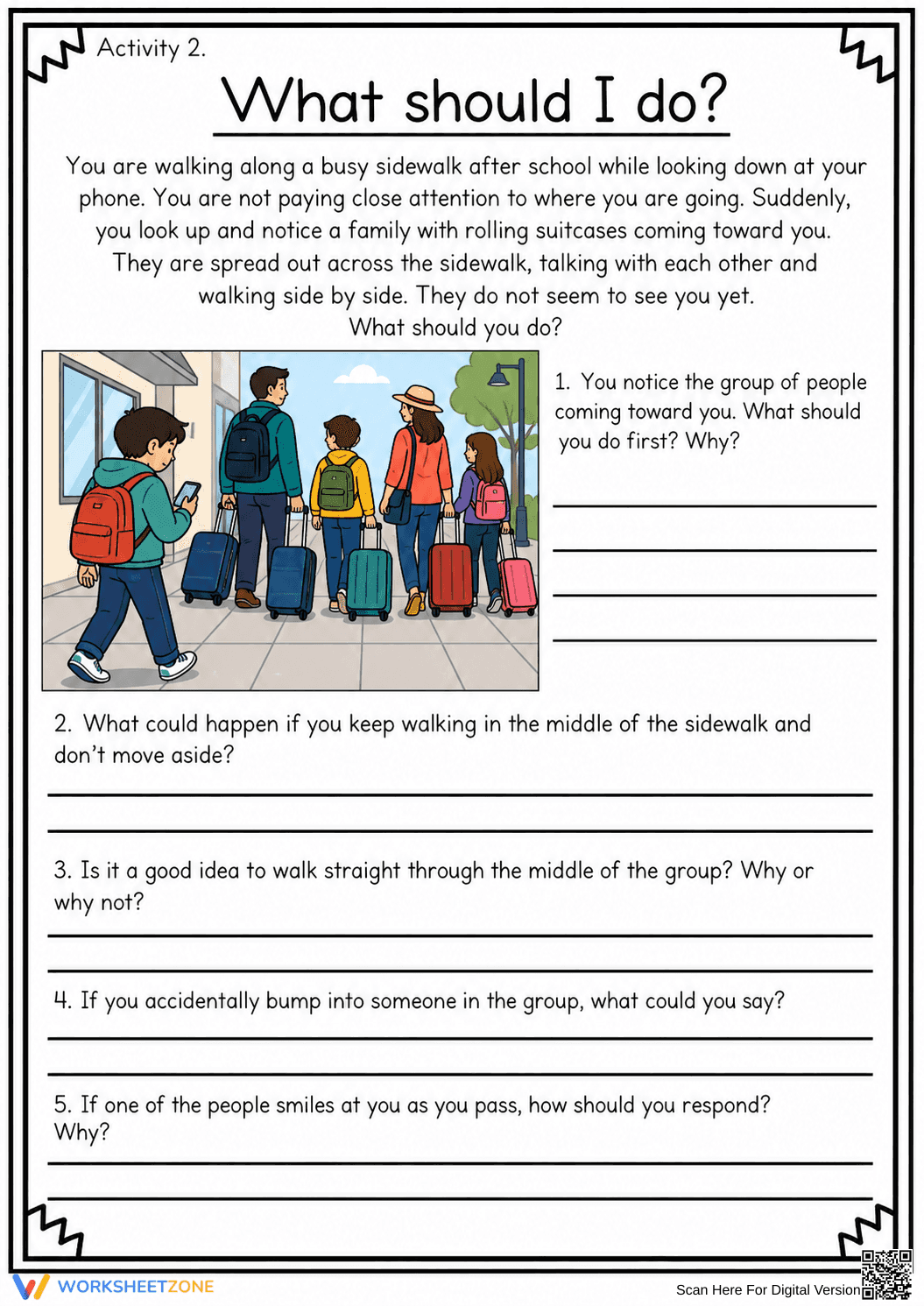

Social Problem-Solving Worksheet | Grade 9-12 Ready
Paste this activity's link or code into your existing LMS (Google Classroom, Canvas, Teams, Schoology, Moodle, etc.).
Students can open and work on the activity right away, with no student login required.
You'll still be able to track student progress and results from your teacher account.
Social awareness is a cornerstone of high school development. This worksheet provides a realistic scenario involving distracted walking and public etiquette. Students analyze a social conflict to determine the most respectful course of action. It bridges the gap between internal thought processes and external social behaviors in real-world settings.
At a Glance
- Grade: 9-12 · Subject: Social Skills
- Standard:
CCSS.ELA-LITERACY.SL.9-10.1— Participate in collaborative discussions and demonstrate social awareness in scenarios- Skill Focus: Social Problem-Solving
- Format: 1 page · 5 problems · Answer key included · PDF
- Best For: Advisory or SEL instruction
- Time: 15–20 minutes
This single-page PDF features a visual prompt of a student texting while walking. It includes five open-ended reflection questions targeting perspective-taking and polite communication. The layout is clean, providing ample writing space for multi-sentence responses without requiring additional teacher preparation or materials.
Zero-Prep Workflow
- Print: Generate copies for your group in under 2 minutes.
- Distribute: Assign the sheet as a quiet bell-ringer or advisory activity (10-15 minutes).
- Review: Discuss the answers as a group to facilitate a 5-minute conversation on social norms and community expectations.
Standards Alignment
The primary standard addressed is `CCSS.ELA-LITERACY.SL.9-10.1`, which requires students to initiate and participate effectively in a range of collaborative discussions with diverse partners. By reflecting on social scenarios, students prepare to express their ideas clearly and persuasively. Both standard codes can be copied directly into lesson plans, IEP goals, or district curriculum mapping tools.
How to Use It
Use this as a formative assessment during an advisory period to gauge student understanding of social boundaries. It also works well as a sub plan filler that maintains instructional value. Observe how students justify their responses to question four regarding accidental contact; this provides insight into their conflict-resolution skills and empathy levels. Expected completion time is 15 to 20 minutes.
Who It's For
This resource is ideal for high school students in general education or those receiving specialized social-emotional support. It pairs naturally with an anchor chart on public etiquette or a direct instruction lesson on situational awareness. It is particularly useful for teens navigating the complexities of mobile phone use in shared public spaces.
This educational resource is specifically designed to address CCSS.ELA-LITERACY.SL.9-10.1 by challenging high school students to analyze social dynamics and predict consequences in public spaces. By focusing on the intersection of technology use and physical situational awareness, the worksheet facilitates the development of pragmatic language and social-emotional intelligence. Research by Fisher & Frey (2014) emphasizes that scaffolded social scenarios allow students to rehearse complex interpersonal interactions in a low-stakes environment, which is critical for transitioning into adult professional and social spheres. The five targeted questions require students to move beyond simple 'yes/no' answers, instead demanding justification for their social choices. This alignment ensures that the activity serves both as a behavioral intervention and a literacy-based reflection tool. Educators can utilize this worksheet to document progress in social-emotional learning goals or as a foundational piece for larger classroom discussions regarding community norms and personal responsibility in shared public environments.


