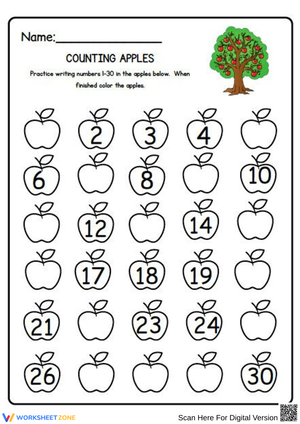
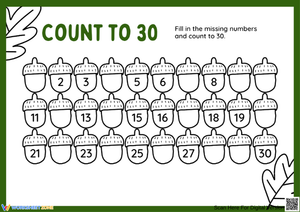
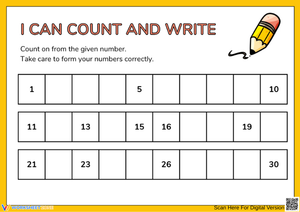
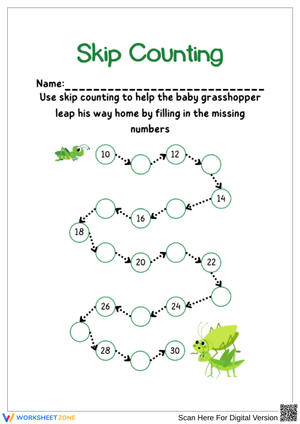
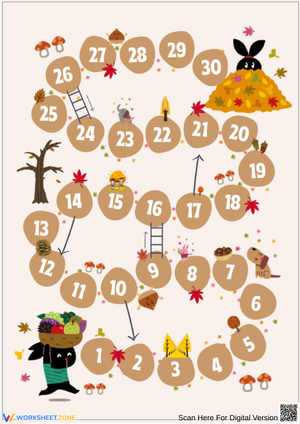
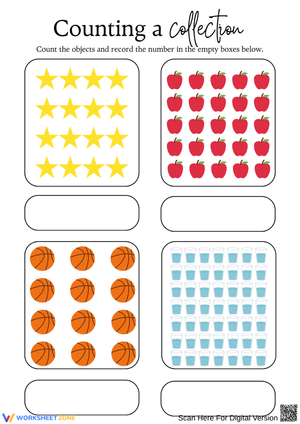
These counting to 30 printable worksheets for 1st grade give teachers a clear picture of who is counting with genuine understanding and who is reciting from memory — a distinction that rarely surfaces during morning calendar or choral counting but becomes visible the moment a student works alone on paper. Each worksheet targets one skill directly: forward sequences, missing numerals, object counting with one-to-one correspondence, numeral writing, or moving between representations like ten frames and tally marks. The result is a collection teachers can place into morning work, small-group instruction, or intervention folders without rewriting the lesson plan.
The Specific Skills Each Worksheet Targets
The set addresses five task types, each reaching a different layer of number understanding:
- Forward sequences from a non-zero start: Students fill in counting chains beginning at 8, 14, or 23 — not always 1 — testing whether their counting knowledge is anchored to the first number or genuinely portable.
- Missing-number identification: Gaps appear at varied positions within a row, so students cannot coast by counting on from the last numeral they wrote.
- Object counting with one-to-one correspondence: Students mark or cross off pictures as they count, then record the total as a numeral — a two-step process that separates the counting act from the recording act.
- Numeral writing and tracing: Formation practice catches reversal habits before they become automatic, an easier correction at age 6 than at age 8.
- Multiple representations: Students match a quantity to its ten-frame, tally mark, and written numeral on a single worksheet — the kind of flexibility that separates procedural recall from actual number understanding.
These five types are not interchangeable. A student might complete a forward-counting sequence without error and then stall for thirty seconds when shown a ten-frame displaying 17 and asked to write the numeral. That stall tells the teacher exactly where to direct the next small-group session.
Frequent Student Errors Worth Watching For and Addressing Directly
The most predictable mistake in this number range is decade-break confusion. A student writes 28, 29, 30 without hesitation, then writes 18, 19, 10 on the next sequence — resetting the ones digit instead of advancing the tens digit. On paper, this error stays visible for the teacher to examine at the end of a lesson rather than evaporating the moment the student finishes speaking. That permanence is one reason written practice catches what oral routines miss.
Object counting errors follow a different pattern. Students who count pictures arranged in a scattered layout — not a tidy row — often count the same image twice or skip one without noticing. Teaching students to mark each image as they count eliminates most of this confusion and gives them a strategy that transfers beyond the page. A third pattern worth distinguishing: numeral reversal. A student who writes a mirror-image 6 or a backwards 9 often understands the quantity perfectly. That reversal is a formation habit, not a conceptual gap, and it calls for attention during tracing practice rather than additional number sense instruction.
How to Build These Worksheets Into Your Lesson Plans
The steadiest placement is as a consistent opening routine during the first six to eight weeks of 1st grade. A short page — one forward sequence, one missing-number row, two or three object-counting items — gives students an independent task to begin while the teacher handles arrival and attendance. Model the format once during whole-group time, and from that point on students know exactly what to do when they find the page on their desk. That predictability is worth more than novelty during the first weeks of school.
In math centers, counting to 30 printable worksheets for 1st grade pair directly with a basket of linking cubes or two-color counters. Students who need more support build each quantity before writing; students working confidently self-check by building after they record. This setup solves a common center problem: faster students sitting idle while the teacher works with another group. For intervention, use one worksheet per session rather than working through several. Sit alongside the student, ask them to count aloud while they work, and watch where they pause, erase, or restart from 1. Those behaviors tell more than the final written answers do.
Standard Alignment
These counting to 30 printable worksheets for 1st grade connect to CCSS.MATH.CONTENT.1.NBT.A.1, which requires students to count to 120 starting from any number less than 120. Counting to 30 reliably is the fluency prerequisite for that standard — students who still lose track in the mid-20s will not hold a number sequence together when it extends into the 80s and 100s later in the year. From a pacing standpoint, this practice belongs in the first quarter of 1st grade: it functions simultaneously as a diagnostic checkpoint and a fluency-building routine, landing before teachers introduce two-digit place value decomposition. The missing-number tasks also touch the pattern-recognition strand of early algebraic thinking, though they remain grounded in the counting-and-cardinality work students carried over from kindergarten.
Adjusting the Worksheets for a Range of Learners
For students still building foundational counting, cover the lower portion of the page with a blank sheet so only one task is visible at a time. This reduces visual load without changing the content — the skill stays the same, but the student's attention isn't pulled toward unfinished items below. Let these students place counters directly on printed images as they count, and read any written directions aloud before they begin independently. Some students entering 1st grade are still landing their reliable counting around 20; working within that range first and extending to 30 gradually is developmentally sound and easy to manage with the same worksheet by simply stopping the task partway through.
On-level students benefit from a partner-share step after finishing a page: they pick one answer, explain how they counted to a partner, and compare methods. This adds math language practice without altering the written task. Students ready for more challenge can write their own missing-number row — choosing any span within 1 to 30 — and leave two or three gaps for a classmate to fill. That small extension reveals whether the student understands sequence structure or is simply reproducing what the worksheet shows.
Frequently Asked Questions
How do these worksheets differ from kindergarten counting practice?
Kindergarten counting practice typically stays close to 20 and centers on one-to-one correspondence with concrete objects. These worksheets extend the working range to 30, introduce missing-number tasks at varied positions, and ask students to shift between representations — ten frames, tally marks, and written numerals — within a single task. The formats also expect more independent work, matching the raised expectations of early 1st grade math.
Can these pages be used for formative assessment?
Yes. A single completed page shows whether a student counts forward accurately, identifies a missing numeral without restarting from 1, and writes numerals legibly. If you need a quick summative snapshot, select one worksheet with two or three item types and score accuracy and numeral formation separately — they are distinct data points that call for different instructional responses.
How often should 1st graders practice counting to 30?
Daily brief practice — five to eight minutes — builds fluency faster than longer weekly sessions. Spaced, repeated contact with the same number range helps students recognize sequences automatically rather than reconstructing them from the beginning each time. Once a student counts reliably from any starting point within 30, the counting to 30 printable worksheets for 1st grade shift their function: they become targeted review for students who still need reinforcement rather than new instruction for the class as a whole.
What should early finishers do while classmates complete the page?
A few extension prompts written on an index card near the math center — write the sequence backward from 30, find two numbers on the page that differ by exactly 10, draw a ten-frame to match a number you circled — give early finishers purposeful work without requiring the teacher to intervene. These take under two minutes to prepare and cost nothing in additional materials.













 Interactive Worksheet Maker
 Quiz Maker
 Word Search Maker
 Crossword Puzzle Maker
 Word Scramble Generator
 Sentence Scramble Generator
 Handwriting Worksheet Generator
 Name Tracing Generator
 Fill In The Blank Generator