


























Views
Downloads
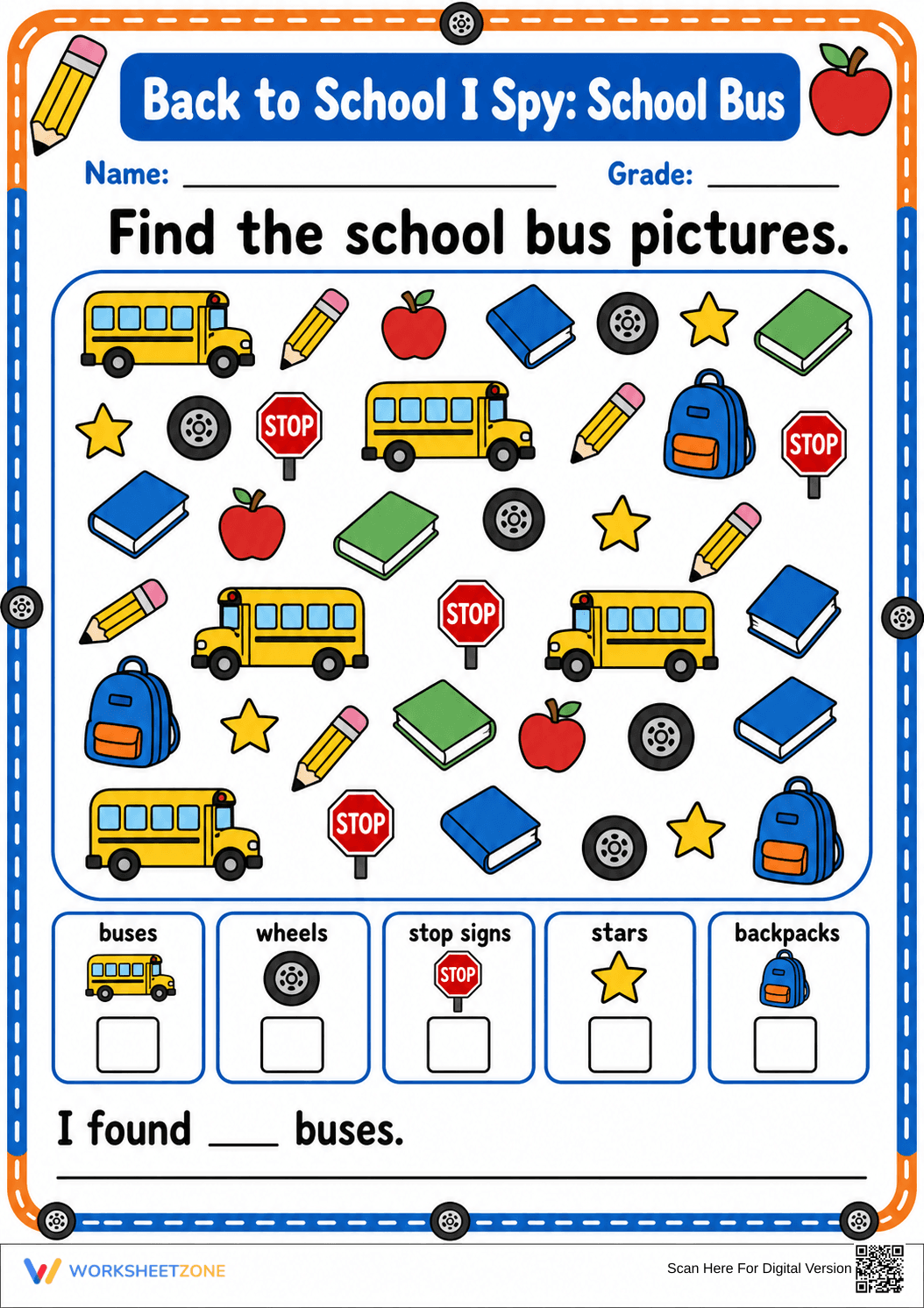

Printable Back to School I Spy: School Bus Counting
Paste this activity's link or code into your existing LMS (Google Classroom, Canvas, Teams, Schoology, Moodle, etc.).
Students can open and work on the activity right away, with no student login required.
You'll still be able to track student progress and results from your teacher account.
This Kindergarten math worksheet strengthens visual discrimination and counting skills through an engaging 'I Spy' activity. Students search for and count five different school-themed objects, including buses, wheels, and backpacks, to practice one-to-one correspondence. By recording their findings in a structured table, learners build a solid foundation for cardinality and data organization in a fun, thematic format.
At a Glance
- Grade: Kindergarten · Subject: Math
- Standard:
CCSS.MATH.CONTENT.K.CC.B.4— Understand the relationship between numbers and quantities; connect counting to cardinality- Skill Focus: Visual discrimination and counting
- Format: 1 page · 6 tasks · Answer key included · PDF
- Best For: Morning work or math centers
- Time: 10–15 minutes
What's Inside
The worksheet features a large, clear search area filled with colorful school icons like pencils, apples, and stars. Below the search field, a dedicated counting table provides five labeled boxes for recording the frequency of specific items. A final summary sentence allows students to practice writing their primary finding, ensuring a comprehensive approach to early math and literacy skills.
Zero-Prep Workflow
The zero-prep design of this worksheet ensures a smooth classroom experience. Step 1: Print the single-page PDF (30 seconds). Step 2: Distribute to students as a morning warm-up or independent center activity (1 minute). Step 3: Review the counts as a whole group to provide immediate feedback on accuracy (5 minutes). This streamlined workflow requires less than 2 minutes of teacher preparation, making it an ideal choice for busy mornings or unexpected substitute plans.
Standards Alignment
This resource is primarily aligned with CCSS.MATH.CONTENT.K.CC.B.4, which requires students to understand the relationship between numbers and quantities. It also supports CCSS.MATH.CONTENT.K.CC.B.5 by asking students to count objects in a scattered arrangement. Both standard codes can be copied directly into lesson plans, IEP goals, or district curriculum mapping tools.
How to Use It
Use this worksheet during the 'You Do' phase of a lesson on counting to 10. It works exceptionally well as a formative assessment; observe if students use a marking strategy, like crossing out objects, to keep track of their count. The expected completion time is 10 to 15 minutes, depending on the student's level of visual scanning proficiency and fine motor control.
Who It's For
This activity is designed for Kindergarten students but is also suitable for Pre-K learners ready for counting practice or first graders needing a quick review. It pairs naturally with a 'Back to School' picture book or a direct instruction lesson on identifying shapes and objects within a complex visual field.
This educational resource is specifically designed to support the development of early numeracy through visual discrimination and one-to-one correspondence. By engaging with the CCSS.MATH.CONTENT.K.CC.B.4 standard, students learn to connect number names to specific quantities within a thematic 'Back to School' context. Research by Fisher & Frey (2014) emphasizes the importance of scaffolded visual tasks in developing cognitive stamina and mathematical fluency in early childhood learners. This worksheet provides a structured environment where students can practice counting objects in scattered configurations, a critical precursor to more complex arithmetic operations. The inclusion of a summary sentence further bridges the gap between mathematical computation and literacy, encouraging students to express their findings in a complete thought. Educators can utilize this tool to assess a child's ability to track objects systematically and record data accurately. This resource serves as a foundational component in a comprehensive early elementary mathematics curriculum, ensuring students master cardinality with confidence and precision.


