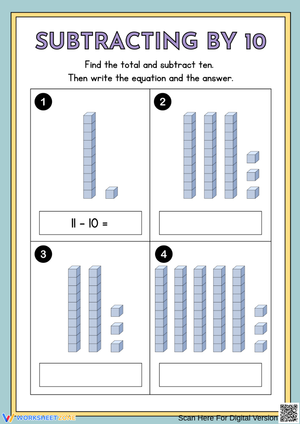
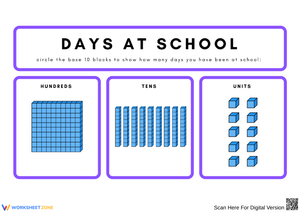
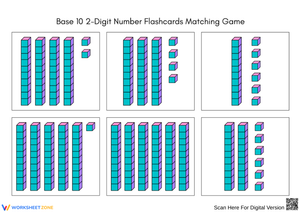
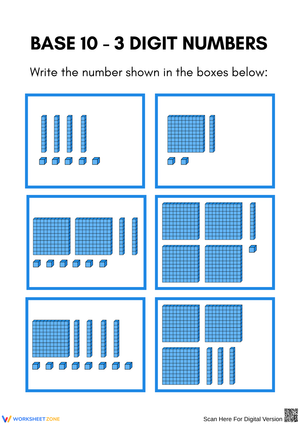
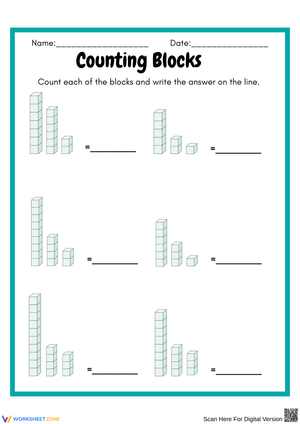
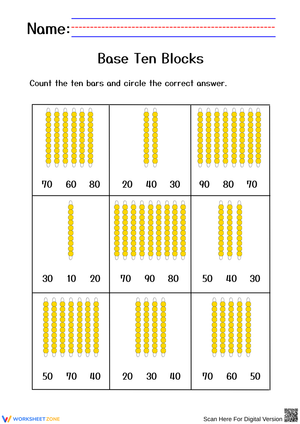
These base ten blocks printable worksheets for 1st grade give teachers a ready supply of visual practice that bridges hands-on block work and pencil-and-paper independence. Each worksheet uses printed images of tens rods and ones cubes — the same physical forms students handle at the math table — so the move from manipulative exploration to individual seat work doesn't feel like a switch to a completely different activity. The set addresses the full range of ones-and-tens skills that Grade 1 number sense requires, from reading a block picture and writing the numeral to drawing blocks for a given number and making simple comparisons.
The Specific Skills Targeted
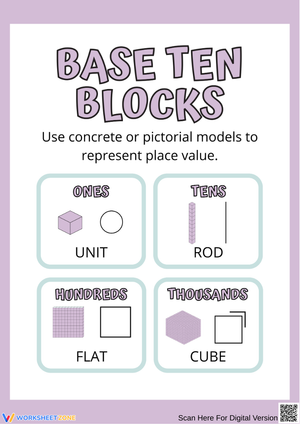
Each worksheet focuses on a distinct move students need to make fluently with two-digit numbers. The work stays within ones and tens only — no hundreds flats appear anywhere in the set, which keeps all tasks aligned to Grade 1 expectations and avoids the cognitive overload that comes from introducing a third place-value position before students have secured the first two.
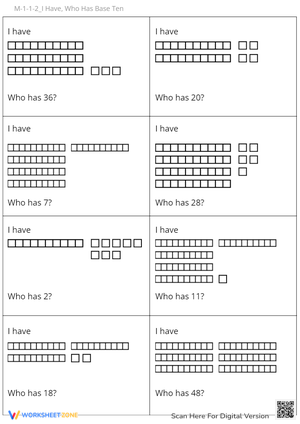
- Counting tens and ones from a block image: Students look at a printed arrangement of rods and cubes, count each group separately, and record the matching two-digit number. Three rods and four cubes becomes 34 — that decomposition step is the core move these worksheets practice.
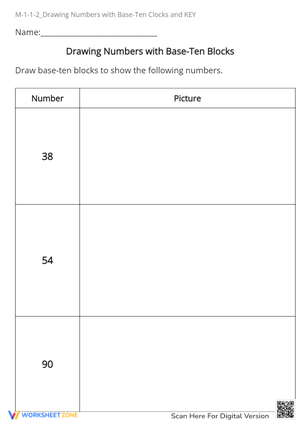
- Translating a numeral into a block drawing: Given a number like 52, students sketch five tens rods and two ones cubes. This direction — numeral to image rather than image to numeral — is consistently harder for first graders and worth treating as its own skill.
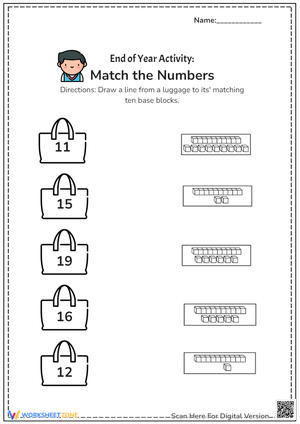
- Matching block pictures to written numbers: Students draw lines between block images and numerals, reinforcing the connection between the visual model and the written symbol.
- Comparing two-digit numbers with block models: Side-by-side block arrangements help students determine which value is greater and which is less. Seeing both numbers in picture form before writing a comparison gives students a concrete check on their own reasoning.
- Adding groups of blocks: Some worksheets show two collections of rods and cubes and ask students to find the combined total, introducing addition within 100 in a format where the numbers remain visible and manageable throughout the task.
Standard Alignment
These worksheets sit squarely in the Number and Operations in Base Ten domain of the Common Core State Standards. The most central standard is CCSS 1.NBT.B.2, which requires students to understand that the two digits of a two-digit number represent amounts of tens and ones — every counting and drawing task in the set addresses this directly. Worksheets that pair block images with numeral writing support CCSS 1.NBT.A.1, which covers reading and writing numerals to 120. Comparison tasks align to CCSS 1.NBT.B.3, and addition work with block groups connects to CCSS 1.NBT.C.4. Restricting all representations to ones and tens keeps the resources in Grade 1 territory rather than drifting into the three-digit work students encounter in second grade.
The Place Value Errors That Surface in Student Work
The most reliable mistake is digit reversal when students count blocks and then record. A student who correctly counts two tens rods and seven ones cubes will sometimes write 72 instead of 27 — not because they miscounted, but because they wrote the ones digit first, recording in the direction they finished counting. This pattern is worth watching for during the first few independent practice sessions because it reveals whether a student understands positional value or is simply following a counting routine without grasping the structure behind it.
A second error surfaces on drawing tasks. When asked to draw 40, some students sketch four individual ones cubes rather than four tens rods. They read the digit 4 and act on it, ignoring the tens column entirely. That specific mistake signals that the student has learned to count blocks but hasn't yet internalized that position changes value. Asking students to build the number with physical blocks first, then draw what they built, generally catches this before it becomes ingrained practice.
Fitting These Worksheets Into Your Lesson Planning
The most effective sequence runs from whole-group modeling to guided small-group practice before students reach independent work. During a whole-class introduction, projecting one worksheet and working through the first two problems together — thinking aloud about counting rods before cubes, then recording each group in a tens-ones chart — gives students a clear procedure to follow when they work alone. For guided groups of four to six students, providing each child with a printed worksheet alongside physical base ten blocks lets them build the number, verify it in three dimensions, and then record it on paper. That concrete-to-representational move is where sustained understanding takes hold.
Base ten blocks printable worksheets for 1st grade also function well as independent math center materials with a simple answer key for self-checking, and they travel home without any special preparation — a short note explaining that long bars represent ten units helps family members give useful feedback rather than guessing at the format. Exit tickets are another reliable use: one problem cut from a worksheet takes about three minutes at the close of a place value lesson and tells you clearly whether the next session should reteach, review, or advance.
Adjusting the Set for a Range of Learners
Students who are still solidifying one-to-one counting do better with worksheets that use smaller numbers — ideally under 30 — with blocks arranged in clean rows rather than scattered groupings. One practical adjustment is to cover the answer box and have students count aloud before writing. Removing the pressure of simultaneous counting and recording keeps their attention on the place-value task rather than splitting it across two demands at once.
Students who have already secured tens-and-ones understanding can work with the same worksheets but take on an added challenge: represent the number a second way. The number 34 can also be shown as 34 ones cubes with no tens rods — which is technically correct and pushes toward flexible decomposition thinking. Adding a "show two ways" prompt to any worksheet converts a straightforward counting task into something that requires genuine place-value reasoning, and it doesn't require preparing a separate resource.
Frequently Asked Questions
What does each worksheet in this set look like?
Each worksheet shows printed images of tens rods and ones cubes alongside one or more tasks — counting a block arrangement and writing the numeral, drawing blocks for a given number, or comparing two quantities. The base ten blocks printable worksheets for 1st grade in this collection stay within the two-digit range at all times; ones and tens are the only representations used, and all numbers fall within 0–120.
Do students need physical manipulatives to complete these?
No. Each worksheet works as a pencil-and-paper activity without additional materials. That said, pairing a printed worksheet with physical blocks during guided group sessions deepens understanding — students build the number in three dimensions, check it, then record it on paper. For math centers and homework, no manipulatives are needed.
What number range do these worksheets cover?
All tasks stay within 0–120, consistent with CCSS 1.NBT.A.1. Most problems fall in the 10–99 range, where tens-and-ones work is most intensive. Numbers below 10 appear infrequently because a single-digit number doesn't call for a tens rod, which removes the place-value challenge that sits at the center of this work.
Can these be used in kindergarten or early 2nd grade?
Late-kindergarten students with solid single-digit counting can handle the simpler worksheets focused on numbers under 30. For early second grade, base ten blocks printable worksheets for 1st grade work well as a diagnostic at the start of a three-digit number unit — they confirm whether students retained the tens-and-ones foundation they'll need before hundreds are introduced.













 Interactive Worksheet Maker
 Quiz Maker
 Word Search Maker
 Crossword Puzzle Maker
 Word Scramble Generator
 Sentence Scramble Generator
 Handwriting Worksheet Generator
 Name Tracing Generator
 Fill In The Blank Generator