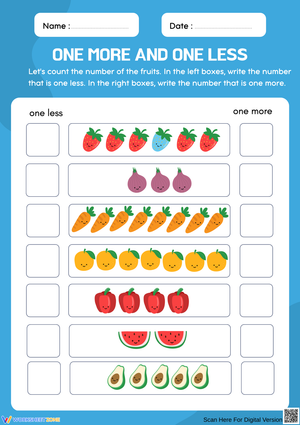
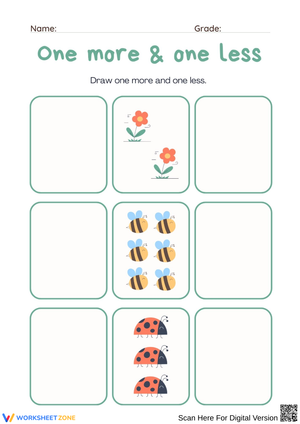
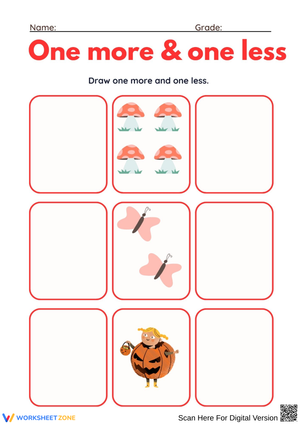
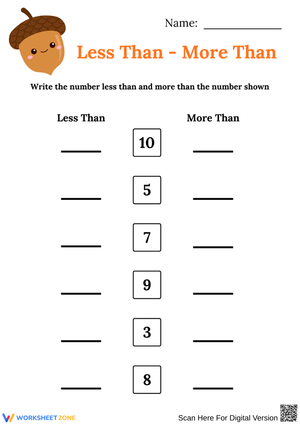
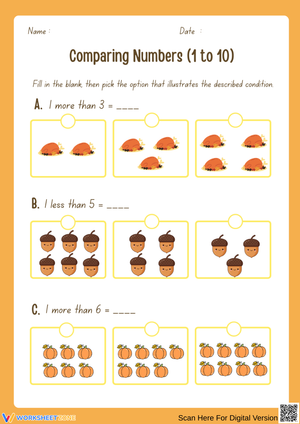
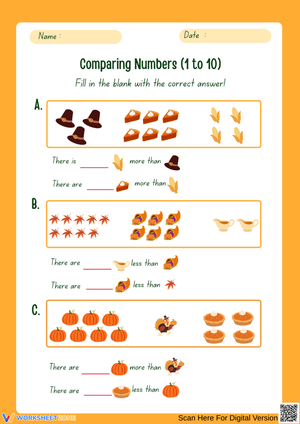
These 1st grade one more or one less worksheets resources give teachers printable, focused practice for one of the most foundational number relationships in early elementary math. The concept — adjusting a quantity by exactly one, in either direction — looks narrow, but it asks first graders to hold three things in mind simultaneously: the starting number, the direction of change, and the result. Getting that right across different problem formats is what this skill practice builds.
Errors That Surface Early — and What They Tell You
The most revealing mistake in this topic isn't a computation error — it's directional confusion. A student who confidently writes "8" as the answer to "1 less than 7" has not miscounted; they've defaulted to the counting-forward habit that dominates most of their early math experience. This shows up most clearly when "less" items appear after a run of "more" items. Students stop reading the direction word and respond to the rhythm of the page instead.
A subtler pattern: students who use a number line correctly will sometimes hop one space in the right direction, land on the correct number, and then write the number they started from. They found the answer and didn't transfer it. Watching pencil movement during independent work — not just scanning the answer column — catches this before it hardens into habit.
What's Inside the Set
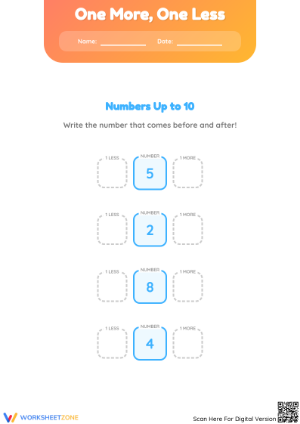
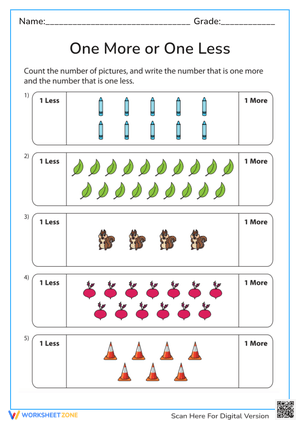
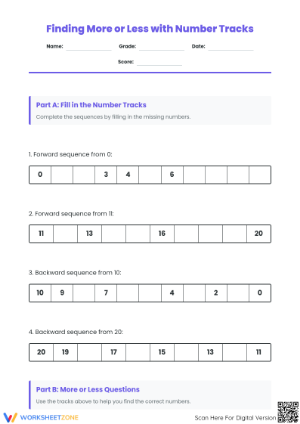
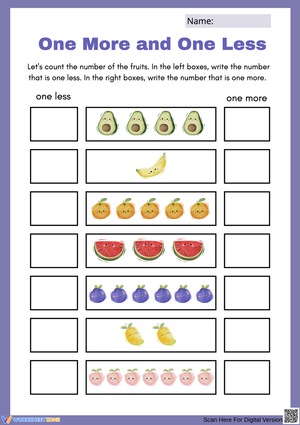
Across the 1st grade one more or one less worksheets collection, each worksheet targets one format so teachers can select the right page for each point in a lesson sequence.
- Ten frame worksheets: A partially filled frame shows the starting quantity; students determine 1 more or 1 less and record the numeral.
- Number line worksheets: Students mark a given number and hop forward or back by one, writing where they land.
- Fill-in-the-blank statements: Both phrasings appear — "9 is 1 more than ___" and "14 is 1 less than ___" — so students practice reading the relationship from either direction.
- Mixed review worksheets: One more and one less items appear in random order, removing any repeating pattern that students might follow automatically.
- Extended range practice: Pages that move into teen numbers and across decade boundaries, where the concept gets harder in ways smaller numbers conceal.
Why This Format Works for This Skill at This Grade
First graders are in the middle of a transition — from counting objects to operating on numerals — and that transition takes longer than a single lesson. A student who answers "1 more than 6" correctly with a ten frame visible may write the same starting number as the answer when the visual disappears. That's not carelessness; that's cognitive load. Numeral recognition, directionality, and recall run simultaneously, and when one drops, the answer breaks.
The most useful worksheet format at this stage keeps the transition gradual. Visual supports appear in the first few items on a page, then pull back as items progress. By the time a student reaches numeral-only problems, they've already rehearsed the direction of change twice with concrete support. That warm-up structure produces more reliable results than presenting abstract problems first and adding manipulatives only after students struggle.
Fitting These Worksheets Into Your Teaching Week
In a first-grade room, these pages fit into the day without added prep. During a mini-lesson, project two or three problems and solve them together using a class number line or counters. After that, the page becomes independent practice while the teacher pulls a small group. Asking students to draw a small arrow — up for more, down for less — before writing each answer slows impulsive errors and leaves a visible record of their thinking before the numeral goes on the page.
- Morning warm-up: Four to six problems in the opening ten minutes sets counting-sequence thinking before the main lesson begins.
- Math centers: Pair each worksheet with linking cubes or a number card set. Students build the starting amount, adjust by one, and record. The physical step keeps the concept grounded before the written answer is required.
- Small-group reteaching: Use visual-heavy pages alongside immediate teacher feedback. Ask students to say the direction aloud — "I'm going down one" — before writing, and correct the language before it produces an error on the page.
- Exit check: Three problems cut from a mixed-review worksheet, handed out in the last five minutes of math block, give clean information about who has generalized the skill and who still needs reteaching.
Short practice cycles produce better data. A ten-minute set shows whether students understand the concept; a longer page often measures endurance more than skill.
Standard Alignment
The core standard for this skill is CCSS.MATH.CONTENT.1.OA.C.5, which connects counting to addition and subtraction. Finding 1 more is the most concrete form of adding 1; finding 1 less is the most concrete form of subtracting 1. Districts typically place this work in the first unit of Grade 1, before formal addition and subtraction facts are introduced, because it bridges the counting strategies students bring from kindergarten to the operational thinking required for the rest of the year. Each 1st grade one more or one less worksheets page in this collection targets that bridge directly — the student who answers "1 more than 13" without counting from one is showing readiness to treat 13 + 1 as a known fact rather than a procedure.
Adapting the Worksheets for a Mixed-Ability First-Grade Class
Not every first grader is working at the same level of abstraction when this concept is introduced. Some students are still counting each object individually; others have solid number sense within 20 and need a challenge that tests genuine understanding rather than familiar number territory.
Students who need more concrete support benefit from the within-10 ten frame pages. Large visuals give them something to count, and keeping the number range small means the numeral itself doesn't create an extra layer of difficulty before the concept is established. Verbal rehearsal alongside the worksheet — asking students to say "I'm going back one" before writing — helps the language and the math reinforce each other without adding a separate activity to the rotation.
For students ready to go further, pages with numbers across decade boundaries reveal gaps that smaller numbers hide. "1 less than 30" or "1 more than 49" will stall a student who has been operating from memory rather than understanding. Asking those students to explain their answer in writing shows whether the skill is procedural or conceptual. One honest tradeoff: the written-explanation format frustrates students who understand the math but struggle with written expression, so accept verbal responses when writing creates the barrier rather than evidence.
Frequently Asked Questions
How many problems per page works best for first graders?
Eight to twelve items is the practical range for a full worksheet. Beyond that, later problems tend to measure stamina rather than understanding. For exit checks, three to five problems is enough to make an instructional decision without cutting into transition time.
Can this set be used with kindergarteners?
The within-10 visual pages work well in late kindergarten, particularly for enrichment. The key is pairing the page with physical counters rather than treating it as independent written work, since many kindergarteners are still building one-to-one correspondence and the written recording step adds cognitive load before the concept is secure.
Students keep mixing up "more" and "less" across multiple sessions. What actually helps?
The confusion almost always lives in the vocabulary before it shows up in the math. Have students say the direction word aloud — "less means I go down" — before touching the pencil. A physical gesture paired with the language helps too: thumbs up for more, thumbs down for less. Once the phrasing becomes automatic, the directional error typically disappears. If it persists, check whether the student can distinguish more and less in non-number contexts before returning to the page.
Do these worksheets hold up in hybrid or at-home settings?
PDF format adapts well to both. Pages can be printed for in-class use or assigned through annotation-enabled platforms where students draw arrows or type numerals directly into the same structure. For teachers managing a range of learning environments, a well-organized set of 1st grade one more or one less worksheets pages covers in-person, at-home, and intervention contexts without requiring separate materials for each.













 Interactive Worksheet Maker
 Quiz Maker
 Word Search Maker
 Crossword Puzzle Maker
 Word Scramble Generator
 Sentence Scramble Generator
 Handwriting Worksheet Generator
 Name Tracing Generator
 Fill In The Blank Generator