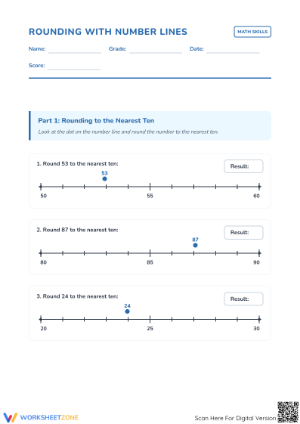
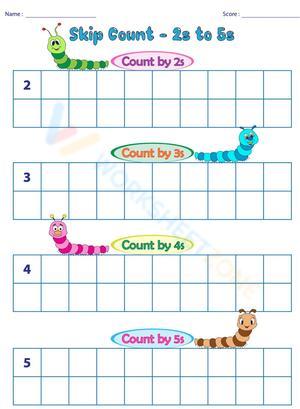
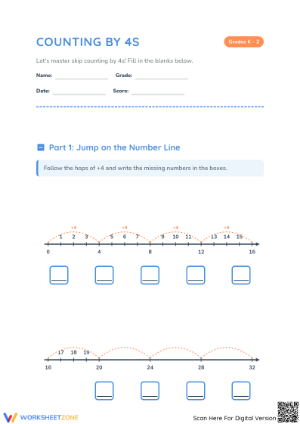
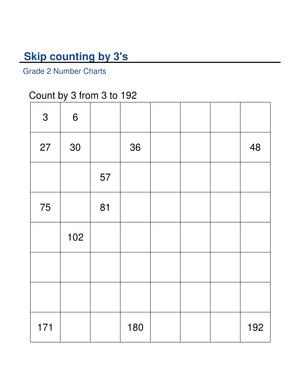
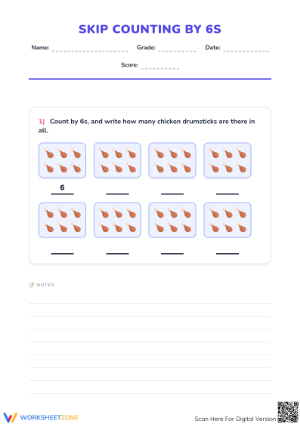
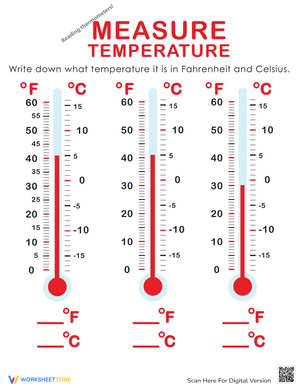
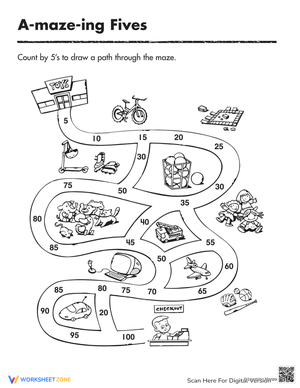
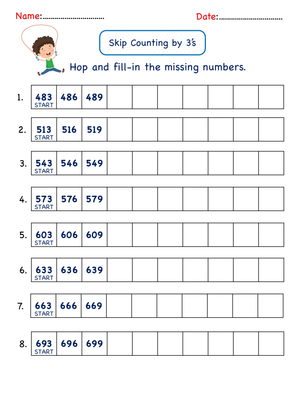
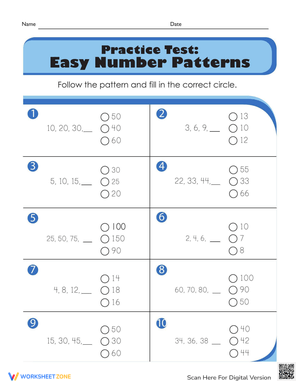
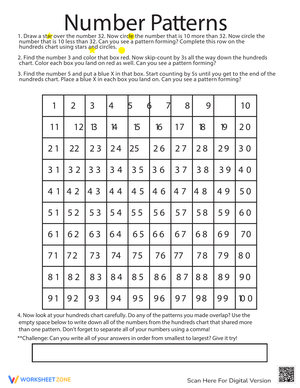
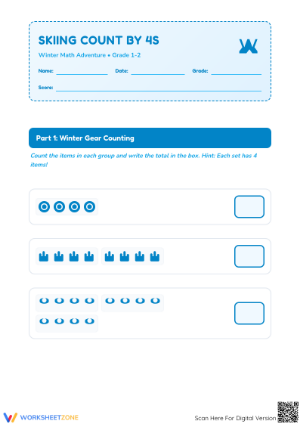
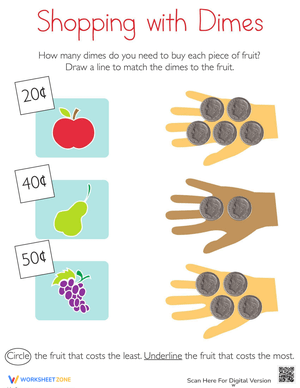
1st grade skip counting printable worksheets give teachers a focused, reusable set of tools for one of the most cognitively significant transitions in early math: moving students away from counting every object one by one toward thinking in groups. Each worksheet in this set targets counting by 2s, 5s, or 10s using formats that reward close attention to pattern — not guessing or rote recitation. The skills students build here are direct prerequisites for place value fluency and the multiplication work that arrives in third grade.
The Specific Skills Targeted
The three intervals — 2s, 5s, and 10s — are not grouped together arbitrarily. Each builds a distinct layer of number sense that first graders need before multiplication formally appears.
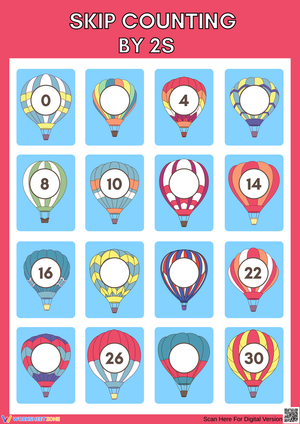
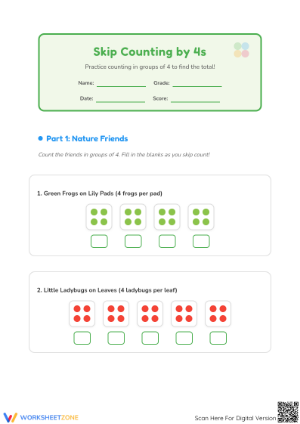
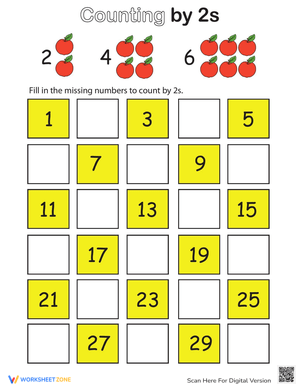
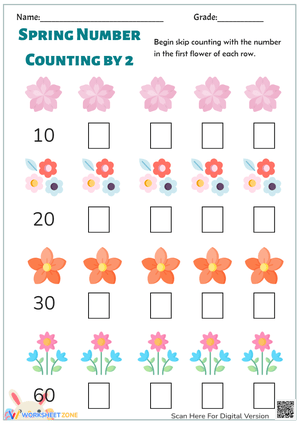
Counting by 2s introduces students to pairs and to even numbers as a category distinct from a memorized list. Worksheets in this range use visual groupings — two mittens, two eyes, two dots — so the interval feels concrete before it becomes symbolic. Students who understand the 2s sequence are doing early repeated addition: 2 + 2 + 2 is not the same cognitive operation as 1, 2, 3, and that difference matters for what comes later.
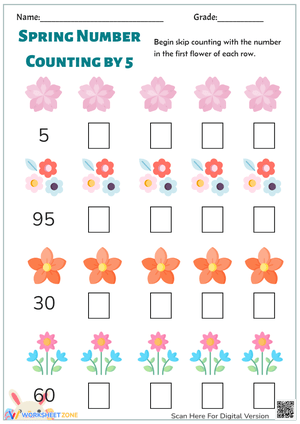
Counting by 5s connects to two reference points that appear in first grade instruction: the analog clock face and the nickel. The 5s sequence also produces an alternating pattern in the ones digit — 5, 0, 5, 0 — that most students don't notice until someone names it explicitly. Worksheets that begin a sequence at 35 or 55 rather than always starting at 5 force students to engage with that alternating structure rather than recite from memory.
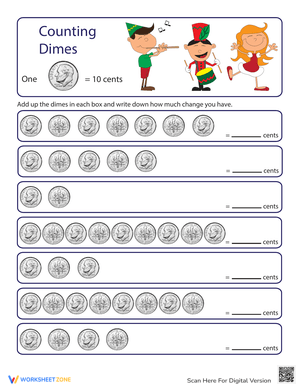
Counting by 10s is the interval most tightly linked to place value. When students count 10, 20, 30, they watch the tens digit change while the ones digit stays at zero — a concrete preview of how the base-ten system is organized. Students who see that connection move into two-digit addition with far more confidence than those who treat the 10s sequence as a separate chant.
Worksheet Formats That Work With Six-Year-Olds
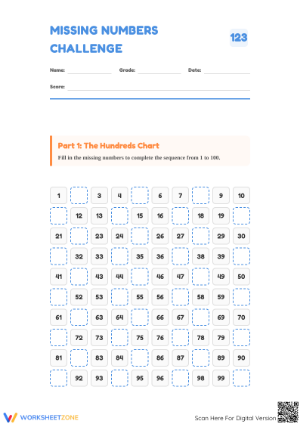
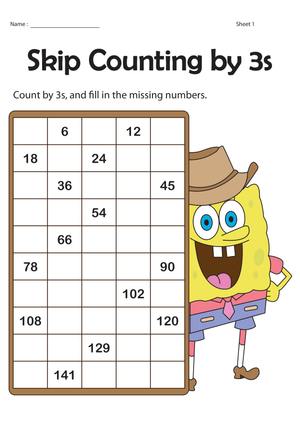
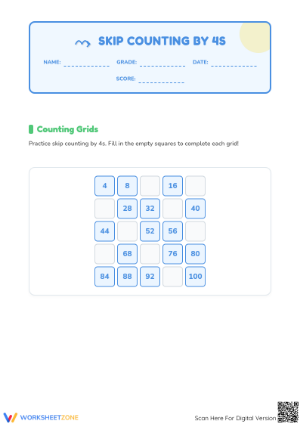
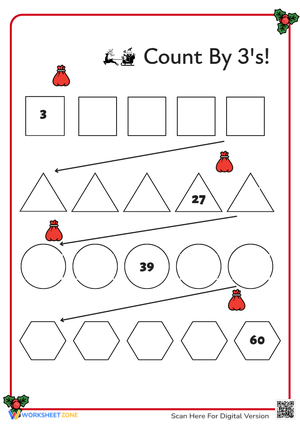
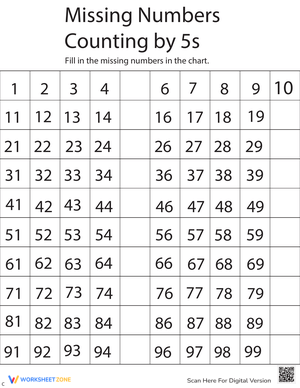
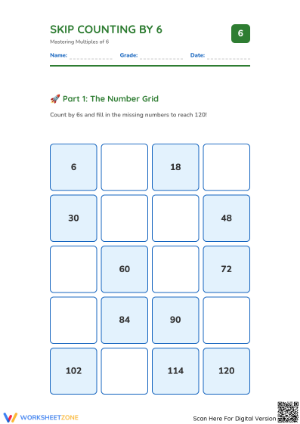
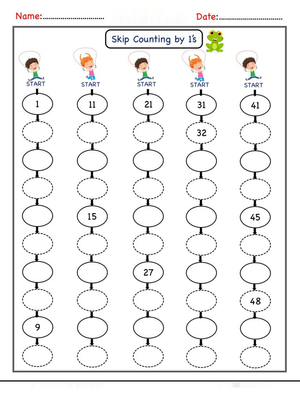
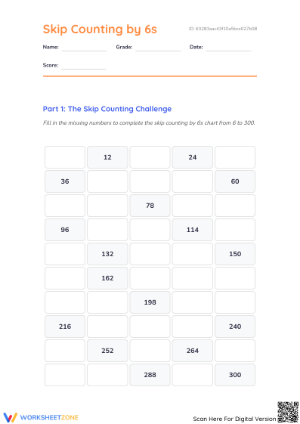
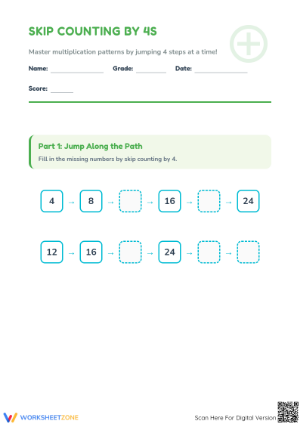
Missing-number sequences present a partial count — some numbers given, others left blank — and ask students to identify the rule and fill in what's absent. Because the blanks can appear anywhere in the sequence, not just at the end, students can't coast on rote recitation. They have to determine whether the interval is 2, 5, or 10 from the numbers they're given, which is a meaningful step toward flexible thinking about counting rules.
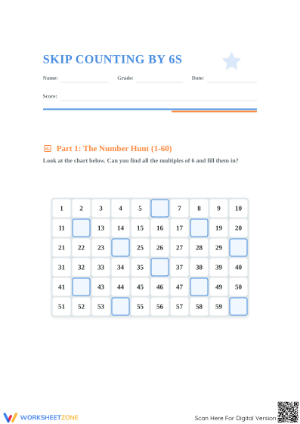
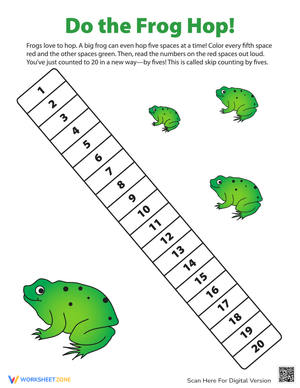
Hundreds chart activities ask students to shade every second, fifth, or tenth square. The resulting color pattern stays on the page and continues to teach after the lesson ends — posted charts become reference tools. Shading every tenth square reveals a single vertical column and makes the relationship between a number like 40 and the quantity four tens visually obvious in a way an oral sequence does not.
Cut-and-paste sequencing puts numbers out of order and asks students to arrange them correctly. First graders who freeze when facing blank fill-ins will often engage more readily when the numbers are already on the table and the task is ordering rather than generating. The format also functions as its own answer key — a completed puzzle that doesn't form a coherent image tells the student something went wrong, before the teacher arrives.
Mistakes Students Make That These Worksheets Help You Catch
The most consistent error in 10s counting isn't starting at the wrong number — it's breaking pattern mid-sequence. A student writes 10, 20, 30, 40 without hesitation, then produces 41, 42. The opening of the sequence was memorized; the rule was not internalized. Missing-number worksheets with blanks placed inside the sequence rather than at the end surface this immediately, because students must apply the interval rule rather than continue a recitation.
The 5s sequence produces a specific transfer problem. Students who can recite 5, 10, 15, 20 from the beginning will stall when asked to start at 35 and continue forward. Oral fluency in the sequence from 5 doesn't equal understanding of the 5-unit interval. Worksheets that open sequences at 25, 40, or 55 make this visible within the first two problems.
Counting by 2s from an odd starting point catches students who have learned the sequence as a list of even numbers rather than as an interval rule. A student fluent with 2, 4, 6, 8 will often write 3, 4, 6, 8 when asked to count by 2s starting at 3. This error is worth watching for in written work — it reveals a specific gap between knowing the list and understanding what generates it.
Building These Worksheets Into Your Teaching Week
The morning warm-up is the most reliable entry point. After a weekend without structured counting practice, three or four minutes on a familiar skip counting worksheet reactivates the skill before any new instruction begins. Low-stakes warm-up tasks produce more transparent student errors than graded work — students are less likely to guess anxiously and more likely to show what they actually know.
Math centers are the right home for cut-and-paste and missing-number formats. One set of 1st grade skip counting printable worksheets covers weeks of center rotations without reprinting when the fill-in versions are laminated and slipped into dry-erase pockets. Students mark answers with whiteboard markers, erase, and repeat. Early finishers can work through the same worksheet a second time with a different starting number when the teacher adjusts the instructions on a sticky note placed over the prompt.
Projecting a worksheet on a document camera and completing it whole-group before releasing students to independent work gives teachers a chance to name the pattern explicitly — say it, show it, run it all the way through together — before students attempt an identical format alone. This gradual release sequence matters most when introducing a new interval, particularly 5s, where the alternating ones digit catches students off guard if they weren't prepared for it during instruction.
Standard Alignment
CCSS.MATH.CONTENT.1.NBT.A.1 requires first graders to count to 120, starting from any number less than 120. Counting by 10s from zero covers the full range of that standard in fourteen steps; counting by 2s and 5s within the same range applies the same number line in different intervals. These worksheets work across all three intervals, keeping practice tied to the standard's counting-sequence expectation throughout the year.
The work students do here is also direct preparation for CCSS.MATH.CONTENT.2.NBT.A.2, which explicitly requires counting within 1000 by 5s, 10s, and 100s. Teachers who use 1st grade skip counting printable worksheets consistently across the year are building the interval understanding and sequence recognition that second grade instruction depends on — not doing isolated skill work that disappears at the end of the unit.
Adjusting the Set for a Range of First-Grade Learners
Students working below grade level benefit from worksheets that include a printed number line or hundreds chart on the same page. The reference tool doesn't give the answer — it requires students to locate where they are in the sequence and use the pattern to move forward — but it reduces memory load enough that the counting rule itself stays in focus. Pairing the worksheet with physical ten-rod base-ten blocks, so students place one rod on each number they land on, adds a tactile dimension that printed sequences alone don't provide.
On-grade students rotate through all three formats — fill-in sequences, hundreds chart shading, cut-and-paste ordering — within the same week. Students who complete only one format fluently haven't fully learned the skill; they've learned to complete a task type. Mixing formats within the center rotation is the most direct way to check for genuine understanding versus task familiarity.
Advanced students get more from these materials when the instructions change rather than the worksheets themselves. Providing 1st grade skip counting printable worksheets with modified entry points — count by 5s starting at 17; count by 10s starting at 43; identify which interval a mystery sequence uses before completing it — asks students to treat intervals as rules rather than memorized lists. None of that requires new materials. It requires a sticky note or a projected instruction revision.
Frequently Asked Questions
Should I introduce counting by 2s, 5s, and 10s at the same time?
Sequencing them works better than introducing all three simultaneously. Most first grade teachers start with 10s, because the pattern — ones digit stays at zero, tens digit increments by one — connects directly to place value concepts already in play. Counting by 5s comes next; the alternating ones digit is a new wrinkle but manageable once 10s are solid. Counting by 2s last gives students time to understand even numbers as a category before practicing them as a sequence. Running all three concurrently, before any one is established, tends to produce confusion about which rule applies when.
How long should a skip counting worksheet take during independent work time?
Five to eight minutes is the appropriate range. Worksheets that consistently run longer either have too many problems for a single sitting, or the format hasn't been introduced whole-group before students attempt it alone. If students are spending time figuring out what a worksheet is asking rather than practicing counting, the format needs to be modeled before it becomes independent work — the answer is not to reduce the number of problems.
What do I do when a student can recite the sequence aloud but stalls on the written worksheet?
Oral fluency and written fluency are different skills at this age. The cognitive cost of handwriting — forming numerals, managing grip, maintaining spacing — competes with the same working memory that tracking a number sequence requires. A student who counts by 5s aloud without hesitation but freezes when writing them is not missing the math. A practical approach: the student says the next number aloud, writes only that number, then pauses before saying the next. Over several sessions, the two processes integrate. This is a developmental issue, not a knowledge gap, and it resolves with practice rather than re-teaching the counting rule.













 Interactive Worksheet Maker
 Quiz Maker
 Word Search Maker
 Crossword Puzzle Maker
 Word Scramble Generator
 Sentence Scramble Generator
 Handwriting Worksheet Generator
 Name Tracing Generator
 Fill In The Blank Generator