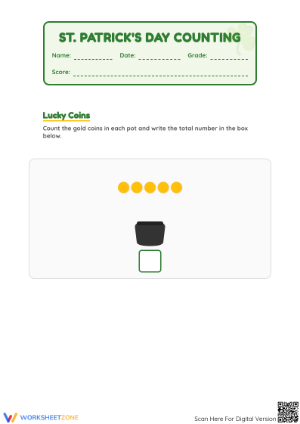
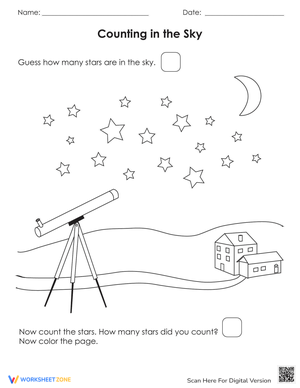
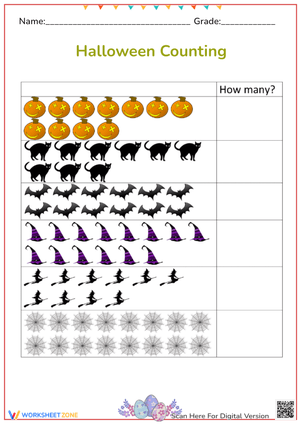
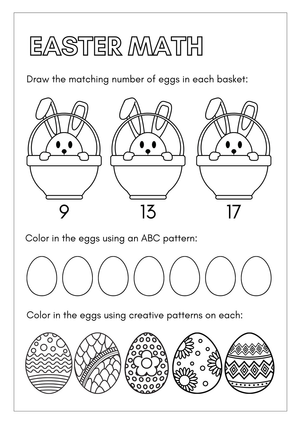
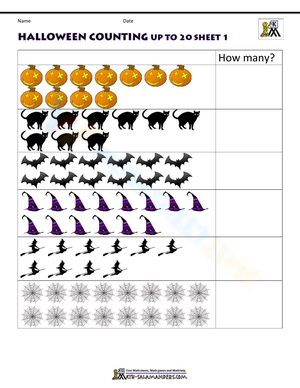
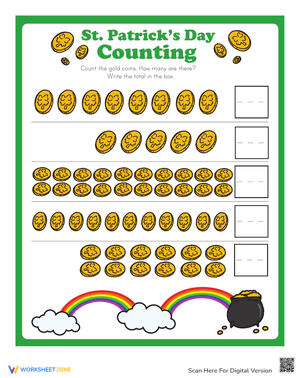
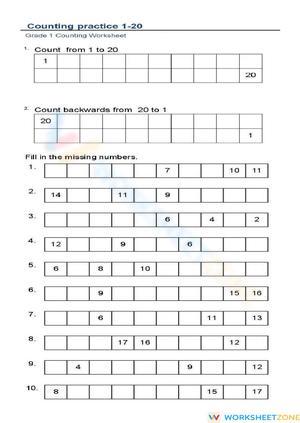
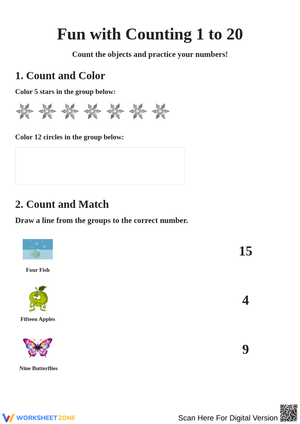
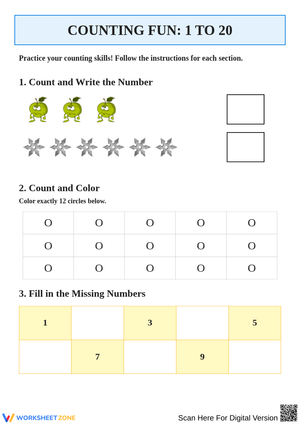
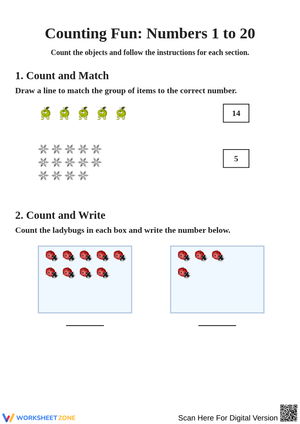
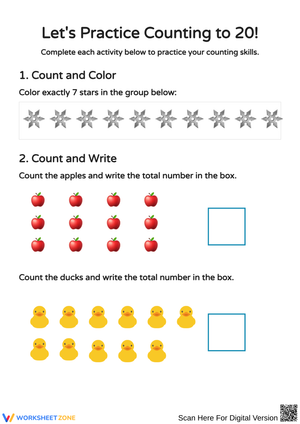
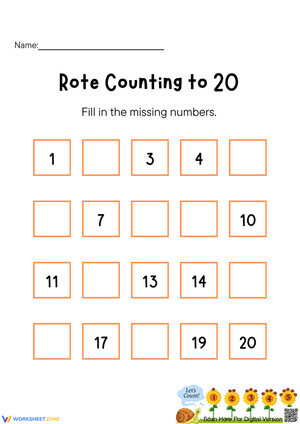
These counting to 20 worksheets for 1st grade give teachers a focused set of printable practice tools that move students from rote number recitation toward genuine quantity understanding — covering one-to-one correspondence, number recognition, sequencing, and double ten-frame reading across the full 1–20 range. Each worksheet targets a specific segment of this skill rather than asking students to do everything at once, which matters when you are working with first graders whose counting confidence can collapse at 13 just as easily as it holds together at 7.
Where the Counting Sequence Actually Gets Hard
The numbers 11 through 19 are not a smooth extension of the pattern students learned before them. Unlike the twenties and thirties — where the naming convention is entirely predictable — the teen numbers carry linguistic histories that obscure their mathematical structure. "Eleven" and "twelve" contain no audible reference to ten. "Fifteen" disguises "five," and "thirteen" reshapes "three." First graders who memorized the spoken sequence in kindergarten often recite through 11 and keep going without any sense that a full group of ten is embedded in every number on that list.
The practical consequence shows up in written work: a student transcribing a teen number frequently reverses the digits, writing 51 for 15 or 41 for 14. This is not a careless mistake — it reflects a genuine gap in place-value understanding. The spoken word "fifteen" gives no audible cue that the 1 belongs in the tens place. These worksheets address that gap directly, pairing written numerals with double ten-frame images so students see the "one full ten and five more" structure every time they encounter the number 15.
The Specific Skills Targeted
The set covers the following skills, each addressed in at least one dedicated worksheet:
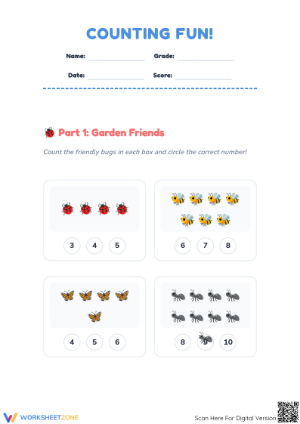
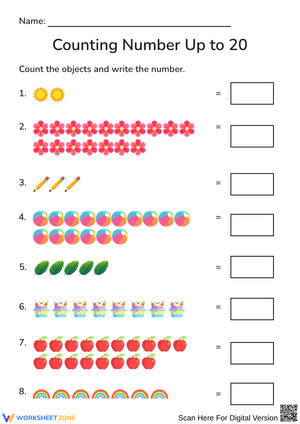
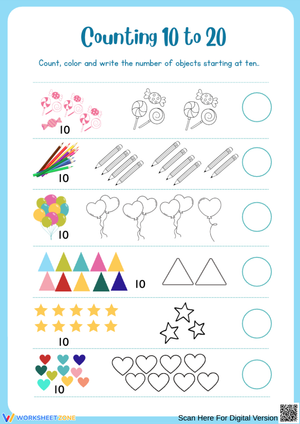
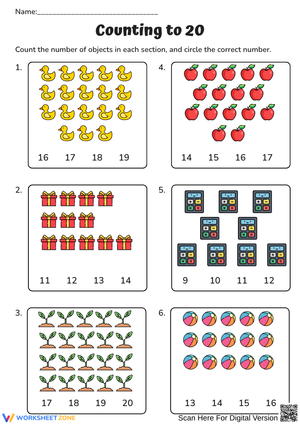
- One-to-one correspondence — students touch and count objects arranged in lines, circles, and scattered patterns up to 20
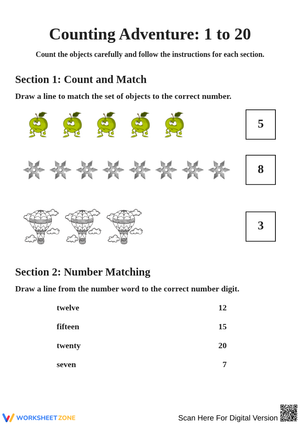
- Numeral recognition — matching a written number to its corresponding quantity
- Number word recognition — connecting written words like "seventeen" to numerals and dot arrays
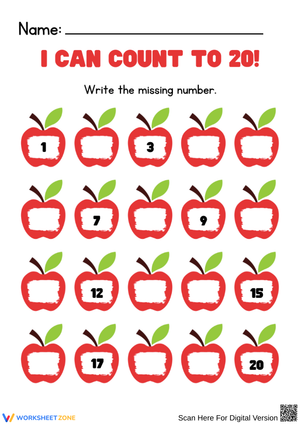
- Forward and backward sequencing — writing missing numbers in both directions within the 1–20 range
- "One more / one less" relationships — identifying the number directly before or after a given value
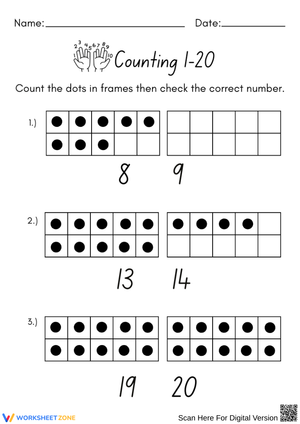
- Double ten-frame reading — naming the quantity shown when one or both frames are partially or fully filled
- Number writing — tracing and then independently producing numerals, with attention to the easily reversed 6 and 9 and the digit-reversal risk in all teen numbers
Why the Ten-Frame Format Carries This Much Weight
A double ten-frame does something a number line cannot: it makes the structure of a number visible rather than just positional. When a student looks at 17 on a number line, they see a point. When they look at 17 on a double ten-frame, they see one completely filled row of ten and seven dots in the second frame. That image — a full ten plus extras — is the conceptual foundation of the entire base-ten system. Building that image during the 1–20 range means students arrive at formal place-value instruction later in first grade already carrying an accurate mental picture.
The worksheets use ten-frames in two directions: students read them (name the number shown) and produce them (fill in dots to represent a given number). The production tasks are particularly revealing. A student who draws 17 dots scattered randomly across a double ten-frame without filling the first frame before starting the second has not internalized the group-of-ten concept, even if they can say "seventeen" without hesitation. That observation is worth more than a circled answer on a recognition task.
Recommended Lesson-Planning Strategies for These Worksheets
These worksheets slot naturally into the seven or eight minutes before a math lesson begins — not as busywork, but as priming. Starting class with a single sequencing task (fill in the missing numbers between 13 and 18) activates the counting sequence right before instruction, which reduces the retrieval load students carry into the lesson itself. Spaced retrieval works here: returning to the same skill across Monday, Wednesday, and Friday produces more durable memory than three worksheets in a single sitting.
For small-group rotations, these counting to 20 worksheets for 1st grade work well as the independent station task while the teacher pulls a different group. Students at the independent station can work through one worksheet without needing directions restated, which keeps the rotation running smoothly. The scattered-arrangement counting worksheets — where students mark each object with a small dot or checkmark as they go — also double as a conversation starter during review: asking a student to walk through their marks shows exactly where one-to-one correspondence broke down, if it did at all.
Common Misconceptions to Watch For and Correct
Beyond the digit-reversal issue with teen numbers, two other patterns appear consistently in student work at this level. The first is what you might call "phantom counting" — a student moves their finger across a row of objects and speaks number words at roughly the right pace, but the synchronization breaks down somewhere in the middle. They end up with a count of 14 for a group of 13, not because they skipped an object, but because they said two number words while their finger was on the same object. This error is nearly invisible when students count quickly; it only surfaces when you ask them to touch each object and pause before saying the next number.
The second pattern is sequence stalling at 15 and 16. Students who have the forward sequence solid through 14 sometimes produce "fifteen... sixteen... um... eighteen?" because those two numbers have not been practiced as often as the earlier ones. Worksheets that isolate the 14–19 range catch this gap faster than full-sequence tasks do, and they let you address it before it becomes an automatic error.
Standard Alignment
These worksheets directly support CCSS.MATH.CONTENT.1.NBT.A.1, which requires first graders to count to 120 starting from any number less than 120. The 1–20 range is the instructional entry point for that standard: it is where one-to-one correspondence is consolidated, where the teen number structure is first encountered, and where the base-ten framework is introduced visually before students are expected to operate with it symbolically. Teachers who work through this material in September and October build the exact foundation that 1.NBT.A.1 depends on for the rest of the year.
Differentiating These Worksheets Across Ability Levels
For students still consolidating numbers 1–10, the worksheets that stop at 10 — counting scattered objects, writing numerals 1–10 in sequence, reading a single ten-frame — give them accurate practice without confronting the teen numbers before they are ready. Using those worksheets in a small-group setting, while the rest of the class works in the 11–20 range, lets you run one independent station without building two entirely different assignments from scratch.
These counting to 20 worksheets for 1st grade also extend upward for students who have the 1–20 range well established. Missing-number sequences presented in non-standard order — starting at 14, or counting backward from 19 — push students to think about the structure of the sequence rather than recite it from memory. Pairing those worksheets with a brief written prompt ("write two things you notice about the numbers in your sequence") turns a counting task into early number-sense reasoning, which is appropriate for first graders working well ahead of grade level.
Frequently Asked Questions
A student keeps writing 21 instead of 12 and 51 instead of 15 — what actually helps?
Have the student build the number with a double ten-frame before writing it. For 12, they fill one complete ten-frame and mark two dots in the second. Then they write the numeral while the ten-frame is still in front of them, pointing to the full frame as they write the 1 and the partial frame as they write the 2. This needs to be practiced across multiple days — these reversals come from a place-value gap, not a handwriting one, and no amount of numeral tracing resolves them on its own.
Can these worksheets function as formative assessment rather than just practice?
Yes, and the scattered-object counting worksheets are the most useful for that purpose. Collect them without giving students time to self-correct, then look at three things: where their tracking marks stop or become inconsistent, whether the written numeral is accurate and unreversed, and whether their ten-frame drawings fill the first frame before moving to the second. Those three observations together give a clearer picture of a student's number sense than a circled answer on a recognition task ever could.
How do these work for a first grader receiving intervention, or a kindergartner extending their practice?
The worksheets covering 1–10 work well for both groups — rebuilding one-to-one correspondence and numeral writing without the added pressure of the teen numbers. The counting to 20 worksheets for 1st grade that focus on 11–20, particularly the ten-frame production tasks, are the ones to introduce only after a student reliably identifies and writes all numbers through 10 without reversals. Rushing to the teen numbers before that foundation is secure tends to compound the place-value confusion rather than resolve it.
Is there a recommended sequence for introducing these worksheets across the school year?
Start with recognition and one-to-one correspondence in the 1–10 range, then move to sequencing tasks (missing numbers, before-and-after) in the same range. Once students handle those consistently, bring in the double ten-frame worksheets to build the "full ten plus more" structure before introducing teen numerals directly. Teen number sequencing tasks and backward-counting worksheets work best last, after students have a reliable visual anchor for what each teen number actually represents — rather than just a memorized name attached to a confusing written symbol.













 Interactive Worksheet Maker
 Quiz Maker
 Word Search Maker
 Crossword Puzzle Maker
 Word Scramble Generator
 Sentence Scramble Generator
 Handwriting Worksheet Generator
 Name Tracing Generator
 Fill In The Blank Generator