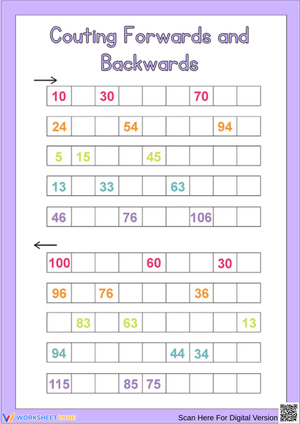
Counting Backward PDF Worksheets for 1st Grade
These counting backward pdf worksheets for 1st grade give teachers a focused, printable solution for the counting direction that trips up first graders more reliably than any forward sequence: moving down the number line one step at a time without losing the thread. Each worksheet targets a specific task format — countdown sequences, missing-number fills, or number-line work — sized for five to ten minutes of independent practice after whole-group instruction closes.
The Specific Skills Each Worksheet Builds
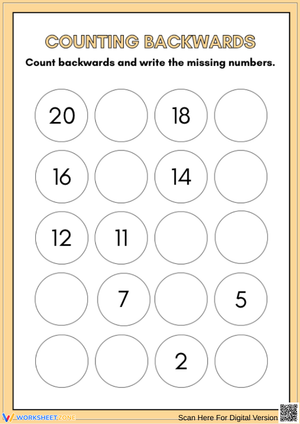
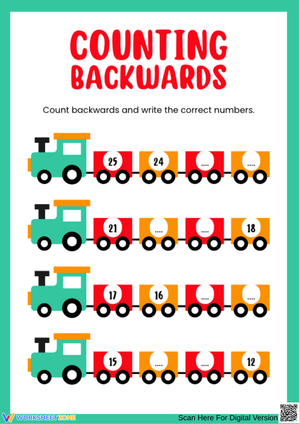
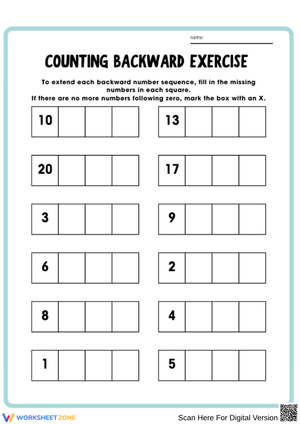
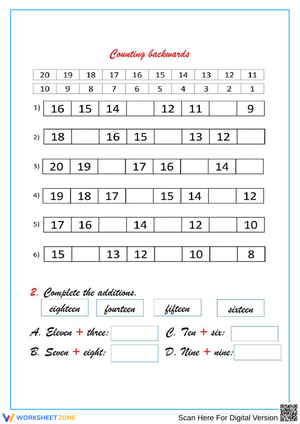
The set covers backward counting within two ranges: within 10 for students still building basic fluency, and within 20 for students ready to extend into teen numbers. Task types vary across the worksheets. Complete countdown sequences ask students to write the full path from a starting number to zero. Missing-number tasks — a partial sequence like 16, __, 14, 13 — require identifying the gap without a full chain to reference. Random starting points move students away from the memorized 10-to-0 and 20-to-0 countdowns by asking them to begin from numbers like 13 or 17. Number-line tasks keep the visual model connected to the written sequence, and one-less exercises make the link to early subtraction explicit by asking students to write the number immediately before a given value.
Most worksheets carry five to ten items — narrow enough to stay manageable for students just meeting the skill, short enough to use three or four times across the week without burning out on repetition.
Why Backward Counting Earns Real Instructional Time in Grade 1
First graders arrive with strong forward-counting habits built through kindergarten — calendars, counting songs, lineup counts. Backward counting has no equivalent ambient reinforcement, and reversing a well-practiced sequence is genuinely harder. Flexibility with counting direction, not just fluency in one direction, marks stronger number relationships. A student who can accurately say "nine, eight, seven..." is beginning to internalize that each step removes one — which is the core logic of subtraction before formal notation enters the picture.
Grade 1 is the right developmental window. Second-grade teachers rely on incoming students already fluent with backward sequences because count-back subtraction strategies depend on it. Closing that gap in first grade with consistent practice means students arrive at subtraction instruction with the sequence ready, rather than learning the strategy and the number order simultaneously under cognitive pressure.
Student Errors Worth Watching For and Addressing Directly
The most common error is number-skipping in the teens: a student who writes "10, 9, 8" without hesitation will often produce "19, 18, 16," skipping 17 with no awareness it happened. The written medium makes that gap visible in a way choral counting does not — which is one reason these worksheets function as diagnostic tools, not just practice pages.
A second pattern is direction reversal. Students write the first few numbers correctly — 15, 14, 13 — then flip: 12, 13, 14. The forward sequence is overlearned and reclaims control when attention drifts. Arrows printed on the worksheet showing "going down" reduce these reversals before they solidify. A third issue is early stopping: students write two or three numbers, then stall. Building stamina with five-item rows before moving to ten addresses this without changing the activity type.
Building These Worksheets Into Your Weekly Lesson Plans
These worksheets work best as brief written follow-ups to oral and visual instruction, not as standalone events. A reliable sequence: open the math block with a 90-second choral count backward from 20, model that path on a posted number line, then give students five minutes on one worksheet before the main lesson begins. That three-part structure — hear it, see it, write it — cements the pattern without eating into the day's primary instructional time.
- Monday warm-up after morning meeting: a 10-to-0 countdown page reactivates the sequence after the weekend before any new instruction starts.
- Math center rotation: pair a worksheet with a laminated number line so students self-check each step before continuing.
- Small-group pull: work through a missing-number worksheet together, asking each student to point to the number on a number strip before writing it down.
- Exit task: one countdown row and one missing-number item — two questions, readable in under a minute, useful for sorting who needs a reteach the following day.
- Friday consolidation: a sheet starting from random numbers within 20 serves as a week-end retention check before the next unit moves forward.
One practical note: worksheets distributed during the final eight minutes before dismissal rarely yield readable data. Students are mentally packing up. Collect during the math block, well before any transition begins, if you want results that tell you something.
Standard Alignment
These counting backward pdf worksheets for 1st grade address CCSS.MATH.CONTENT.1.OA.C.5, which asks students to relate counting to addition and subtraction. Counting back is the direct precursor to count-back subtraction — a student who can move fluently down from 9 already understands the core mechanic of subtracting one step at a time. The missing-number tasks in particular mirror the reasoning students use when solving early subtraction by counting back from the minuend. The fluency component also connects to CCSS.MATH.CONTENT.1.NBT.A.1, which expects students to count to 120 starting at any given number, in either direction.
In classroom sequence, backward counting belongs inside the fall Number Sense unit, before formal subtraction instruction begins. Students who arrive at count-back strategies already fluent in the sequence are not learning two new things at once — and that distinction matters when the cognitive demands of first-grade math are stacking up week by week.
Adjusting Each Worksheet for the Full Range of Your Class
The starting-number range is the main differentiation lever in this set. Students still gaining confidence stay within 10, keeping the number line available as a full reference throughout. They work in the same format as classmates practicing in a higher range — which matters more than it might seem to six-year-olds who notice immediately when they're handed something visibly different. For students ready to go further, counting backward pdf worksheets for 1st grade that open from random numbers like 14 or 17 require genuine thinking rather than a memorized sequence. Removing the number-line reference is the appropriate next move for these students; they have enough number knowledge to self-monitor without it.
For students who need the most support before any written practice, give them a physical number strip from 0 to 20 and have them move a counter backward, saying each number aloud, before picking up a pencil. That movement builds the kinesthetic memory of "going down" before the worksheet demands it independently — and it reveals whether the gap is in the sequence itself or only in the written production.
Frequently Asked Questions
When during the school year should these worksheets be introduced?
Oral backward counting typically begins in the first weeks of Grade 1 as part of daily number-sense routines. Written worksheet practice works best once students can say the sequence aloud with basic accuracy — usually mid-fall for most classes. If students are still stumbling on the verbal count, more oral and movement-based practice comes first. The worksheets are a follow-up to instruction, not an introduction to it.
My students can count backward out loud but fall apart on paper. What is happening?
This is a specific and common gap, not a sign of deeper confusion. Oral counting draws on auditory rhythm and group momentum; written practice requires holding the sequence in working memory while simultaneously producing numerals. Have students say each number aloud before writing it, and keep the number line available as a reference until written fluency catches up to oral fluency. That transition usually happens faster than expected once the routine is consistent.
How often should students practice with these worksheets?
Three to four short sessions per week outperform one longer session. Spaced retrieval — returning to the same skill across several days rather than in one extended block — is what builds lasting retention for counting sequences. A five-minute worksheet used consistently across the week produces better results than a 20-minute worksheet block used once and not revisited until the following week.
Can these worksheets serve students outside of first grade?
The within-10 worksheets fit late kindergarten for students ready to extend beyond the forward count. The within-20 and random-starting-point worksheets work as review or intervention for second graders who are still shaky on backward sequences before count-back subtraction strategies become a classroom expectation. The counting backward pdf worksheets for 1st grade designation marks the primary instructional target, but the skill level is the more useful guide when deciding what a particular student actually needs.
Clear All