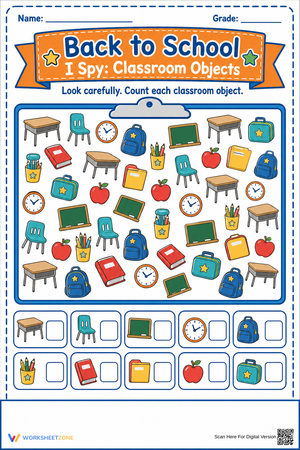
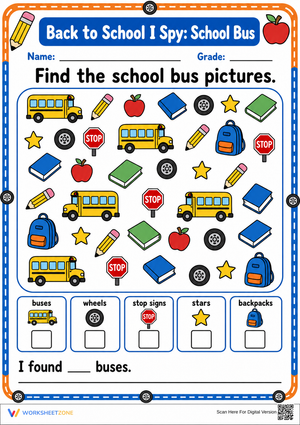
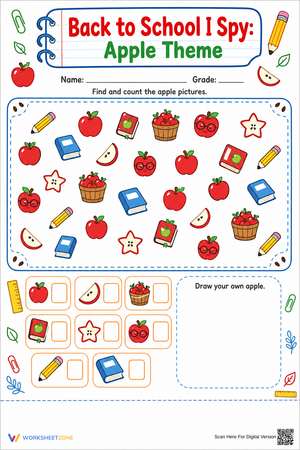
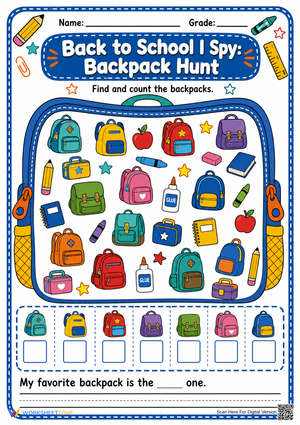
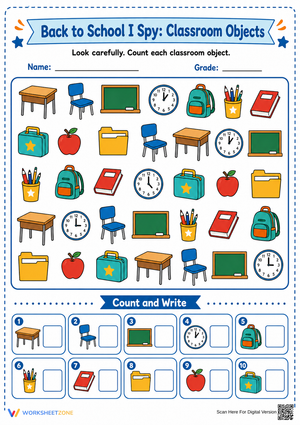
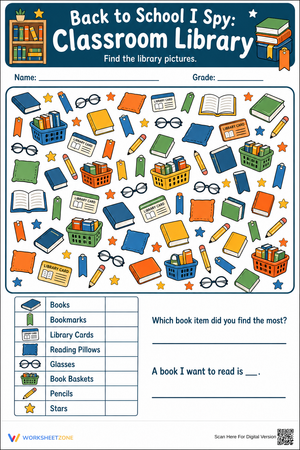
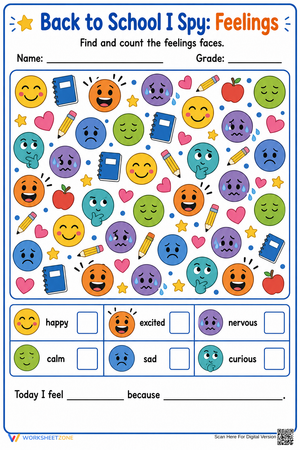
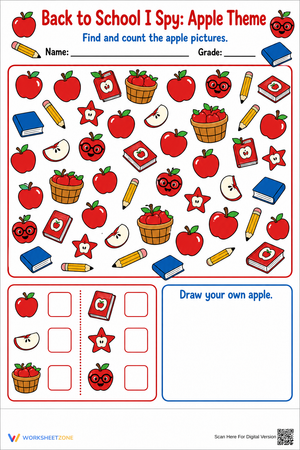
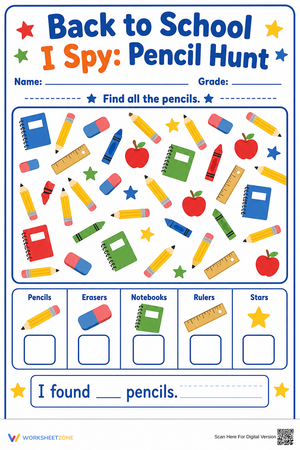
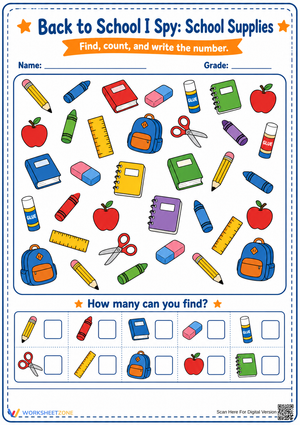
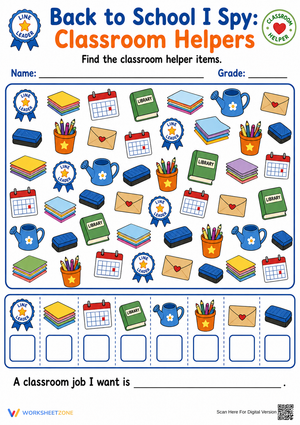
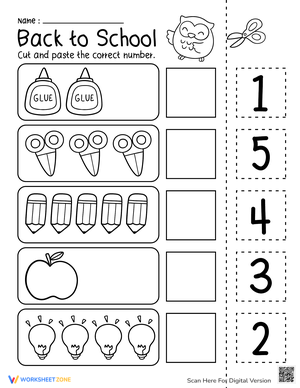
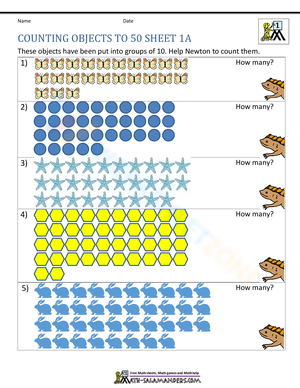
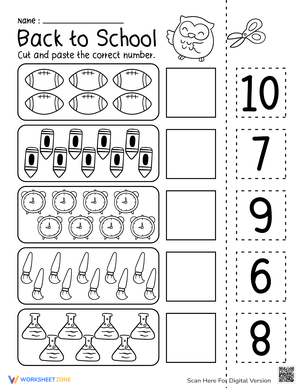
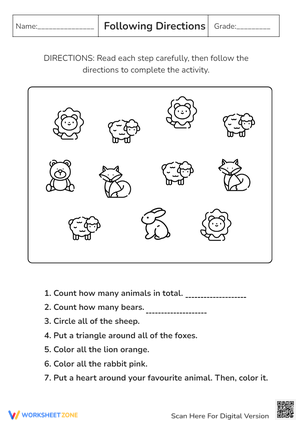
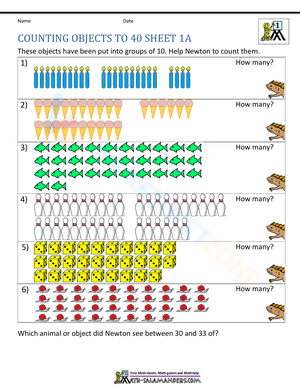
These counting objects worksheets for 1st grade give teachers a direct path into the most foundational skill in early elementary math: connecting a physical quantity to its written numeral. The set spans one-to-one correspondence practice, ten-frame subitizing, organized set comparison, and grouped skip counting — the precise progression first-grade classrooms need to move students from halting finger-counting toward confident, accurate numeral production.
What Each Worksheet Targets
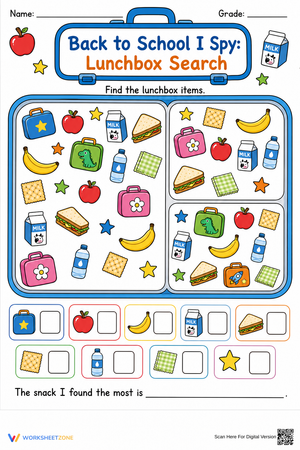
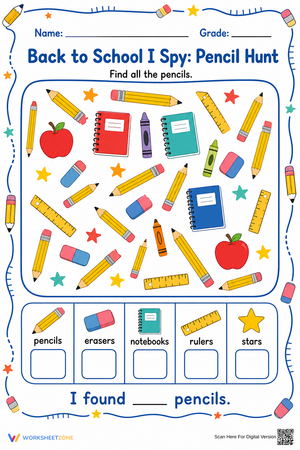
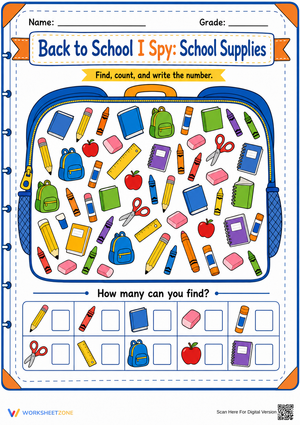
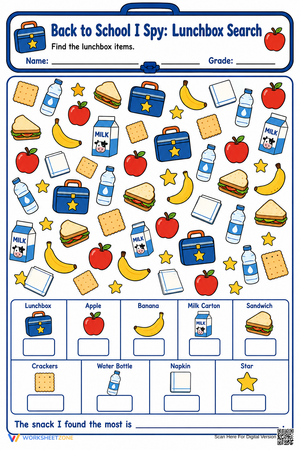
Each worksheet focuses on a distinct counting skill rather than mixing concepts together. Students underline, cross out, or dot-mark objects as they count, then write the corresponding numeral — a two-step sequence that separates the tracking action from the recording action and reduces careless errors. Across the set, students work with:
- Scattered image arrays requiring systematic left-to-right tracking
- Ten-frame arrangements that build subitizing alongside counting
- Side-by-side set comparisons using greater than, fewer than, and equal language
- Grouped objects arranged in pairs and fives that introduce skip counting by 2s and 5s
- Open numeral lines where students fill in the missing count after identifying the set size
The visual field on each worksheet is deliberately uncluttered — images are sized and spaced so a six-year-old's index finger can point to each one without ambiguity. That design choice matters more than it sounds; crowded arrays are the single biggest source of tracking errors in this age group.
Why One-to-One Correspondence Needs Structured Print Practice
First graders arrive having heard the count sequence hundreds of times. What most of them have not yet internalized is cardinality — the understanding that the last number spoken names the quantity of the entire set, not just the final object touched. A student can recite "one, two, three, four, five" while pointing at five bears and still answer "four" when asked how many there are. That specific error, which surfaces constantly in September, tells you the child has rote sequence but not cardinality.
Printed counting worksheets address this directly when they require a written answer after the count — not a circle-the-right-number multiple choice, which lets students bypass counting entirely through elimination. The counting objects worksheets for 1st grade in this set ask students to count, mark each object, and then write the total. That three-part physical routine anchors the cardinality principle more reliably than oral practice alone, because it forces the student to commit to a final answer rather than hover between two options.
Student Counting Errors Worth Catching Early
The most common error is double-counting in dense arrays. A student marks an object, moves to the next, then glances back — and counts the first one again. On worksheets with fifteen or more items, this can inflate a student's total by two or three. Teaching a deliberate cross-out method, rather than a light dot that is easy to overlook, solves this for most students within a week of consistent practice.
A subtler error appears with ten-frame worksheets. Students who understand that a full row equals five will sometimes misapply that knowledge to a partial second row — seeing three dots and calling them "two" because they expect a pattern, not because they counted. The fix is to have students point-count the second row aloud before writing, rather than assuming the visual pattern is self-evident. This shows up most often in students who are fast and confident, which is exactly why it tends to go uncorrected longer than it should.
A third pattern worth watching: when objects are arranged in groups of five for skip-counting practice, some students revert to counting every individual item rather than counting the groups. That tells you the skip-counting concept has not transferred yet — they see the grouping but do not trust it. A quick demonstration with physical cubes, grouping them into fives on the desk before returning to the worksheet, usually resolves the confusion on the spot.
How to Build These Worksheets Into Your Lesson Plans
The most practical placement is the first ten minutes of math block as a warm-up review, or the last eight minutes before lunch or pickup as a low-stakes formative check. Because each worksheet is self-contained and takes most first graders five to eight minutes to complete, they slot into transitions without cutting into direct instruction time.
For math centers, laminate each worksheet and pair it with a small set of counters. Students place one counter on each image as they count, then slide the counters into a pile and count them again to self-check — an independent verification routine that requires no teacher presence. The counting objects worksheets for 1st grade also work well as Monday warm-ups after a weekend gap, when spaced retrieval is at its most effective and even students who understood a concept on Friday benefit from a brief reactivation before new material is introduced.
For whole-group instruction, project one worksheet and model the cross-out tracking method explicitly before students touch their own copies. That five-minute demonstration prevents the chaotic, inconsistent counting habits that form when students are simply handed a page without procedural direction.
Standard Alignment
These worksheets align with CCSS.MATH.CONTENT.1.NBT.A.1, which requires first graders to count to 120 starting from any number less than 120, and to read and write numerals representing quantities up to 120. The worksheets address the counting and numeral-writing components of that standard directly. They also reinforce the cardinality and one-to-one correspondence principles established in kindergarten under CCSS.MATH.CONTENT.K.CC.B.4 and K.CC.B.5, giving teachers a clean diagnostic instrument for identifying students who arrived in first grade without those prerequisites secured.
In classroom terms, this standard governs the first six weeks of first-grade math instruction — before addition and subtraction are introduced formally. Teachers who use these worksheets as formative checks in that window can identify cardinality gaps while there is still instructional time to address them before place value work begins in earnest.
Differentiating These Worksheets Across Student Levels
For students who are still securing one-to-one correspondence, pair each worksheet with physical manipulatives — small tiles, chips, or mini erasers — and require them to place one object on each printed image before writing the numeral. That concrete-to-representational bridge moves faster than repeated paper-only practice because it keeps the physical counting action directly connected to the 2D image on the page.
For students who have already mastered basic counting and need extension, use each worksheet as a launch point rather than an endpoint. After recording the total, ask the student to count on from that number to the next group of ten, or to identify how many more objects would be needed to reach the nearest ten. That oral extension costs no preparation time and turns a completed worksheet into a brief formative conversation about number relationships.
Students who struggle specifically with dense arrays but not with cardinality often benefit from a folded index card placed below each row to isolate it visually — a simple technique that reduces visual overload without changing the mathematical demand of the task at all.
Frequently Asked Questions
What numeral range do these worksheets cover?
The set covers quantities from 1 through 30, with the majority of worksheets focused on 1–20, where most first-grade standards and diagnostic assessments are concentrated. A smaller group extends to 30 for students who are ready to move beyond the initial standard range.
Can these be used diagnostically rather than just for practice?
Yes, and this is one of the most useful applications. Assign one worksheet without prior instruction and observe whether students cross out items systematically, count accurately, and write the correct numeral. Students who consistently write a numeral one less than the correct total nearly always have a cardinality gap — they are touching each object in sequence but not understanding that the final number names the whole group. That single observation tells you more than a multiple-choice pretest.
How should these worksheets be used with students who have already mastered counting to 20?
Use the skip-counting and set-comparison worksheets as the primary entry point for those students. A counting objects worksheets for 1st grade that presents objects in groups of five or ten pushes the skill toward early multiplicative thinking — students are skip counting before they have that name for it. Pair the worksheet with a brief oral explanation of the grouping strategy to move the student from coincidental pattern recognition to intentional mathematical reasoning.
Are the images appropriate across different classroom contexts?
The images are common, school-appropriate objects and animals: pencils, apples, stars, leaves, dogs, and similar items. None of them require seasonal or cultural context to interpret, which means each worksheet functions across any point in the instructional calendar without needing a thematic introduction from the teacher.













 Interactive Worksheet Maker
 Quiz Maker
 Word Search Maker
 Crossword Puzzle Maker
 Word Scramble Generator
 Sentence Scramble Generator
 Handwriting Worksheet Generator
 Name Tracing Generator
 Fill In The Blank Generator