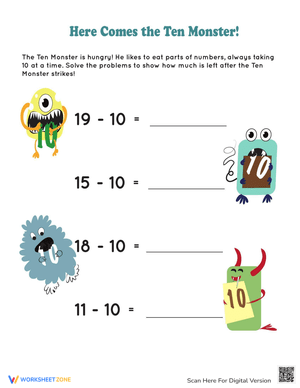
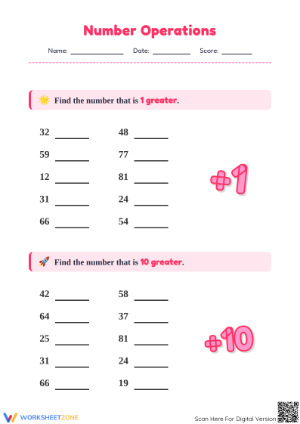
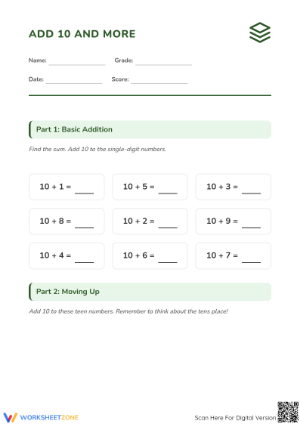
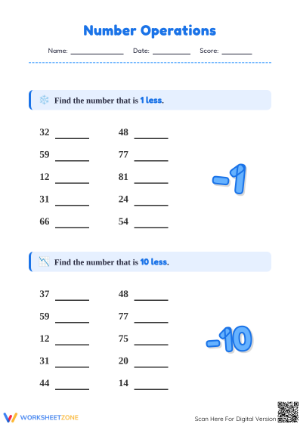
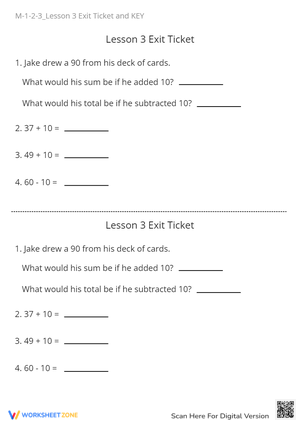
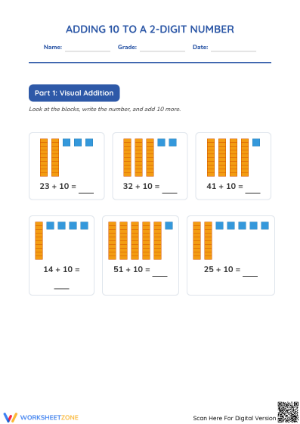
These 1st grade 10 more 10 less worksheets give first-grade teachers a focused set of practice problems for the moment students need to stop counting by ones and start thinking in groups of ten. Each worksheet targets the same core concept from a different angle — hundreds chart navigation, base-ten block models, missing number tables, and brief word problems — so the mental pattern develops across multiple representations rather than through repetition of a single format.
What Each Worksheet Covers
The set moves through four main task types, each demanding a slightly different kind of thinking.
- Hundreds chart activities — Students shade or circle a starting number, then identify the square directly below (ten more) and directly above (ten less). The spatial logic of the chart makes the tens structure visible in a way that written equations alone cannot.
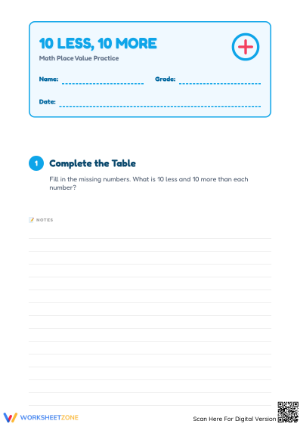
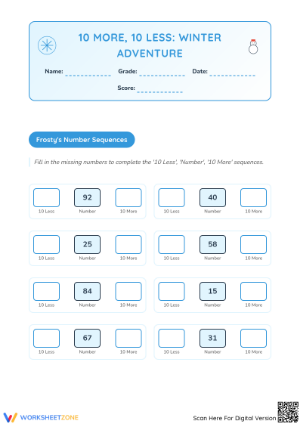
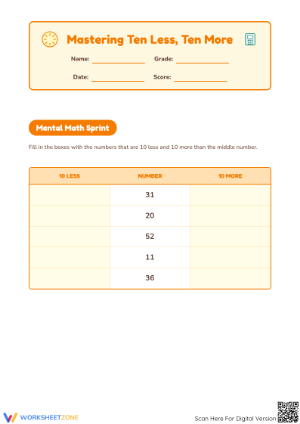
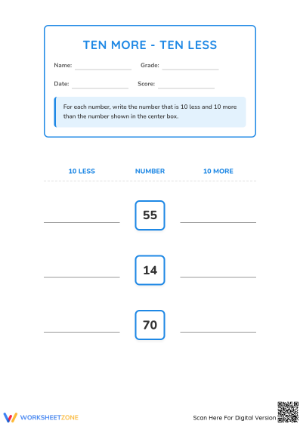
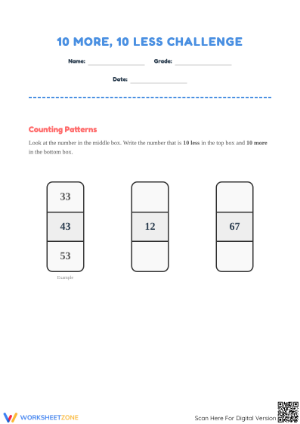
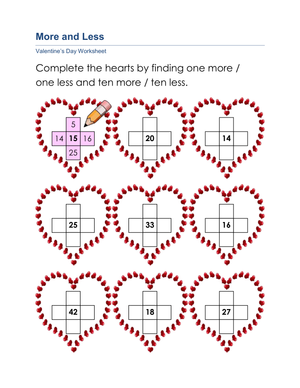
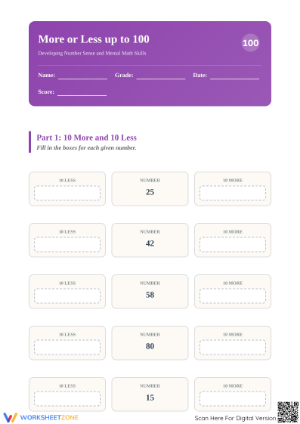
- Missing number tables — A center number anchors a small grid; students fill in ten more, ten less, one more, and one less. Placing all four relationships side by side forces students to distinguish between changing the tens digit and changing the ones digit — a distinction that trips up many first graders.
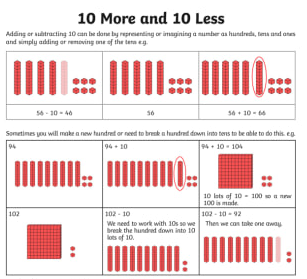
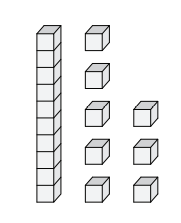
- Base-ten block diagrams — Students count rods and units, add or remove a rod, and record the new total. The visual shows clearly that the rod count changes by one and the unit count doesn't move at all.
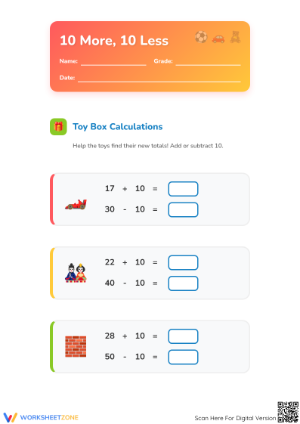
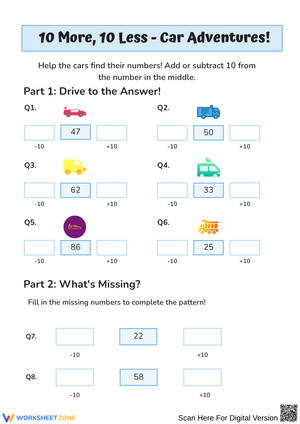
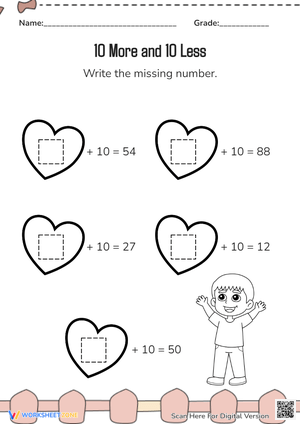
- Word problems — Short, grade-appropriate scenarios require students to apply the mental computation to a context: a jar of stickers, a box of crayons, children on a bus. The transfer from symbol to situation is where fluency becomes genuine understanding.
What Student Work Reveals About Place Value Gaps
The most consistent mistake in student work on this skill: changing the ones digit instead of the tens digit. A student asked for ten more than 37 writes 38. This isn't carelessness — it reflects incomplete place value understanding. They know "ten more means bigger," but they haven't internalized that tens and ones occupy separate positions that operate independently. Because the error is structural, correcting it requires a visual bridge. Having students point to the tens digit and say aloud "this is the only digit that moves" before writing the answer reduces the error more reliably than re-explaining the concept a second time.
A second error appears specifically near 90. Students who answer 37→47 without hesitation will pause or guess incorrectly when the problem is 94→104. The transition from a two-digit to a three-digit result is cognitively distinct from everything else in this skill set, and several worksheets isolate that boundary with extra practice problems so it doesn't catch students off guard during a formal assessment.
Standard Alignment
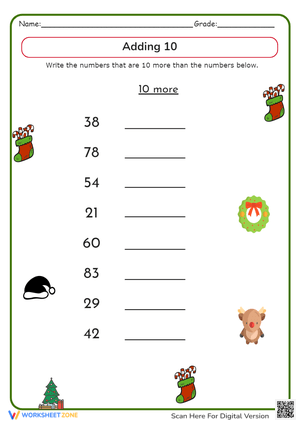
These worksheets address 1.NBT.C.5, which requires students to mentally find ten more or ten less than any two-digit number without counting and to explain their reasoning. The emphasis on explanation — not just the correct answer — is deliberate. A student who writes 47 for "ten more than 37" may have arrived there by counting up ten individual steps. The standard asks for something different: recognition that the tens place increased by one while the ones place stayed fixed. Several worksheets include a brief prompt ("How do you know?") so students practice articulating the reasoning, meeting the full expectation of 1.NBT.C.5 rather than just its computational half.
Fitting These Worksheets Into Your Weekly Routine
Paper practice works best as a follow-up to concrete work with physical base-ten blocks rather than a replacement for it. A five-minute block activity — students build a number with rods and units, physically add or remove one rod, then record the new number — gives them a sensory reference point that makes the worksheet task meaningful. Once that foundation is in place, a single worksheet fits cleanly into the eight minutes before specials, a Monday warm-up after morning meeting, or the closing task of a small-group math rotation.
In small-group rotations, these worksheets function as both practice and formative check. While students work independently, circulate and watch where they pause — at the decade crossing, at the transition over 100, or at the moment they are asked to explain rather than just calculate. The hesitation tells you more than the final answer. Teachers who use 1st grade 10 more 10 less worksheets this way often catch the ones-versus-tens confusion before it becomes a habit that carries into second-grade regrouping.
Why the Format Matches How First Graders Build Number Sense
The concrete-representational-abstract (CRA) progression is built into how the worksheets are sequenced. Students who need a visual reference — a hundreds chart printed on the page or a base-ten block diagram to consult — have it available on those worksheets. Students who are ready to work from the written number alone encounter tasks without those visual anchors. This structure reflects how first graders develop number sense: not in one linear pass, but by returning to the same concept through different entry points until the mental operation feels automatic. As the pattern becomes internalized, working memory frees up for the reasoning and verbal explanation the standard requires.
Tiering the Practice for Different Learners
Students who are still consolidating place value concepts work best starting with worksheets that use multiples of ten as starting numbers — 20, 50, 70. When the ones digit is zero, there is no ambiguity about which digit changes, and the pattern becomes immediately apparent. Once that is secure, introduce two-digit numbers with non-zero ones digits. The final tier involves numbers in the eighties and nineties, where adding ten crosses into three-digit territory and students must extend their understanding rather than simply apply a practiced rule.
For students ahead of the class, the word problem worksheets provide a different kind of challenge. A student who can answer 62 + 10 in two seconds still has real work to do when the problem reads "Maria had 62 stamps. She bought one more strip of ten. How many does she have now?" — because the word strip doesn't announce the operation the way a symbol does. These 1st grade 10 more 10 less worksheets give those students a rigorous extension without moving them out of grade-level content.
Frequently Asked Questions
What is 10 more and 10 less in first-grade math?
It means mentally adding or subtracting one group of ten from a two-digit number. The defining feature is that only the tens digit changes — the ones digit stays fixed. This skill marks a transition from counting by ones to operating on place value units directly, which is why it appears in the 1.NBT standards for first grade rather than in the counting and cardinality work that precedes it.
How do I introduce this concept before students use the worksheets?
Start with physical base-ten blocks. Have students build a two-digit number, add one rod, count the new total, then record the before-and-after numbers side by side. Do this for three or four examples before any paper practice. When students move to 1st grade 10 more 10 less worksheets, they carry a tactile reference — the image of one rod sliding in or out — which makes the abstract equation interpretable rather than arbitrary.
What do I do when a student keeps changing the wrong digit?
Have them underline the tens digit in the starting number before writing anything. Then ask them to add one to that underlined digit and copy the ones digit unchanged. This two-step routine interrupts the habit of treating the number as a single unit to be incremented and directs attention to the place that actually changes. Most students correct the error within a few repetitions once they have an explicit procedure to follow rather than an abstract rule to remember.
Are these worksheets appropriate for students who are behind grade level?
Students who haven't yet built a stable understanding of two-digit place value — who still think of 34 as "thirty-four things" rather than "3 tens and 4 ones" — need direct place value instruction before this skill becomes meaningful. The worksheets that include a hundreds chart or base-ten block diagram printed directly on them work well for those students: the visual reference is available without requiring them to hold a concept in memory they haven't yet formed.













 Interactive Worksheet Maker
 Quiz Maker
 Word Search Maker
 Crossword Puzzle Maker
 Word Scramble Generator
 Sentence Scramble Generator
 Handwriting Worksheet Generator
 Name Tracing Generator
 Fill In The Blank Generator