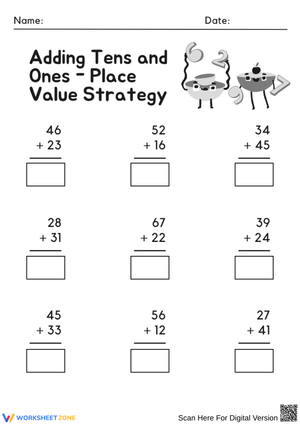
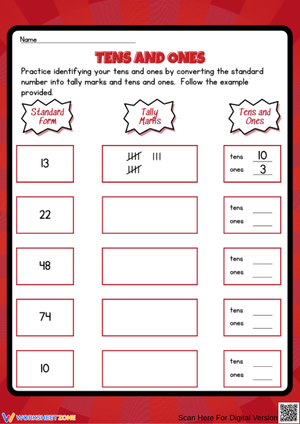
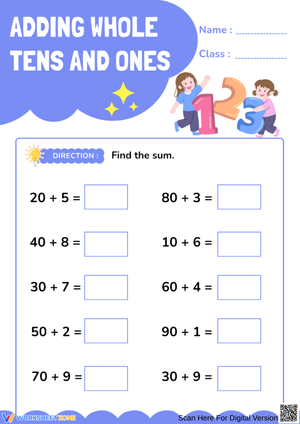
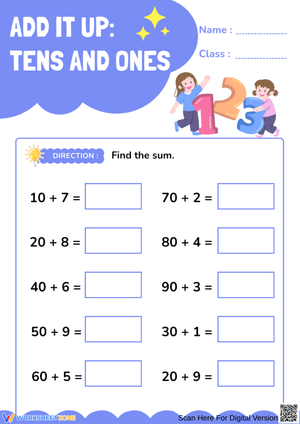
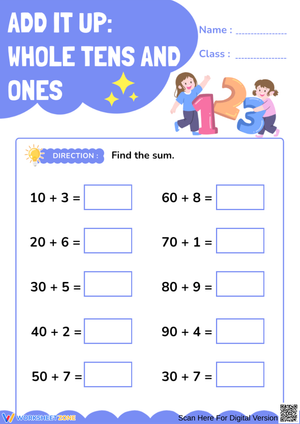
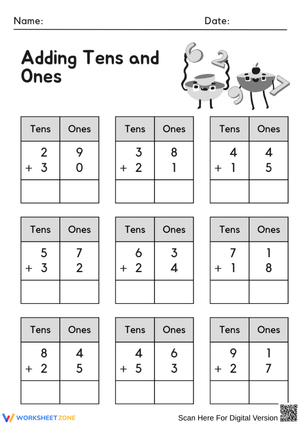
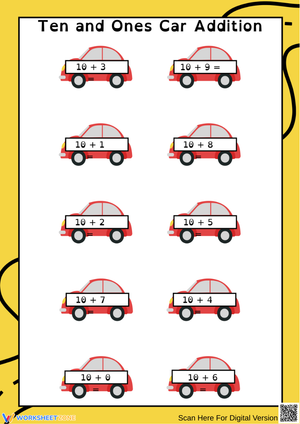
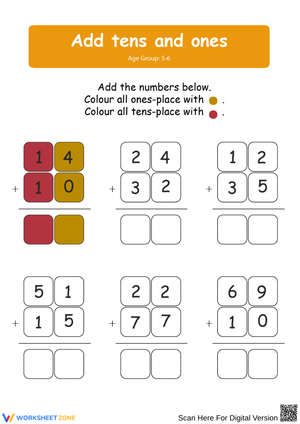
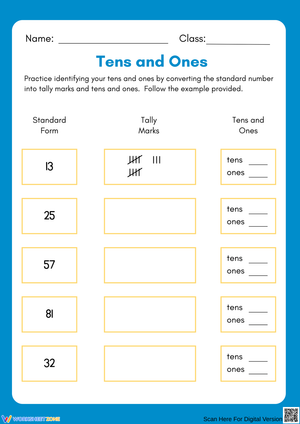
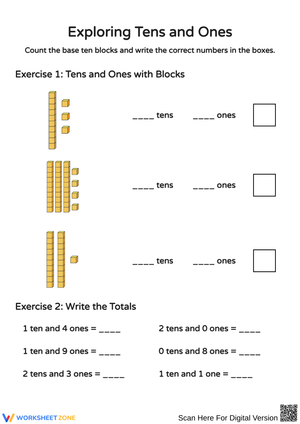
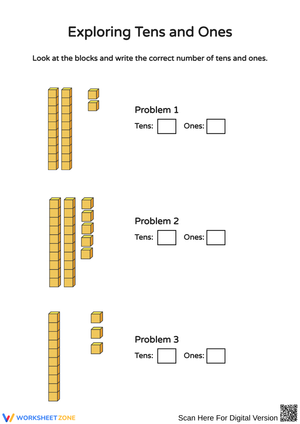
1st grade adding tens and ones worksheets give teachers a focused, repeatable tool for one of the most critical conceptual shifts in early elementary math — the moment when students stop reading 47 as a single symbol and start recognizing it as 4 tens and 7 ones. Each worksheet in this set targets a distinct piece of that understanding, moving from base-ten block diagrams with full visual support to bare number sentences that require students to work from the structure of the number alone.
Skills Each Worksheet Builds
The central task is consistent across every format: recognize how many tens and ones a two-digit number contains, then express that relationship as an addition equation. What changes is the level of visual support. Some worksheets present base-ten block diagrams — rods for tens, small cubes for ones — alongside a blank equation frame. Others use a labeled two-column place value chart where students record tens and ones separately before writing the full equation. The most demanding worksheets remove the visual entirely and present missing-addend problems like ___ + 6 = 46, requiring students to reason from place value structure rather than from a picture.
- Reading base-ten block diagrams and writing matching addition equations
- Completing two-column place value charts for two-digit numbers
- Adding multiples of ten (10 through 90) to single-digit numbers
- Solving missing-addend equations in the form ___ + ___ = two-digit number
- Composing and decomposing numbers between 10 and 99
Frequent Errors Worth Watching For in Student Work
The most consistent mistake is counting each rod in a base-ten diagram as one rather than ten. A student who miscounts four rods as "4" instead of "40" writes 4 + 7 = 11 rather than 40 + 7 = 47. What makes this error instructive is that the same student will often answer correctly when asked verbally whether a rod equals ten — the concept is present, but it has not yet transferred to the visual task. The worksheet surfaces that gap in a way verbal questioning alone cannot.
A second pattern is digit reversal. Students who correctly identify 4 tens and 7 ones frequently write 74 instead of 47. This is not random transposition — it reflects a habit of anchoring to the smaller, more familiar single digit first. Catching this before students move into addition with regrouping matters, because reversed digits become much harder to untangle once carrying enters the picture.
Building These Worksheets Into Your Weekly Lesson Plan
When structuring a unit around 1st grade adding tens and ones worksheets, spend the first two or three sessions with physical base-ten blocks before students ever see a printed worksheet. Students need to handle rods and cubes, count them aloud, and say the matching equation before the printed image on a worksheet carries any meaning. Moving to paper too quickly is the most reliable way to produce the rod-miscounting error described above.
A five-day rhythm works well. Monday stays with manipulatives and teacher modeling. Tuesday's worksheet — base-ten block diagrams with equation frames — connects directly to what students built the day before. Wednesday moves to the place value chart format, which drops the diagram but keeps the labeled structure. Thursday introduces missing-addend equations with no visual support, and Friday's independent worksheet serves as a formative check. Eight minutes before dismissal is enough time to collect and scan for digit reversals and rod-miscounting before grouping students for reteaching the following week.
Standard Alignment
Two connected standards in the Grade 1 Number and Operations in Base Ten domain govern this content. CCSS.MATH.CONTENT.1.NBT.B.2 establishes that students understand a two-digit number as a combination of tens and leftover ones — the conceptual ground the base-ten block and place value chart worksheets build directly. CCSS.MATH.CONTENT.1.NBT.C.4 applies that understanding to addition within 100, requiring students to add a two-digit number and a one-digit number, and to add a two-digit number and a multiple of ten. Used in sequence from most to least visual support, 1st grade adding tens and ones worksheets move students through the full arc of both standards and generate documented work that shows where each student's understanding holds and where it breaks.
Adjusting Each Worksheet for a Range of Learners
Students who have not yet built a stable mental image of ten as a group benefit from keeping physical base-ten blocks on their desk while completing a worksheet. They work the same problems as everyone else — the blocks let them verify each step before writing, so the worksheet becomes a recording sheet rather than the primary task.
Students who move quickly through standard equations benefit from a reverse-direction prompt added at the bottom: "Write any number between 50 and 99. Draw the base-ten blocks. Write the equation." Working from a number to a representation is harder than matching a picture to an equation, and it surfaces depth of understanding in a way the standard format does not.
For English language learners, a small reference box printed directly on each worksheet — a labeled base-ten rod and cube next to the words tens and ones — removes the need to look across the room at a word wall mid-task. That small addition reduces the vocabulary-decoding step so students stay focused on the mathematical reasoning rather than hunting for terminology.
Frequently Asked Questions
How do these worksheets connect to base-ten manipulatives students already use in class?
The printed formats mirror hands-on work deliberately. Rods-and-cubes diagrams show exactly what students build at their desks, so moving from manipulatives to the worksheet requires no conceptual leap — only a shift in medium. Students who have handled physical blocks recognize the printed images immediately and can direct their attention to writing the equation rather than interpreting an unfamiliar visual system.
What if a student solves the problems correctly but cannot explain the reasoning?
This is a developmental stage in first grade, not a red flag. The place value chart format is useful here because it requires students to record the number of tens and ones as separate steps before writing the full equation — making their reasoning visible on paper even when they cannot narrate it aloud. Verbal explanation tends to catch up after several weeks of repeated practice with this format.
Why do the worksheets progress from diagrams to bare equations instead of staying with one format?
A student who matches base-ten block diagrams fluently but freezes when the image disappears has partial understanding, not full command of the concept. The progression exists to locate exactly where understanding stops. 1st grade adding tens and ones worksheets that rely on a single format cannot show a teacher which representation a student still depends on — and that information drives the reteaching decisions that matter most.
Should these worksheets come before or after teaching regrouping?
Before — without exception. Regrouping depends on students understanding that 10 ones can be exchanged for 1 ten. That exchange is logical only to a student who already holds a clear picture of how tens and ones combine to form two-digit numbers. Students who have not fully worked through place value addition treat regrouping as an arbitrary procedure rather than a natural consequence of how the number system is structured.













 Interactive Worksheet Maker
 Quiz Maker
 Word Search Maker
 Crossword Puzzle Maker
 Word Scramble Generator
 Sentence Scramble Generator
 Handwriting Worksheet Generator
 Name Tracing Generator
 Fill In The Blank Generator