


























Views
Downloads

Back to School I Spy Worksheet | Grade 1 Essential
Paste this activity's link or code into your existing LMS (Google Classroom, Canvas, Teams, Schoology, Moodle, etc.).
Students can open and work on the activity right away, with no student login required.
You'll still be able to track student progress and results from your teacher account.
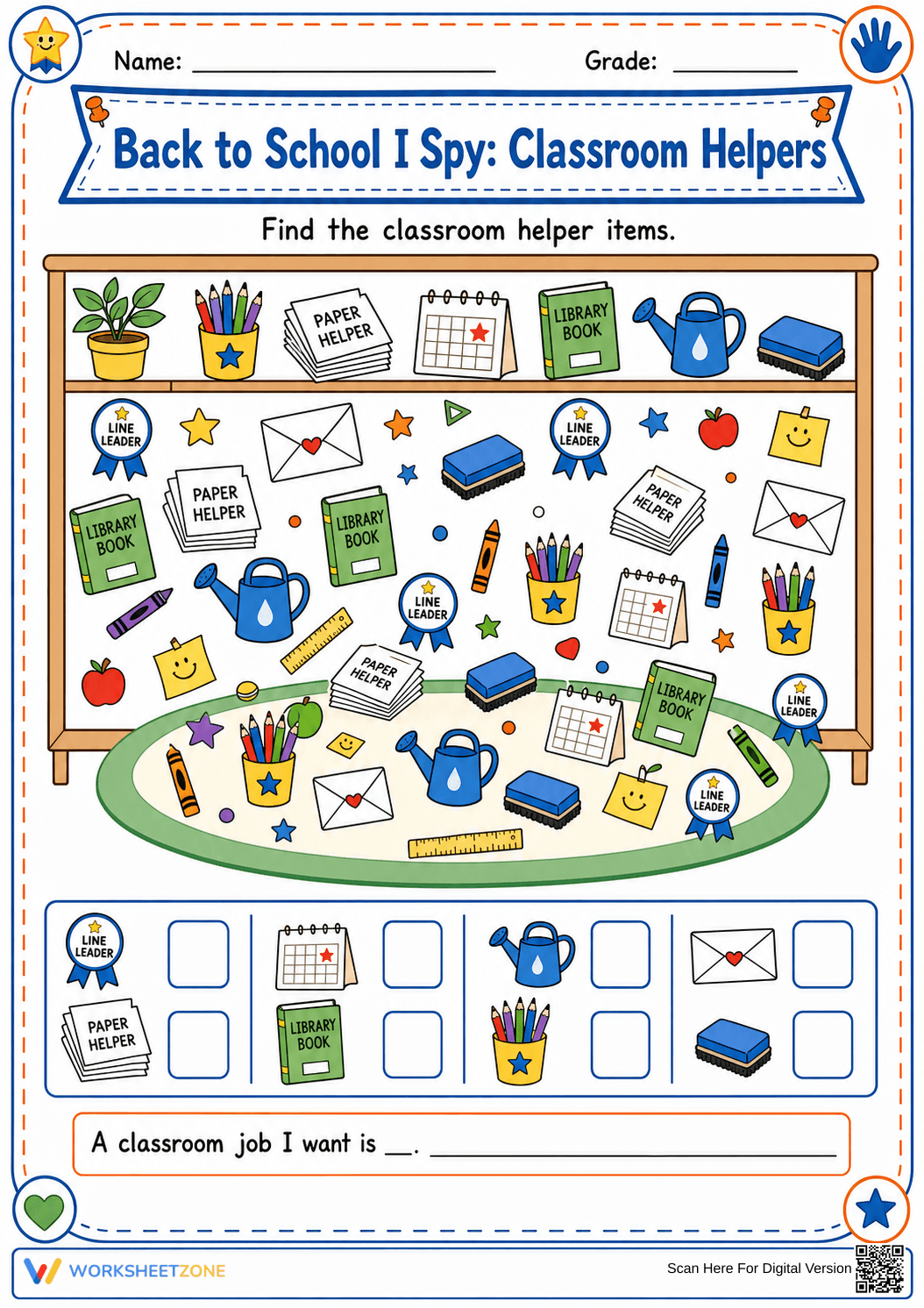
This Grade 1 visual discrimination worksheet helps students master counting and data organization through a fun classroom-themed search activity. Students identify specific classroom helper icons hidden within a busy scene, strengthening their focus and one-to-one correspondence. By the end of the activity, learners will have successfully categorized and quantified eight different types of school objects.
At a Glance
- Grade: 1 · Subject: Math
- Standard:
CCSS.MATH.CONTENT.1.MD.C.4— Organize and represent data by counting objects in categories- Skill Focus: Visual discrimination and counting
- Format: 1 page · 9 problems · Answer key included · PDF
- Best For: Morning work or back-to-school icebreakers
- Time: 15–20 minutes
Inside this resource, you will find a high-contrast, one-page activity featuring a large "I Spy" search area framed as a classroom shelf. The worksheet includes eight distinct icons to find, such as line leader badges, library books, and watering cans. Below the search area, a structured counting grid provides a dedicated space for students to record their totals, followed by a personal reflection prompt about classroom jobs.
The zero-prep workflow for this worksheet is designed for maximum efficiency in a busy classroom. First, print the single-page PDF (30 seconds). Next, distribute the sheets to students as they arrive or during a transition period (1 minute). Finally, review the counts as a whole group to provide immediate feedback on accuracy (5 minutes). This streamlined process requires less than two minutes of total teacher preparation, making it an ideal choice for sub plans or unexpected schedule changes.
This activity is aligned to the primary standard `CCSS.MATH.CONTENT.1.MD.C.4`, which requires students to organize, represent, and interpret data with up to three categories. While this worksheet expands that to eight categories, it provides the necessary scaffolding through clear visual icons. This standard code can be copied directly into lesson plans, IEP goals, or district curriculum mapping tools to ensure compliance with state frameworks.
To use this effectively, assign it as a warm-up during the first week of school to introduce the concept of classroom roles. As students work, circulate and observe their scanning patterns; students who struggle to find items may benefit from using a highlighter or crossing off items as they find them. This serves as a quick formative assessment of their visual tracking skills and attention to detail before moving into more complex data units.
This worksheet is designed for first-grade students but is also highly effective for kindergarteners ready for a challenge or second graders needing a quick review. It is particularly useful for English Language Learners (ELLs) as it pairs vocabulary with clear visual representations. Pair this with a classroom job anchor chart or a read-aloud about community helpers to create a comprehensive introductory lesson.
Research from RAND AIRS 2024 indicates that high-quality, visually engaging supplemental materials significantly improve student time-on-task during independent practice. This worksheet applies those findings by using a structured layout that reduces cognitive load while maintaining high interest. By focusing on the CCSS.MATH.CONTENT.1.MD.C.4 standard, the activity bridges the gap between play-based learning and formal data representation. The inclusion of a reflection prompt encourages students to connect mathematical counting with social-emotional learning, specifically regarding their role within the classroom community. This dual-purpose design ensures that the 15-20 minutes of instructional time spent on the activity contributes to both academic mastery and classroom culture. Educators can rely on this resource as a validated tool for developing the foundational scanning and sorting skills necessary for later success in more advanced statistical and algebraic thinking modules.


