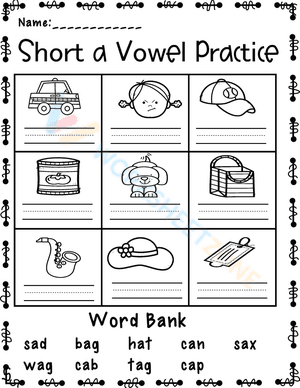
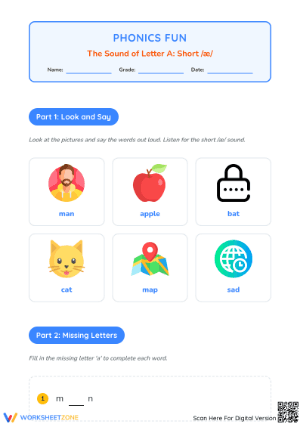
Short vowel worksheets aren't warm-up busywork. They're the practice layer that turns a taught sound into a readable word. In a structured, science-of-reading aligned block, you introduce a sound, model blending, and then hand students a page that asks them to read and spell closed-syllable CVC words like bat, met, and hum. The worksheet is where the letter-sound link gets enough repetitions to stick.
Because short vowels sit inside closed syllables, where at least one consonant follows and clips the vowel short, they're the first vowel pattern most K-1 readers can decode independently. Get these five sounds automatic and your students have a decoding engine for hundreds of one-syllable words. That's why the page you choose matters as much as the mini-lesson before it.
Sequencing the five short vowel sounds
Random vowel mixing is the fastest way to confuse a beginner. Reading Universe recommends teaching short vowels explicitly and one at a time, letting students build accuracy before you interleave sounds. A dependable order pairs each vowel with a clear anchor word so students always have a reference:
- Short a — apple
- Short i — itch or insect
- Short o — octopus
- Short e — edge or elephant
- Short u — umbrella or up
Introduce a and i early because their mouth positions differ enough to reduce mix-ups, then add o, e, and u. Only after each vowel is solid in isolation should worksheets mix all five, which is where true decoding shows up. Sequencing your pages this way means each sheet builds on the last instead of testing sounds you haven't taught yet.
Classroom Implementation
Slot short vowel worksheets into a predictable daily routine. Open with 60 seconds of phonemic awareness, model two or three words, then release students to the page while you pull a small group. The worksheet keeps the class productive and gives you a paper trail of who blended and who guessed.
Here's the move most teachers skip: build every short vowel worksheet from a deliberate mix of real and nonsense CVC words. Real words like bug and hut can be memorized by sight, which hides a blending gap. When a student decodes a nonsense word like vom or zeb, they can't fall back on memory—they have to apply the vowel sound. If a child aces the real-word column but stalls on nonsense words, you've found a pure decoding problem before it compounds into a fluency problem in second grade.
Pair the paper with a multisensory routine so the worksheet reinforces teaching instead of replacing it. Have students use a small mirror to watch their mouth open for short a, or run a finger along a rollercoaster arc to stretch and isolate the middle vowel. Sound boxes under each CVC word give a spot to push a chip for every phoneme, connecting the physical count to the letters on the page.
Frequently Asked Questions
1. What grade levels benefit most from short vowel worksheets?
Kindergarten and first grade are the sweet spot, since short vowels in CVC words are usually the first decoding students master. They also serve second and third graders in intervention who still confuse vowel sounds. Because phonics gains are strongest when instruction starts early, don't wait to introduce these sounds.
2. How should teachers sequence the five short vowel sounds?
Teach one vowel at a time with a clear anchor word before mixing. A common order is a, i, o, e, then u, separating easily confused sounds like short e and short i. Only mix all five once each is accurate in isolation, which is when real decoding shows.
3. How can short vowel worksheets support small-group intervention?
Trim each page to one vowel, slow the pace, and have students read aloud so you hear where blending breaks. Add mirrors and sound boxes for multisensory support, and give multilingual learners extra days on vowels absent from their first language. Prioritize accurate repetitions over page length.
4. What's the difference between short vowel and long vowel worksheet design?
Short vowel sheets center on closed-syllable CVC words with one vowel clipped by a following consonant. Long vowel sheets add patterns like silent e and vowel teams, where the vowel says its name. Students should read mixed short vowels accurately before you introduce long vowel pages.
5. How often should short vowel practice appear in a daily phonics block?
Aim for short, daily contact—a brief worksheet or decodable reading task every day beats one long session weekly. Even five to ten focused minutes of CVC reading and spelling builds automaticity, and daily practice gives you a steady stream of formative evidence to guide the next lesson.















 Interactive Worksheet Maker
 Quiz Maker
 Word Search Maker
 Crossword Puzzle Maker
 Word Scramble Generator
 Sentence Scramble Generator
 Handwriting Worksheet Generator
 Name Tracing Generator
 Fill In The Blank Generator