


























Views
Downloads


Essential Short Vowel A Phonics Worksheet | Grade 1-2
Paste this activity's link or code into your existing LMS (Google Classroom, Canvas, Teams, Schoology, Moodle, etc.).
Students can open and work on the activity right away, with no student login required.
You'll still be able to track student progress and results from your teacher account.
This Grade 1 phonics worksheet provides targeted practice for mastering the short vowel "a" sound within CVC word structures. Students engage in phonemic isolation and word family categorization to build foundational literacy skills. By completing missing sounds and sorting words, learners develop the phonological awareness necessary for early reading fluency and spelling accuracy.
At a Glance
- Grade: 1-2 · Subject: ELA Phonics
- Standard:
CCSS.ELA-LITERACY.RF.1.2.C— Isolate and pronounce initial, medial vowel, and final sounds in CVC words- Skill Focus: Short Vowel "a" & Word Families
- Format: 2 pages · 16 problems · Answer key included · PDF
- Best For: Independent practice or morning work
- Time: 15–20 minutes
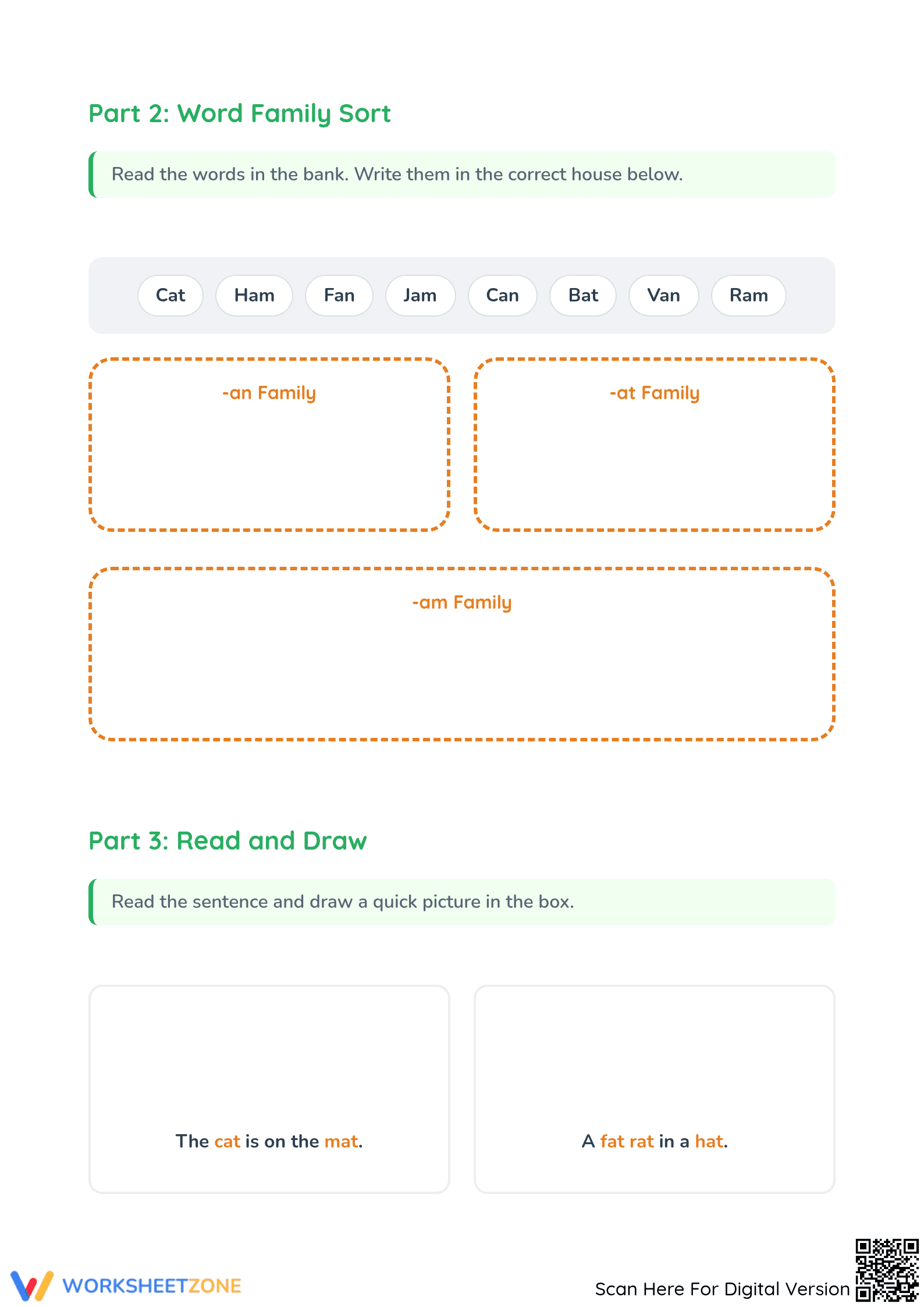
This comprehensive 2-page PDF features three distinct activity sections designed for young learners. Part 1 includes 6 visual prompts where students fill in missing consonants for CVC words like "hat" and "map." Part 2 offers an 8-word bank for sorting into -an, -at, and -am word family houses. Part 3 concludes with 2 "Read and Draw" prompts to reinforce reading comprehension through artistic expression. A full answer key is provided for quick grading.
Teachers can implement this resource in under 2 minutes. Simply print the 2-page document and distribute it to students during your phonics block. Because the instructions are visual and self-explanatory, minimal teacher intervention is required. Reviewing the work is efficient using the included answer key, making this an ideal solution for substitute folders, homework, or quick formative assessments during literacy centers.
The primary focus is CCSS.ELA-LITERACY.RF.1.2.C, which requires students to isolate and pronounce initial, medial vowel, and final sounds in spoken single-syllable words. It also supports RF.1.3.B by helping students decode regularly spelled one-syllable words. Both standard codes can be copied directly into lesson plans, IEP goals, or district curriculum mapping tools to ensure instructional alignment.
Use this worksheet during the independent practice phase of a gradual release lesson on short vowels. It serves as an excellent formative assessment to check if students can distinguish between similar word endings like -at and -am. Expect students to finish in 15 to 20 minutes. Observe if students correctly identify the "pan" and "map" images to gauge their ability to map vocabulary to specific phonemes.
This resource is designed for first-grade students beginning their phonics journey and second graders needing remedial support. It is particularly effective for English Language Learners (ELLs) who benefit from the clear pictorial cues provided for each CVC word. Pair this with a short vowel "a" anchor chart or a CVC blending board for a complete and cohesive instructional experience.
Phonics instruction centered on CVC (Consonant-Vowel-Consonant) patterns is a cornerstone of early literacy development. This worksheet aligns with the Fisher & Frey (2014) framework for purposeful literacy instruction by moving students from phoneme isolation to word categorization. Research from the RAND AIRS 2024 report emphasizes that systematic phonics practice, specifically focusing on vowel sounds like the short "a" in CCSS.ELA-LITERACY.RF.1.2.C, significantly improves decoding speed in primary grades. By integrating visual aids with word family sorting, this resource addresses multiple cognitive pathways for orthographic mapping. Providing 16 distinct tasks across two pages ensures sufficient repetition for mastery without overwhelming young learners. Such structured practice is essential for transitioning from phonetic decoding to automatic word recognition, a key predictor of long-term reading comprehension success in elementary education.


