




























Views
Downloads
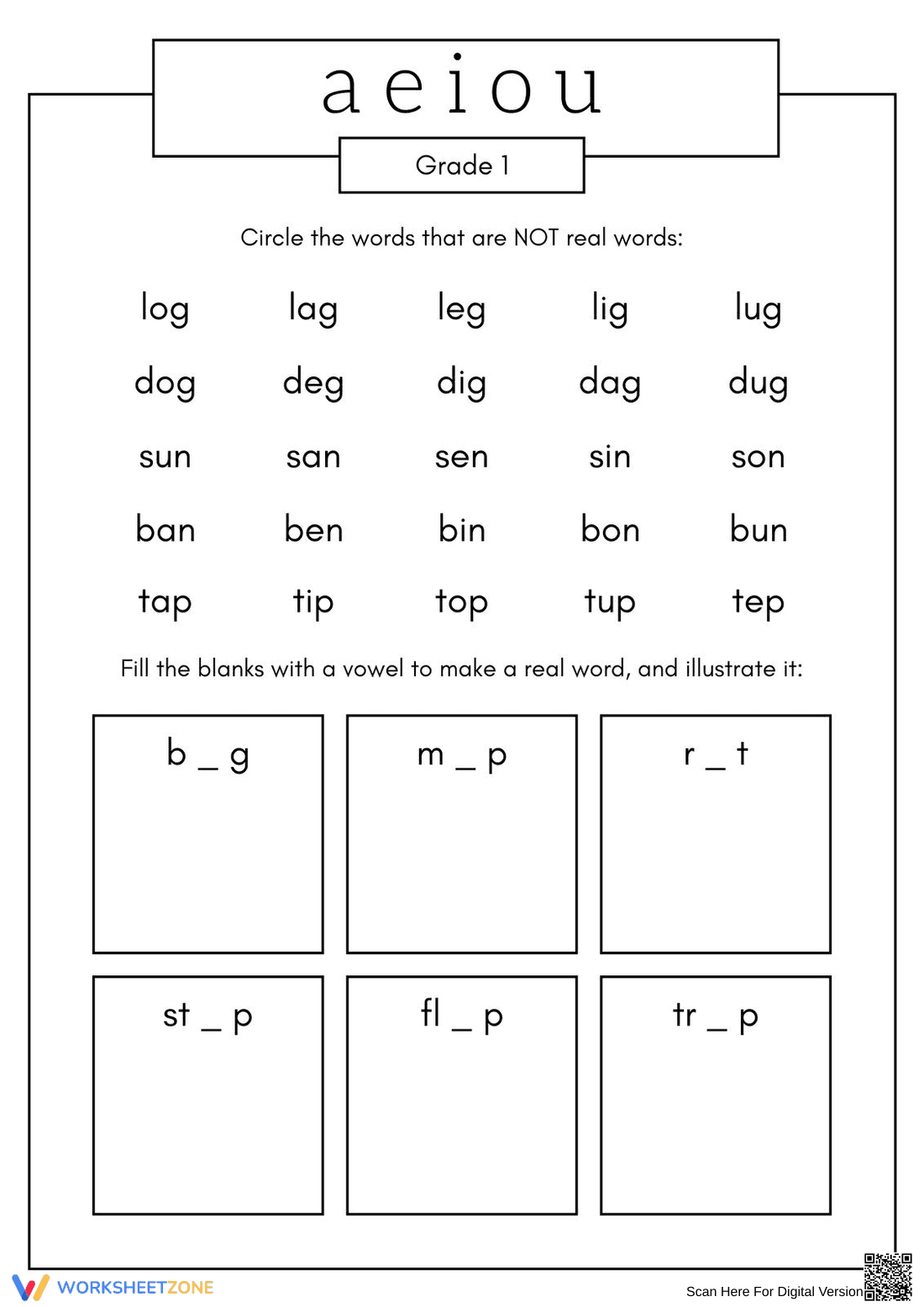

Grade 1 Short Vowels — Printable No-Prep Worksheet

Paste this activity's link or code into your existing LMS (Google Classroom, Canvas, Teams, Schoology, Moodle, etc.).
Students can open and work on the activity right away, with no student login required.
You'll still be able to track student progress and results from your teacher account.
This Grade 1 phonics worksheet helps students master short vowel sounds by distinguishing between real and nonsense CVC words. Young readers practice decoding skills to build strong foundational literacy. The clear layout ensures students independently apply vowel knowledge to complete each task.
At a Glance
- Grade: 1 · Subject: ELA
- Standard:
CCSS.ELA-LITERACY.RF.1.3.B— Decode regularly spelled one-syllable words- Skill Focus: Short Vowels & CVC Words
- Format: 1 page · 31 problems · Answer key included · PDF
- Best For: Independent practice and centers
- Time: 10–15 minutes
This single-page resource features two task types to reinforce vowel comprehension. The top section presents 25 CVC word variations where students circle nonsense words, testing decoding accuracy. The bottom section includes six fill-in-the-blank exercises where learners supply the missing medial vowel to create a real word, then illustrate it. An answer key is provided.
Zero-Prep Workflow
This worksheet is designed for immediate classroom implementation with minimal teacher setup.
- Print (1 minute): Simply print the single-page PDF and the accompanying answer key. No special materials or cutting required.
- Distribute (1 minute): Hand out to students during literacy blocks. The instructions are simple enough for first graders to follow independently.
- Review (3 minutes): Use the provided answer key to quickly check student work or project it on the board for self-correction.
With a total teacher prep time of under two minutes, this resource is highly suitable for emergency sub plans or last-minute center activities.
Standards Alignment
This resource is directly aligned to CCSS.ELA-LITERACY.RF.1.3.B, requiring students to decode regularly spelled one-syllable words. By evaluating real versus nonsense words and supplying missing medial vowels, learners demonstrate mastery of foundational phonics conventions. It also supports phonemic awareness by having students isolate vowel sounds. Both standard codes can be copied directly into lesson plans, IEP goals, or district curriculum mapping tools.
How to Use It
Deploy this worksheet during independent practice after direct instruction on short vowel sounds. It serves as an excellent literacy center station where students can work at their own pace. As a formative assessment observation tip, watch how students tackle the nonsense words; hesitation may indicate they are struggling with specific vowel phonemes rather than general blending. Expected completion time ranges from 10 to 15 minutes, making it a perfect morning work assignment.
Who It's For
This activity is primarily designed for first-grade students developing their early reading and spelling skills. It offers natural differentiation; advanced readers can quickly decode and illustrate, while students needing support can use manipulatives or an anchor chart to sound out the CVC combinations. Pair this worksheet with a decodable reading passage focused on short vowels to reinforce the skills practiced here.
Mastering medial vowel sounds is a critical milestone in early literacy development. This worksheet targets CCSS.ELA-LITERACY.RF.1.3.B, helping students decode regularly spelled one-syllable words through targeted CVC practice. According to Fisher & Frey (2014), providing students with structured opportunities to distinguish between real and nonsense words significantly improves their phonological decoding accuracy and overall reading fluency. When young learners actively manipulate vowels to build words and immediately illustrate their meaning, they solidify the cognitive link between phonics and comprehension. This targeted practice ensures that foundational reading skills are deeply embedded, reducing the cognitive load required for future complex text analysis. By integrating both identification and generation tasks, this resource offers a comprehensive approach to vowel mastery that supports long-term academic success in early elementary language arts.


