




























Views
Downloads

Printable Short Vowel Sounds Worksheet for Kindergarten

Paste this activity's link or code into your existing LMS (Google Classroom, Canvas, Teams, Schoology, Moodle, etc.).
Students can open and work on the activity right away, with no student login required.
You'll still be able to track student progress and results from your teacher account.
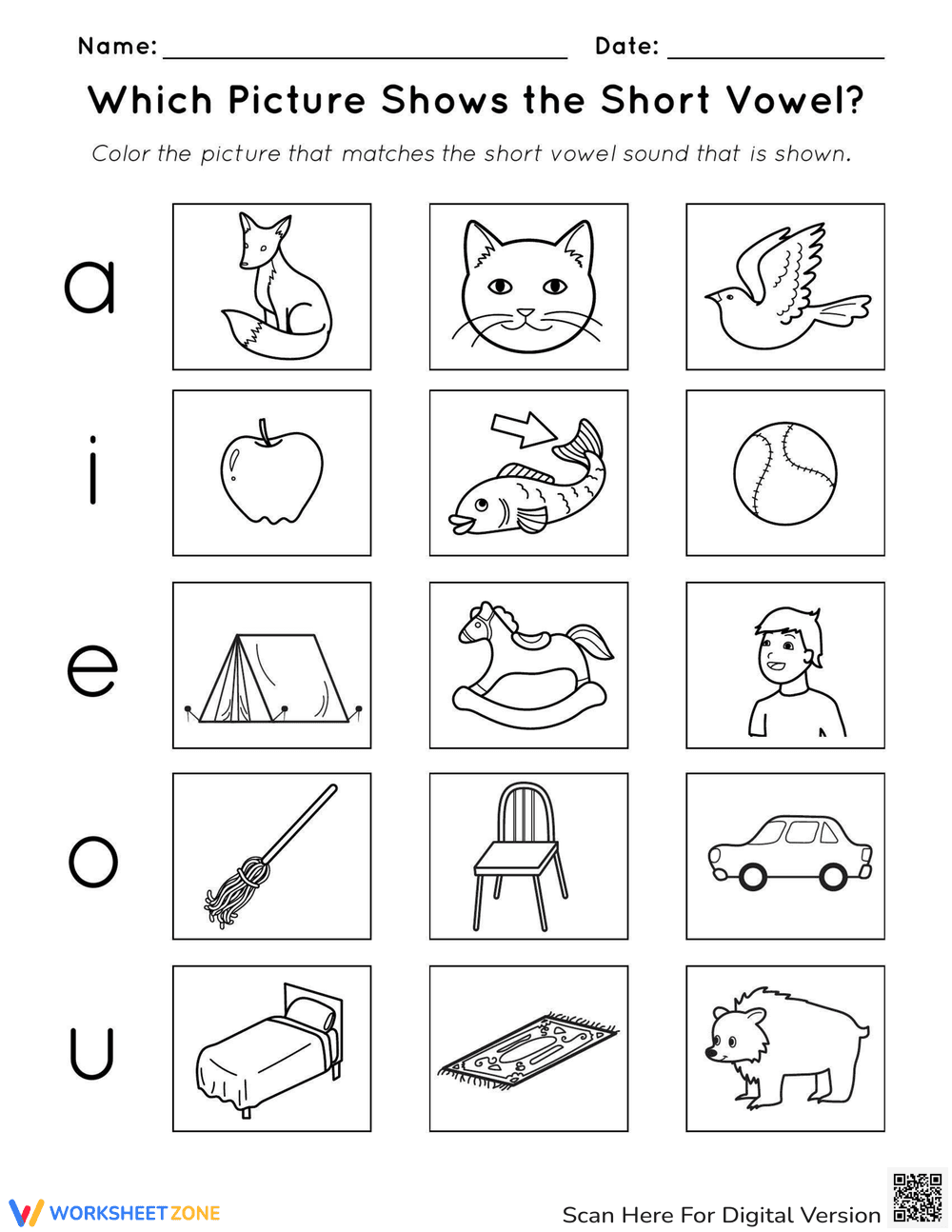
This printable Kindergarten phonics worksheet helps young learners master short vowel sounds through engaging visual identification. Students look at the target vowel, pronounce the names of three illustrated objects, and color the picture that contains the matching short vowel sound. This activity builds essential phonemic awareness and early reading readiness.
At a Glance
- Grade: Kindergarten · Subject: ELA Phonics
- Standard:
CCSS.ELA-LITERACY.RF.K.3.B— Associate short vowel sounds with their common spellings- Skill Focus: Short vowel sound identification
- Format: 1 page · 5 problems · Answer key not included · PDF
- Best For: Morning work or independent phonics practice
- Time: 10–15 minutes
This single-page PDF features five rows, each dedicated to one primary vowel: a, i, e, o, and u. Each row displays the lowercase vowel on the left, followed by three line drawings. Students analyze the pictures—such as a cat, fish, tent, mop, and rug—to isolate the medial short vowel sound and color the correct image. The clean layout minimizes visual distractions, making it ideal for early childhood learners.
This resource is designed for immediate classroom integration with zero teacher preparation. First, print the single-page PDF (takes under 1 minute). Next, distribute the sheet to students along with crayons (takes 1 minute). Finally, review the completed worksheets to assess student understanding (takes 2 minutes). The self-explanatory format also makes it an excellent choice for emergency substitute plans.
This worksheet aligns directly with the Common Core State Standard CCSS.ELA-LITERACY.RF.K.3.B, which requires students to associate the long and short sounds with the common spellings for the five major vowels. By focusing specifically on isolating short vowel sounds in single-syllable words, it supports foundational reading development. Both standard codes can be copied directly into lesson plans, IEP goals, or district curriculum mapping tools.
Use this worksheet during small-group instruction to reinforce vowel sounds after a direct phonics lesson. Alternatively, assign it as a quick formative assessment at the end of a unit to gauge individual student mastery. Teachers can observe which students struggle to associate the letter with its corresponding sound, providing a clear indicator for targeted intervention. The activity typically takes 10 to 15 minutes to complete.
This activity is tailored for preschool and kindergarten students who are beginning to decode simple words. It is also highly beneficial for English language learners (ELL) and older students receiving tier-two reading intervention. Pair this worksheet with a short vowel anchor chart or a shared reading passage to reinforce the target sounds in context.
Early phonemic awareness is a critical predictor of reading success, as highlighted in the Fisher & Frey (2014) framework. This worksheet targets the foundational skill of isolating short vowel sounds, aligning with CCSS.ELA-LITERACY.RF.K.3.B. By combining visual cues with letter-sound correspondence, the activity helps kindergarten students bridge the gap between spoken phonemes and written graphemes. Research indicates that structured practice—such as coloring matching pictures—strengthens orthographic mapping in early readers. Teachers can integrate this resource into daily phonics routines to support evidence-based reading instruction. The clear layout ensures students focus entirely on the phonological task, making it a reliable tool for formative assessment and independent practice in early childhood classrooms. This ensures students build the necessary decoding skills for future reading fluency.


