




























Views
Downloads



Essential Short Vowel Practice Worksheet | Kindergarten

Paste this activity's link or code into your existing LMS (Google Classroom, Canvas, Teams, Schoology, Moodle, etc.).
Students can open and work on the activity right away, with no student login required.
You'll still be able to track student progress and results from your teacher account.
This Kindergarten phonics worksheet provides essential practice for students learning to isolate and identify short vowel sounds within common words. By matching high-quality visual illustrations to their corresponding vowel letters, learners build the foundational phonemic awareness necessary for early reading success. The worksheet focuses on the medial vowel position, helping students distinguish between the distinct sounds of a, e, i, o, and u.
At a Glance
- Grade: Kindergarten · Subject: ELA Phonics
- Standard:
RF.K.3.B— Associate the long and short sounds with common spellings for the five major vowels- Skill Focus: Medial Short Vowel Identification
- Format: 4 pages · 8 problems · Answer key included · PDF
- Best For: Literacy centers and independent phonics practice
- Time: 10–15 minutes
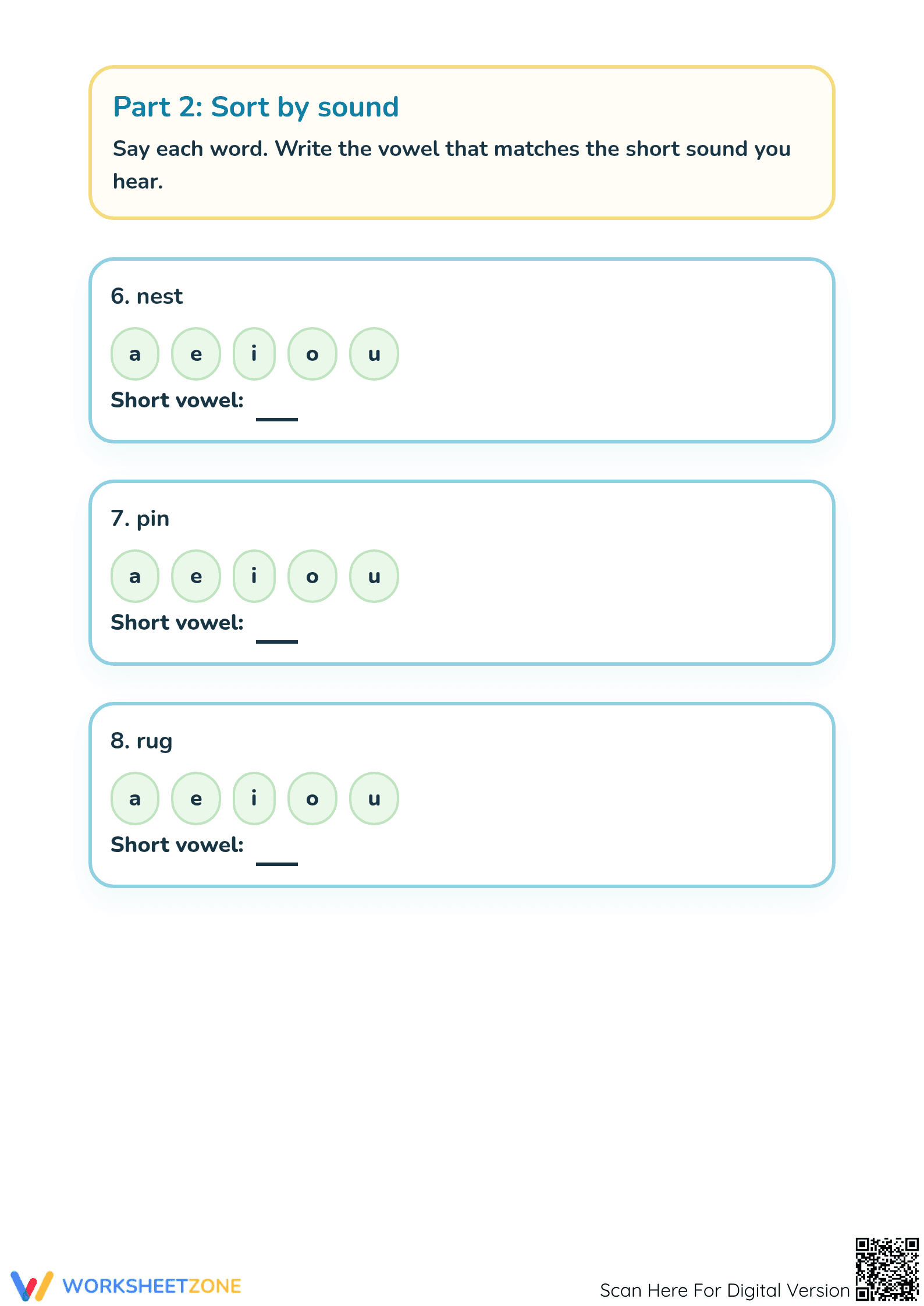
What's Inside: This 4-page PDF collection features 8 structured problems divided into two logical parts. Part 1 presents students with a picture and a target word, such as "bath" or "lock," and asks them to choose the correct medial short vowel from a multiple-choice selection. Part 2 shifts to sound sorting, where students listen to the word and write the vowel that matches the short sound they hear. A full answer key is included for rapid grading or student self-correction.
Zero-Prep Workflow
- Print: Generate the 4-page document in less than 30 seconds using any standard printer.
- Distribute: Hand out the sheets to individuals or small groups for immediate engagement.
- Review: Use the provided answer key to check all 8 problems in under 1 minute.
This resource is specifically designed as a print-and-go solution for busy educators, requiring less than 2 minutes of total teacher preparation time before it is ready for classroom use.
Standards Alignment
This resource is aligned to CCSS.ELA-LITERACY.RF.K.3.B: Associate the long and short sounds with common spellings (graphemes) for the five major vowels. It also supports the broader goals of RF.1.2.C by requiring students to isolate and pronounce mid-vowel sounds in spoken single-syllable words. Both standard codes can be copied directly into lesson plans, IEP goals, or district curriculum mapping tools.
How to Use It
This worksheet is ideal for use during the independent practice portion of a foundational literacy lesson. After introducing the five short vowel sounds, assign this worksheet to verify that students can transition from auditory recognition to written identification. It also serves as an excellent formative assessment tool; observe if students struggle more with specific vowels, such as the common confusion between short 'e' and short 'i', to guide future small-group instruction. Expect most Kindergarten learners to complete all 8 tasks within 15 minutes.
Who It's For
The primary audience is Kindergarten students beginning their phonics journey, though it is also appropriate for Preschoolers showing early literacy readiness or Grade 1 students requiring remedial vowel support. It pairs naturally with a short vowel anchor chart or a decodable passage featuring CVC words. The clear icons and simplified layout make it accessible for English Language Learners (ELL) who are building their basic English vocabulary alongside their phonics skills.
Effective phonics instruction in early childhood requires explicit practice in mapping phonemic sounds to their corresponding graphemes, particularly for short vowel sounds which often present the highest phonological difficulty for beginning readers. This worksheet aligns with CCSS.ELA-LITERACY.RF.K.3.B by requiring students to isolate and identify short vowel sounds in the medial position of CVC and simple words like 'bath' and 'nest'. According to the RAND AIRS 2024 report on foundational literacy, multimodal engagement—such as the combination of visual picture cues and verbal repetition found in these 8 structured tasks—significantly improves retention of vowel phonemes compared to rote memorization alone. By bridging the gap between auditory recognition and written identification, this resource supports the development of the orthographic mapping process necessary for reading fluency. The inclusion of an immediate answer key allows for corrective feedback, a critical component of high-quality instructional materials for Kindergarten and Grade 1 learners.


