




























Views
Downloads
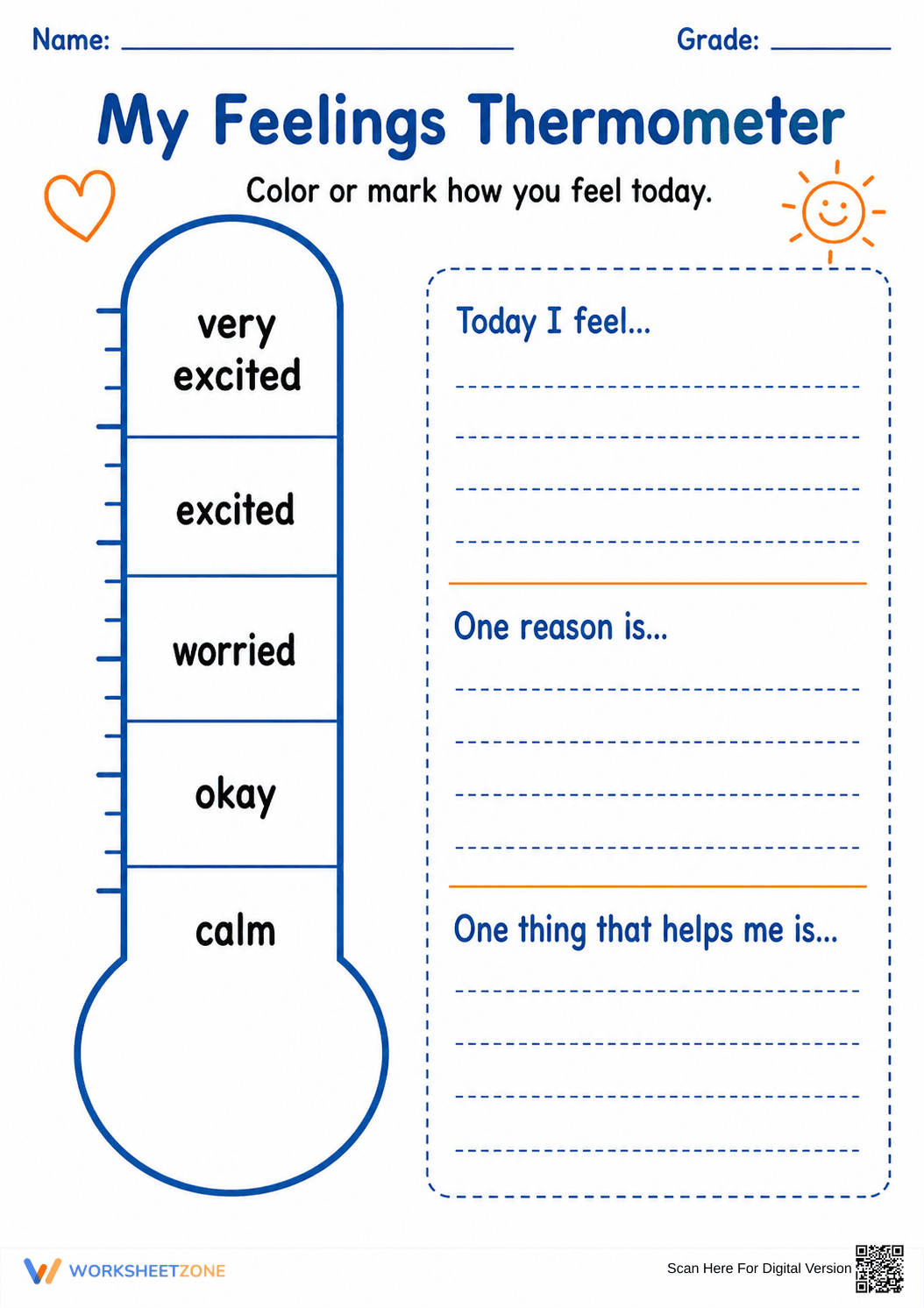

Grade 2 Feelings Thermometer — Printable No-Prep Worksheet

Paste this activity's link or code into your existing LMS (Google Classroom, Canvas, Teams, Schoology, Moodle, etc.).
Students can open and work on the activity right away, with no student login required.
You'll still be able to track student progress and results from your teacher account.
This Grade 2 social-emotional learning worksheet helps students identify and articulate their current emotional state. By using a visual feelings thermometer and guided writing prompts, learners connect their feelings to specific causes and coping strategies. This resource builds essential self-awareness and emotional regulation skills in a structured, accessible format.
At a Glance
- Grade: 2 · Subject: SEL
- Standard:
CCSS.ELA-LITERACY.W.2.8— Recall personal experiences to answer questions- Skill Focus: Emotional regulation and self-expression
- Format: 1 page · 4 tasks · No answer key needed · PDF
- Best For: Morning meetings and check-ins
- Time: 10–15 minutes
This single-page resource features a large thermometer graphic divided into five emotional states: calm, okay, worried, excited, and very excited. Students mark their current level. Three structured sentence frames prompt students to write how they feel, identify one reason, and name one coping strategy. The clean layout provides excellent support for early writers.
This resource offers a highly efficient zero-prep workflow.
- Print (1 minute): The design prints quickly for an entire class.
- Distribute (1 minute): Hand out during morning arrival.
- Review (0 minutes): Instructions are self-explanatory, requiring no teacher setup.
Total teacher preparation time is under two minutes. It serves as an excellent sub plan activity.
This worksheet aligns with CCSS.ELA-LITERACY.W.2.8: Recall information from experiences or gather information from provided sources to answer a question. By asking students to reflect on their current emotional state and articulate a specific reason for it, the activity directly supports experiential writing and personal reflection. Both standard codes can be copied directly into lesson plans, IEP goals, or district curriculum mapping tools.
Teachers can utilize this tool effectively during morning meetings as a daily emotional check-in. Before starting academic instruction, students complete the thermometer to help teachers gauge the classroom climate. Alternatively, it works well in a calm-down corner for individual students who need a moment to process big feelings. As a formative assessment observation tip, educators can review the completed sheets to identify students who consistently mark "worried" or struggle to name a coping strategy, indicating a need for targeted SEL support. Expected completion time ranges from 10 to 15 minutes.
This worksheet is primarily designed for second-grade students, though it remains highly effective for learners in grades 1 through 5. The visual scaffolds and sentence starters provide excellent differentiation for English Language Learners and students receiving special education services who might struggle with open-ended emotional expression. It pairs naturally with read-aloud books about feelings or direct instruction lessons on emotional regulation and mindfulness techniques.
Integrating structured emotional check-ins into daily routines significantly impacts student readiness to learn. According to a comprehensive RAND AIRS 2024 report on social-emotional learning interventions, classrooms that utilize visual emotional regulation tools experience a marked decrease in behavioral disruptions and an increase in academic engagement. This specific resource supports CCSS.ELA-LITERACY.W.2.8 by requiring students to recall personal experiences to answer questions about their feelings. By connecting a visual thermometer to concrete writing prompts, learners bridge the gap between abstract emotions and tangible self-advocacy. The plain-English skill of recalling personal experiences to answer questions ensures that students not only identify their emotional state but also analyze its root cause. Consistent use of this evidence-based practice fosters a supportive classroom environment where students develop the critical self-awareness necessary for long-term academic and personal success.


