




























Views
Downloads

Let It Go SEL Worksheet | Grade 1 Printable

Paste this activity's link or code into your existing LMS (Google Classroom, Canvas, Teams, Schoology, Moodle, etc.).
Students can open and work on the activity right away, with no student login required.
You'll still be able to track student progress and results from your teacher account.
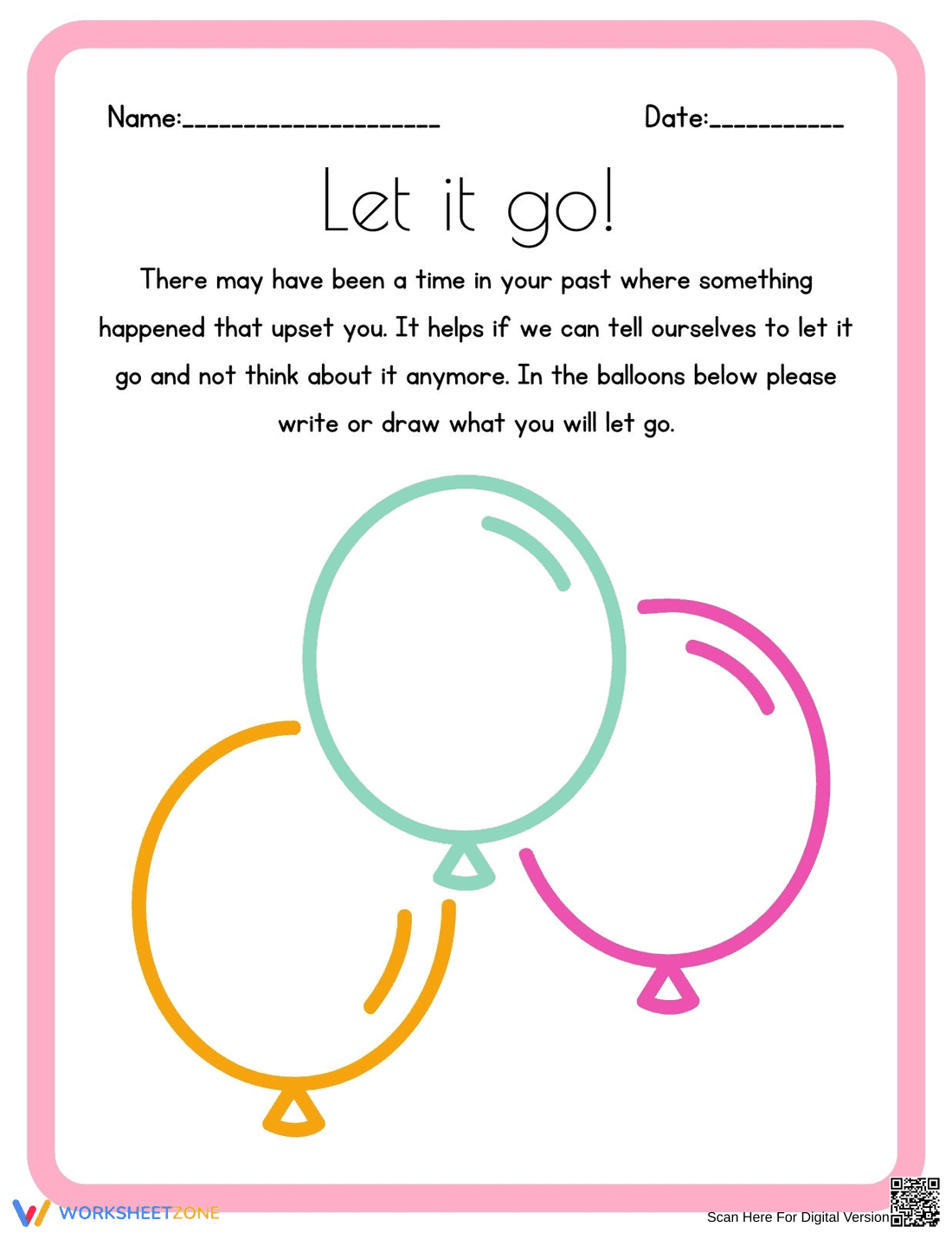
This Grade 1 Social Emotional Learning worksheet helps students practice emotional regulation by identifying and releasing negative feelings. By writing or drawing what upsets them inside the provided balloons, young learners develop healthy coping mechanisms and self-awareness. It offers a safe space to process past frustrations constructively.
At a Glance
- Grade: 1 · Subject: SEL
- Standard:
CCSS.ELA-LITERACY.W.1.8— Recall experiences to answer a question- Skill Focus: Emotional Regulation
- Format: 1 page · 2 problems · No answer key · PDF
- Best For: Morning work or counseling
- Time: 10–15 minutes
This single-page resource features a brief, student-friendly prompt explaining the concept of letting go of upsetting past events. Below the text, students will find two large balloon outlines. These open-ended spaces allow children to either write words or draw pictures representing the specific worries, fears, or frustrations they choose to release. Because the responses are highly personal, no answer key is required.
Zero-Prep Workflow
- Print (1 minute): Simply download the PDF and print a class set. The black-and-white design is printer-friendly and requires no special materials.
- Distribute (1 minute): Hand out the pages during morning meeting, a dedicated SEL block, or after a challenging recess incident.
- Review (3 minutes): Briefly read the instructions aloud. Total teacher prep time is under two minutes, making this an excellent, self-explanatory addition to any substitute teacher plan.
This activity aligns with CCSS.ELA-LITERACY.W.1.8: With guidance and support from adults, recall information from experiences or gather information from provided sources to answer a question. It also supports core CASEL competencies for self-management and self-awareness. Both standard codes can be copied directly into lesson plans, IEP goals, or district curriculum mapping tools.
Teachers can use this worksheet as a proactive morning work activity to set a positive tone for the day, or as a responsive tool following a classroom conflict. Before direct instruction begins, have students complete the balloons to clear their minds of distractions. As a formative assessment observation tip, notice whether students choose to draw or write; this provides insight into their expressive language development and current emotional state. Expect completion to take between 10 and 15 minutes.
This resource is designed for first-grade students, though it is highly adaptable for kindergarten through second-grade classrooms. It is particularly beneficial for students who need extra support with emotional regulation or those with IEP goals related to behavior and self-expression. For differentiation, teachers can act as scribes for students who prefer to dictate their feelings. Pair this activity with a read-aloud book about managing big emotions or a classroom anchor chart detailing calming strategies.
Integrating structured emotional reflection into the early childhood classroom significantly impacts overall academic readiness and behavioral stability. By addressing CCSS.ELA-LITERACY.W.1.8, which requires students to recall experiences to answer a question, this activity bridges the gap between foundational literacy skills and critical emotional intelligence. According to a comprehensive EdReports 2024 analysis, classrooms that consistently embed brief, routine social-emotional check-ins experience fewer behavioral disruptions and demonstrate higher levels of student engagement throughout the instructional day. When young learners are given concrete, visual metaphors—like placing a specific worry inside a balloon and imagining it floating away—they are much better equipped to process complex feelings independently. This simple yet highly effective exercise provides a tangible method for students to externalize internal conflicts, ultimately fostering a more supportive, resilient, and focused learning environment for everyone involved.


